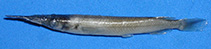
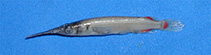
Dermogenys palawanensis

Dermogenys palawanensis Meisner, 2001

Uploaden van uw Foto's en video's
Afbeeldingen | Google afbeelding

Classificatie / Namen Lokale namen | Synoniemen | Catalog of Fishes(Genus, Soort(en)) | ITIS | CoL | WoRMS | Cloffa

> Beloniformes (Needle fishes) > Zenarchopteridae (Internally fertilized halfbeaks)
Etymology: Dermogenys: Greek, derma = skin + Greek, geny, -yos = face, jaw (Ref. 45335)palawanensis: Named for the southwestern Philippine island of Palawan, where this species is endemic.

Milieu: milieu / Klimaatzone / Diepte / verspreidingsgebied Ecologie

; zoet water pelagisch. Tropical

Verspreiding Gebieden | FAO regio's | Ecosystemen | Voorkomen | Verspreidingskaart | Introducties | Faunafri

Asia: Philippines.

Grootte / Gewicht / Leeftijd

Maturiteit: Lm ?  range ? - ? cm
Max length : 3.6 cm SL mannelijk / geslacht onbekend; (Ref. 44897); 4.9 cm SL (female)

Korte beschrijving Determinatiesleutels | Morfologie | Morfometrie

Dorsale zachte stralen (totaal) : 9 - 11; Anale zachte stralen: 14 - 16; Wervels: 39 - 42. Anal fin of this species is similar to D. robertsi, but differs from it by the combination of melanophores anterior to anal fin in females forming a broad V with a wide base, extending onto lateral surface, directly adjacent to genital papilla and extending anteriorly past level of anus; also the females have an elongate, pigmented genital papilla (Ref. 44897).
Cross section: compressed.

Biologie     Verklarende woordenlijst (bv. epibenthic)

Levenscyclus en paargedrag Maturiteit | Voortplanting | Paaien | Eieren | Fecunditeit | Larven

Hoofdreferentie Upload uw referenties | Referenties | Coördinator | Medewerkers

Kottelat, M., 2013. The fishes of the inland waters of Southeast Asia: a catalogue and core bibliography of the fishes known to occur in freshwaters, mangroves and estuaries. The Raffles Bulletin of Zoology 2013 (Suppl. 27):1-663. (Ref. 94476)

Status op de Rode Lijst van het IUCN (Ref. 130435: Version 2025-2 (Global))

  Kwetsbaar (VU) (B1ab(iii)); Date assessed: 10 August 2020

CITES

Not Evaluated

CMS (Ref. 116361)

Not Evaluated

Gevaar voor de mens

  Harmless


Gebruik door de mens

FAO - Publication: search | FishSource |

Meer informatie

Trofische ecologie
Voedsel (prooien)
Dieetsamenstelling
Voedselconsumptie
Voedselrantsoenen
Predatoren
Ecologie
Ecologie
Populatiedynamica
Groeiparameters
Max. leeftijden / maten
Lengte-gewicht rel.
Lengte-lengte rel.
Lengtefrequenties
Massaconversie
Rekrutering
Abundantie
Levenscyclus
Voortplanting
Maturiteit
Rijpheid/kieuwen rel.
Fecunditeit
Paaien
Paaibestanden
Eieren
Ontwikkeling van de eieren
Larven
Larvale populatiedynamiek
Verspreiding
Gebieden
FAO regio's
Ecosystemen
Voorkomen
Introducties
BRUVS - Video's
Anatomie
Kieuwoppervlak
Hersenen
Otoliet
Fysiologie
Lichaamssamenstelling
Voedingsstoffen
Zuurstofverbruik
Type zwemmen
Zwemsnelheid
Visuele pigmenten
Vis geluid
Ziekten en parasieten
Toxiciteit (LC50)
Genetica
genoom
Genetica
Heterozygositeit
Erfelijkheid
Genetische diversiteit
Menselijk gerelateerd
Aquacultuursystemen
Aquacultuurprofielen
Kweeklijnen
Ciguatera gevallen
Postzegels, munten, diversen.
Outreach
Medewerkers
Taxonomie
Lokale namen
Synoniemen
Morfologie
Morfometrie
Afbeeldingen
Referenties
Referenties

Tools

Speciale rapporten

Download XML

Internetbronnen

AFORO (otoliths) | Aquatic Commons | BHL | Cloffa | Websites from users | Bekijk FishWatcher | CISTI | Catalog of Fishes: Genus, Soort(en) | DiscoverLife | ECOTOX | FAO - Publication: search | Faunafri | Fishipedia | Fishtrace | GloBI | Google Books | Google Scholar | Google | IGFA World Record | OneZoom | Open Tree of Life | Otolith Atlas of Taiwan Fishes | PubMed | Reef Life Survey | Socotra Atlas | TreeBase | Tree of Life | Wikipedia: ga naar, zoek | World Records Freshwater Fishing | Zoobank | Zoological Record

Schattingen op basis van modellen

Fylogenetische diversiteitsindex (Ref. 82804):  PD50 = 0.5001   [Uniqueness, from 0.5 = low to 2.0 = high].
Bayesian length-weight: a=0.00457 (0.00198 - 0.01053), b=3.03 (2.83 - 3.23), in cm total length, based on LWR estimates for this (Sub)family-body shape (Ref. 93245).
Trofisch niveau (Ref. 69278):  3.1   ±0.4 se; based on size and trophs of closest relatives
Kwetsbaarheid van de visserij (Ref. 59153):  Low vulnerability (10 of 100). 🛈