Environment: milieu / climate zone / intervalo de profundidade / distribution range
Ecologia
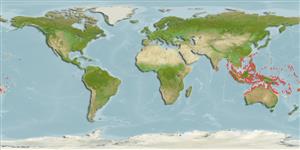
marinhas associadas(os) a recifes; intervalo de profundidade 1 - 20 m (Ref. 90102). Tropical; 27°N - 27°S, 28°E - 133°W (Ref. 74933)
Indo-Pacific: known from the Red Sea, Indian Ocean (except the Seychelles, Chagos Archipelago, Cargados Carajos, Mauritius and Rodrigues), north to Japan and south to Australia; throughout the West Pacific to the Tonga Islands, Samoa, Phoenix and Marshall Islands.
Tamanho / Peso / Idade
Maturidade: Lm ? range ? - ? cm
Max length : 11.2 cm TL macho/indeterminado; (Ref. 90102)
Espinhos dorsais (total) : 8; Raios dorsais moles (total) : 9; Espinhos anais: 2; Raios anais moles: 8.
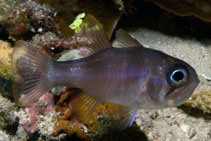
Body shape (shape guide): short and / or deep; Cross section: compressed.
Common in reef flats and shallow lagoons, but hiding by day within Acropora thickets and other corals, as well as in holes and crevices and emerging at night to forage on free-swimming invertebrates (Ref. 1602). Also found in sheltered seaward slopes in 1-20 m (Ref 90102). Feeds on small fishes and benthic invertebrates (e.g. shrimps - alpheids and penaieds; isopods, copepods, crab larvae, polychaete worms); relatively close to cover, within about 1-2 m (Ref. 11890).
Life cycle and mating behavior
Maturidade | Reprodução | Desova | Ovos | Fecundidade | Larvas
Mouthbrooders (Ref. 240). Distinct pairing during courtship and spawning (Ref. 205).
Nakabo, T., 2002. Fishes of Japan with pictorial keys to the species, English edition I. Tokai University Press, Japan, pp v-866. (Ref. 41299)
Categoria na Lista Vermelha da IUCN (Ref. 130435: Version 2025-1)
Ameaça para o homem
Harmless
Utilização humana
Ferramentas
Relatórios especiais
Descarregue XML
Fontes da internet
Estimates based on models
Preferred temperature (Ref.
123201): 25.7 - 29.3, mean 28.7 °C (based on 2182 cells).
Phylogenetic diversity index (Ref.
82804): PD
50 = 0.5020 [Uniqueness, from 0.5 = low to 2.0 = high].
Bayesian length-weight: a=0.01660 (0.00997 - 0.02764), b=2.97 (2.83 - 3.11), in cm total length, based on LWR estimates for this species & (Sub)family-body (Ref.
93245).
Nível Trófico (Ref.
69278): 3.3 ±0.2 se; based on diet studies.
Resiliência (Ref.
120179): Elevada, tempo mínimo de duplicação da população menor que 15 meses (Preliminary K or Fecundity.).
Fishing Vulnerability (Ref.
59153): Low vulnerability (10 of 100).
🛈
Nutrients (Ref.
124155): Calcium = 138 [71, 220] mg/100g; Iron = 0.953 [0.557, 1.629] mg/100g; Protein = 18.6 [17.4, 19.8] %; Omega3 = 0.12 [0.07, 0.20] g/100g; Selenium = 28.6 [15.1, 55.2] μg/100g; VitaminA = 55.8 [16.2, 190.5] μg/100g; Zinc = 1.69 [1.11, 2.49] mg/100g (wet weight);