>
Syngnathiformes (Pipefishes and seahorses) >
Syngnathidae (Pipefishes and seahorses) > Syngnathinae
Etymology: Hippocampus: Greek, ippos = horse + Greek,kampe = curvature (Ref. 45335).
More on author: Bleeker.
Environment: milieu / climate zone / intervalo de profundidade / distribution range
Ecologia
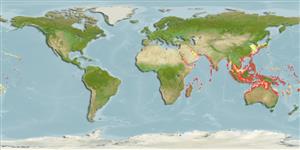
marinhas; estuarina associadas(os) a recifes; não migratória; intervalo de profundidade 0 - 68 m (Ref. 37816), usually 0 - 8 m (Ref. 90102). Tropical; 39°N - 28°S, 32°E - 154°W (Ref. 57009)
Indo-Pacific: southern Africa, the Red Sea to Hawaii and French Polynesia; north to Japan, south to Australia.
Length at first maturity / Tamanho / Peso / Idade
Maturidade: Lm 14.0 range ? - ? cm
Max length : 30.0 cm TL macho/indeterminado; (Ref. 1602)
Descrição breve
Chaves de identificação | Morfologia | Morfometria
Espinhos dorsais (total) : 0; Raios dorsais moles (total) : 17 - 18; Espinhos anais: 0; Raios anais moles: 4.
Body shape (shape guide): other; Cross section: angular.
Inhabit seagrass and marine algae areas of estuaries and seaward reefs; also on steep mud slopes. Found in open water and attached to drifting Sargassum up to 20 km from shore. Adults in pairs (Ref. 48635). Benthic to pelagic (Ref. 58302). Feeds on zooplankton (Ref. 85309). Ovoviviparous (Ref. 205). The males carry the eggs in a brood pouch which is found under the tail (Ref. 205). Not shown to be monogamous in the laboratory (Ref. 30915). Very popular aquarium fish. Highly valued species in traditional Chinese medicine (Ref. 30915). Has been reared in captivity (Ref. 35416).
There are 20 - 1000 larvae in incubating sacks; time of development is 20-28 days. The males carry the eggs in a brood pouch which is found under the tail (Ref. 205).
Lourie, S.A., R.A. Pollom and S.J. Foster, 2016. A global revision of the seahorses Hippocampus Rafinesque 1810 (Actinopterygii: Syngnathiformes): taxonomy and biogeography with recommendations for further research. Zootaxa 4146(1):1-66. (Ref. 115213)
Categoria na Lista Vermelha da IUCN (Ref. 130435: Version 2025-1)
Ameaça para o homem
Harmless
Utilização humana
Pescarias: altamente comercial; Aquacultura: espécies comerciais; Aquário: Espécies comerciais
Ferramentas
Relatórios especiais
Descarregue XML
Fontes da internet
Estimates based on models
Preferred temperature (Ref.
123201): 21.3 - 29, mean 27.8 °C (based on 1008 cells).
Phylogenetic diversity index (Ref.
82804): PD
50 = 0.5000 [Uniqueness, from 0.5 = low to 2.0 = high].
Bayesian length-weight: a=0.00447 (0.00175 - 0.01142), b=2.99 (2.77 - 3.21), in cm total length, based on LWR estimates for this (Sub)family-body shape (Ref.
93245).
Nível Trófico (Ref.
69278): 3.6 ±0.5 se; based on size and trophs of closest relatives
Generation time: 1.1 ( na - na) years. Estimated as median ln(3)/K based on 2
growth studies.
Resiliência (Ref.
120179): Médio, tempo mínimo de duplicação da população 1,4 - 4,4 anos (tm=0.6; Fec=20-1000).
Fishing Vulnerability (Ref.
59153): Low vulnerability (15 of 100).
🛈
Nutrients (Ref.
124155): Calcium = 120 [63, 293] mg/100g; Iron = 1.43 [0.71, 2.71] mg/100g; Protein = 18.2 [16.8, 19.6] %; Omega3 = 0.117 [0.048, 0.280] g/100g; Selenium = 80.9 [32.1, 214.9] μg/100g; VitaminA = 26.5 [6.8, 105.4] μg/100g; Zinc = 2.06 [1.22, 3.28] mg/100g (wet weight);