Elasmobranquios (tiburones y rayas) (sharks and rays) >
Carcharhiniformes (Ground sharks) >
Triakidae (Houndsharks) > Galeorhininae
Etymology: Iago: Name of villain in Shakespeare’s Othello, because members of this genus have been a “troublemaker for systematists and hence a kind of villain” (See ETYFish); garricki: Patronym not identified but clearly in honor of J.A.F. (Jack) Garrick (1928-2018), New Zealand shark taxonomist and biologist (See ETYFish).
Eponymy: The name of this genus derives from Iago, the villain in Shakespeare’s play Othello. The authors say that this genus is “a troublemaker for systematists and hence a kind of villain”. Dr John Andrew Frank (Jack) Garrick (1928–2018) was a New Zealand ichthyologist with a specialization in elasmobranchs. [...] (Ref. 128868), visit book page.
Environment: milieu / climate zone / rango de profundidad / distribution range
Ecología
marino batidemersal; rango de profundidad 250 - 475 m (Ref. 6871). Deep-water; 9°S - 26°S
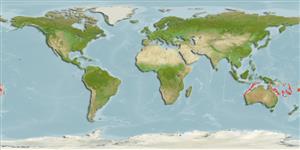
Indo-Pacific: from the South China Sea (off Dongsha Atolll) to nw and ne Australia, including Indonesia, the Philippines, Papua New Guinea and Vanuatu.
Length at first maturity / Tamaño / Peso / Age
Madurez: Lm ?, range 45 - ? cm
Max length : 75.0 cm TL macho / no sexado; (Ref. 244)
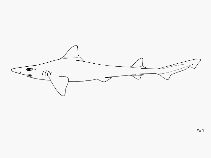
Espinas dorsales (total) : 0; Espinas anales: 0. This species is distinguished by the following characters: snout long and narrow; preoral length 35.1% (34.9-38.7%) head length; eye large, its length 18.5% (17.0-24.1%) HL; gill slit rather short, first gill slit height 47.8% (31.4-51.6%) eye length; anterolateral teeth straight to slightly oblique, blade-like, with 1-3 broad, smooth distal cusplets; first dorsal-fin origin does not reach to the vertical line through the pectoral-fin base; caudal-fin ventral lobe is moderately developed in adults. Colouration: body generally grey, with faint dark edges on dorsal-fin apexes, more prominent in juveniles (Ref. 127459).
Body shape (shape guide): elongated; Cross section: angular.
A little-known tropical shark found on the uppermost insular slopes (Ref. 13563) at depths of 250-475 m (Ref.58048). Stomach contents of a specimen included small Macrouridae (Hymenocephalus sp., Nezumia sp., Ventrifossa spp.), crustaceans (Penaeoidea, Munidae) (Ref. 127459) and cephalopods (Ref. 244). Viviparous, placental (Ref. 50449). Caught irregularly by the small-scale demersal longline fisheries operating in deepwater. Utilized for its meat and fins, but of limited value due to its small size (Ref.58048).
Viviparous, placental (Ref. 50449). With 4 or 5 young per litter (Ref. 244). Size at birth near 23 cm (full-term fetuses) (Ref. 244). Distinct pairing with embrace (Ref. 205).
Ng, S.-L., H.-C. Ho, K.-M. Liu and S.-J. Joung, 2022. Redescription of the longnose houndshark Iago garricki (Carcharhiniformes: Triakidae), based on specimens recently collected from the South China Sea. Zootaxa 5189(1):67-77. (Ref. 127459)
IUCN Red List Status (Ref. 130435: Version 2025-1)
Human uses
Pesquerías: escaso valor comercial
Herramientas
Special reports
Download XML
Fuentes de Internet
Estimates based on models
Preferred temperature (Referencia
123201): 11 - 17.2, mean 12.4 °C (based on 26 cells).
Phylogenetic diversity index (Referencia
82804): PD
50 = 0.6250 [Uniqueness, from 0.5 = low to 2.0 = high].
Bayesian length-weight: a=0.00427 (0.00180 - 0.01010), b=3.04 (2.84 - 3.24), in cm total length, based on LWR estimates for this (Sub)family-body shape (Ref.
93245).
Nivel trófico (Referencia
69278): 4.5 ±0.37 se; based on food items.
Resiliencia (Referencia
120179): Muy bajo, población duplicada en un tiempo mínimo superior a 14 años (Fec=4).
Fishing Vulnerability (Ref.
59153): Moderate to high vulnerability (50 of 100).
🛈