Environment: milieu / climate zone / kisaran kedalaman / distribution range
Ekologi
laut batipelagis; kisaran kedalaman 622 - 1412 m (Ref. 36330). Deep-water
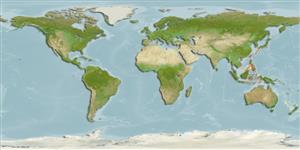
Western Central Pacific: Sulu Sea.
Size / Weight / umur
Kematangan: Lm ? range ? - ? cm
Max length : 23.4 cm SL jantan/; (Ref. 36330)
deskripsi pendek
Kunci identifiaksi (pengenalan) | Morfologi | Morfometrik
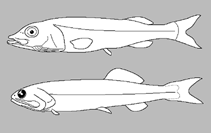
duri punggung lunak (Keseluruhan (total)) : 17 - 21; Sirip dubur lunak: 14 - 18. Body shallow, maximum depth reaching 20%SL. Caudal peduncle relatively long (usually >18%SL). Vertical fin bases against each other. Head not very deep, moderately wide (postorbital width 11-12.5%SL). Snout very short but not blunt; its length 1.5-2.3 times smaller than orbit diameter; olfactory bulbs relatively large; ethymoid in olfactory bulb region relatively narrow. Eyes very large; orbit > 30% HL; no aggregations of light connective tissue in the orbit area around the eyeball; interorbital gap very narrow and < half the orbit diameter. Lacrimal not deep, significantly smaller than lens diameter, slightly overlapping maxillare. Seismosensory canals on head not extended, their pores not enlarged. No separate suprapreoperculum at the upper end of the praeoperculum; preopercular canal connects to the postorbital canal by means of a skin tube. Upper edge of upper jaw overlaps with the vertical of the rear edge of the lens, it may reach the vertical of the back edge of the orbit in large specimens. Supramaxilla 2; front one relatively long; its length equal or shorter than upper outgrowth of the posterior one. Photophores present on the head: a row of 4-5 infraorbitalias; 1 behind back edge of the orbit at its middle level; 5 on both sides along the lower jaw seismosensory canals; 2-4 along the upper 3 rays of the gill membrane; 1 each on the operculum, interoperculum, and between orbit and olfactory capsule. Photophores on body, situated above and below the lateral line, the size increases in the vertical direction that the largest ones cover the lower profile of the body; in front of the vertical fins; 3 rows in the caudal region; several irregular rows of small ones on the gill membranes. Pyloric caeca < 10 (Ref. 36330).
Sazonov, Y.I., 1999. A new species of the genus Rouleina (Argentiniformes, Alepocephalidae) from the Philippine Archipelago Seas and a redescription of R. livida and R. nuda. J. Ichthyol. 39(7):479-487. (Ref. 36330)
Status IUCN Red List (Ref. 130435: Version 2025-1)
ancaman kepada manusia
Harmless
penggunaan manusia
Alat, peralatan
laporan khas
muat turun XML
Sumber internet
Estimates based on models
Preferred temperature (Acuan
123201): 5.4 - 10.1, mean 6.1 °C (based on 113 cells).
Phylogenetic diversity index (Acuan
82804): PD
50 = 0.5010 [Uniqueness, from 0.5 = low to 2.0 = high].
Bayesian length-weight: a=0.00347 (0.00163 - 0.00737), b=3.19 (3.00 - 3.38), in cm total length, based on LWR estimates for this (Sub)family-body shape (Ref.
93245).
Trophic level (Acuan
69278): 3.5 ±0.5 se; based on size and trophs of closest relatives
Daya lenting (Acuan
120179): sedang, Waktu penggandaan populasi minimum 1.4 - 4.4 tahun (Preliminary K or Fecundity.).
Fishing Vulnerability (Ref.
59153): Low vulnerability (19 of 100).
🛈