>
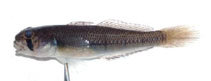
Gobiiformes (Gobies) >
Gobiidae (Gobies) > Gobionellinae
Etymology: Stenogobius: Greek, stenos = narrow + Latin, gobius = gudgeon (Ref. 45335).
More on author: Bleeker.
Environment: milieu / climate zone / गहराई सीमा / distribution range
पारिस्थितिकी
; स्वच्छ जल, अलवण जल; खारा ड़िमरसल. Tropical
Africa: freshwater streams and rivers of Madagascar and Reunion.
आकार / वज़न / Age
परिपक्व अवधि: Lm ? range ? - ? cm
Max length : 15.0 cm SL पुल्लिंग / अलिंग; (Ref. 48660); 6.6 cm SL (female)
Short description
पहचान कुंजी | आकृति विज्ञान | मौरफोमैटरिक्स
पृष्ठीय रीढ़ (सम्पूर्ण) : 7; पृष्ठीय सौफट रेज़ (सम्पूर्ण) : 10 - 11; गुदा कांटा: 1; ऐनल सौफट रेज़: 10 - 11. On males first dorsal fin same height or higher than second dorsal fin with spines generally filamentous; predorsal midline scales 15 to 19, always fully scaled; caudal peduncle elongate when compared to species of S. genivittatus and S. blokzeyli species complexes; in females first and second dorsal fins with dusky spotting forming two to three rows.
Body shape (shape guide): fusiform / normal; Cross section: oval.
Life cycle and mating behavior
परिपक्व अवधि | पुनरुत्पत्ति | मछलीऔ का अंडे देना | अंडे | Fecundity | लार्वा
Watson, R.E., 1991. A provisional review of the genus Stenogobius with descriptions of a new subgenus and thirteen new species (Pisces: Teleostei: Gobiidae). Rec. West. Aust. Mus. 15(3):627-710. (Ref. 34009)
IUCN Red List Status (Ref. 130435: Version 2025-1)
Threat to humans
Harmless
Human uses
साधन
Special reports
Download XML
इंटरनेट स्रोत
Estimates based on models
Phylogenetic diversity index (संदर्भ
82804): PD
50 = 0.5000 [Uniqueness, from 0.5 = low to 2.0 = high].
Bayesian length-weight: a=0.00977 (0.00444 - 0.02153), b=3.04 (2.85 - 3.23), in cm total length, based on LWR estimates for this (Sub)family-body shape (Ref.
93245).
Trophic level (संदर्भ
69278): 3.7 ±0.6 se; based on size and trophs of closest relatives
लौटाव (संदर्भ
120179): माध्यम, न्यूनतम जनसंख्या दुगनी होने का समय 1.4 - 4.4 वर्ष। (Preliminary K or Fecundity.).
Fishing Vulnerability (Ref.
59153): Low vulnerability (10 of 100).
🛈