>
Kurtiformes (Nurseryfishes, cardinalfishes.) >
Apogonidae (Cardinalfishes) > Apogoninae
Etymology: luteus: From the Latin for yellow in reference to its yellow coloration in life (Ref. 33415).
More on authors: Randall & Kulbicki.
Environment: milieu / climate zone / profondeur / distribution range
Écologie
marin récifal; profondeur 1 - 49 m (Ref. 37816). Tropical
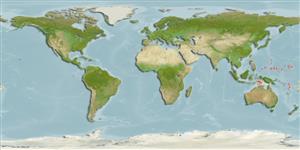
Western Central Pacific: Philippines to the Marshall Islands.
Taille / Poids / Âge
Maturité: Lm ? range ? - ? cm
Max length : 4.4 cm SL mâle / non sexé; (Ref. 33415)
Description synthétique
Clés d'identification | Morphologie | Morphométrie
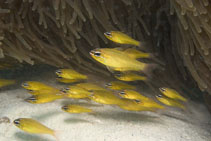
Épines dorsales (Total) : 8; Rayons mous dorsaux (Total) : 9; Épines anales: 2; Rayons mous anaux: 8; Vertèbres: 24. Predorsal scales 4; preopercular edge serrate; preopercular ridge smooth to slightly crenulate; body depth 2.9-3.3 in SL; yellow with six narrow blue stripes on head, the two upper stripes usually continue faintly as broader purplish stripes on body; a blue-edged yellow stripe basally in second dorsal and anal fins; dorsal profile of head slightly convex (Ref. 33415).
Body shape (shape guide): fusiform / normal.
Inhabits sheltered clearwater areas of lagoon and seaward reefs. Aggregates under ledges, in holes, or even among spines of sea urchins. Feeds on planktonic crustaceans and small invertebrates by day and night (Ref. 37816).
Life cycle and mating behavior
Maturité | Reproduction | Frai | Œufs | Fécondité | Larves
A mouth-brooder. Distinct pairing during courtship and spawning (Ref. 205).
Myers, R.F., 1999. Micronesian reef fishes: a comprehensive guide to the coral reef fishes of Micronesia, 3rd revised and expanded edition. Coral Graphics, Barrigada, Guam. 330 p. (Ref. 37816)
Statut dans la liste rouge de l'IUCN (Ref. 130435: Version 2025-1)
Menace pour l'homme
Harmless
Utilisations par l'homme
Outils
Articles particuliers
Télécharger en XML
Sources Internet
Estimates based on models
Preferred temperature (Réf.
123201): 28.1 - 29.1, mean 28.5 °C (based on 20 cells).
Phylogenetic diversity index (Réf.
82804): PD
50 = 0.5000 [Uniqueness, from 0.5 = low to 2.0 = high].
Bayesian length-weight: a=0.01096 (0.00509 - 0.02362), b=3.09 (2.91 - 3.27), in cm total length, based on LWR estimates for this (Sub)family-body shape (Ref.
93245).
Niveau trophique (Réf.
69278): 3.5 ±0.49 se; based on food items.
Résilience (Réf.
120179): Haut, temps minimum de doublement de population inférieur à 15 mois (Preliminary K or Fecundity.).
Fishing Vulnerability (Ref.
59153): Low vulnerability (10 of 100).
🛈
Nutrients (Ref.
124155): Calcium = 272 [137, 741] mg/100g; Iron = 1.65 [0.79, 3.08] mg/100g; Protein = 18.8 [17.4, 20.1] %; Omega3 = 0.186 [0.078, 0.461] g/100g; Selenium = 42.6 [14.8, 108.9] μg/100g; VitaminA = 78.6 [19.7, 309.0] μg/100g; Zinc = 3.41 [1.94, 5.41] mg/100g (wet weight);