Environment: milieu / climate zone / distribuzione batimetrica / distribution range
Ecologia
marino associati a barriera corallina; distribuzione batimetrica 0 - 60 m (Ref. 128797), usually 14 - 45 m (Ref. 37816). Tropical; 22°C - 28°C (Ref. 27115); 32°N - 32°S
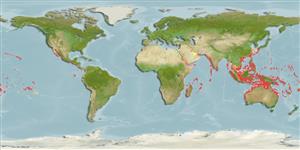
Indo-Pacific: Red Sea to Panama and Columbia, north to southern Japan and the Hawaiian Islands, south to the Lord Howe and Austral islands.
Size / Peso / Age
Maturità: Lm ? range ? - ? cm
Max length : 32.0 cm TL maschio/sesso non determinato; (Ref. 30573); common length : 26.5 cm SL maschio/sesso non determinato; (Ref. 37816); peso massimo pubblicato: 61.16 g (Ref. 124708)
Spine dorsali (totale) : 1 - 4; Raggi dorsali molli (totale) : 52 - 56; Spine anali: 1; Raggi anali molli: 46 - 55.
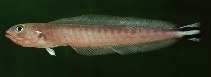
Body shape (shape guide): elongated; Cross section: circular.
Inhabits barren, open areas of outer reef slopes. Occurs in pairs over rocks or sandy areas adjacent to reefs (Ref. 5213). Usually lives in a burrow of their own construction, often under a surface rock on sand (Ref. 48635). Has pelagic stage to at least 5 cm, hence smaller juveniles are not seen on the substrate (Ref. 48635). Benthic and Benthopelagic (Ref. 58302). Marketed fresh (Ref. 9119).
Life cycle and mating behavior
Maturità | Riproduzione | Deposizione | Uova | Fecundity | Larve
Dooley, J.K., 1978. Systematics and biology of the tilefishes (Perciformes: Branchiostegidae and Malacanthidae) with descriptions of two new species. NOAA Tech. Rep. NMFS Circ. No. 411:1-78. (Ref. 8991)
IUCN Red List Status (Ref. 130435: Version 2025-1)
Threat to humans
Harmless
Human uses
Pesca: commerciale; Acquario: Commerciale
Strumenti
Special reports
Download XML
Fonti Internet
Estimates based on models
Preferred temperature (Fonte Biblio.
123201): 24.5 - 29, mean 27.9 °C (based on 1154 cells).
Phylogenetic diversity index (Fonte Biblio.
82804): PD
50 = 0.6250 [Uniqueness, from 0.5 = low to 2.0 = high].
Bayesian length-weight: a=0.00537 (0.00236 - 0.01221), b=3.03 (2.83 - 3.23), in cm total length, based on LWR estimates for this (Sub)family-body shape (Ref.
93245).
Trophic level (Fonte Biblio.
69278): 3.5 ±0.37 se; based on food items.
Fishing Vulnerability (Ref.
59153): Low vulnerability (22 of 100).
🛈
Nutrients (Ref.
124155): Calcium = 60 [34, 90] mg/100g; Iron = 0.54 [0.35, 0.88] mg/100g; Protein = 18 [16, 20] %; Omega3 = 0.0911 [, ] g/100g; Selenium = 33.9 [18.9, 60.5] μg/100g; VitaminA = 88.8 [32.2, 234.5] μg/100g; Zinc = 1.29 [0.92, 1.74] mg/100g (wet weight);