Environment: milieu / climate zone / Tiefenbereich / distribution range
Ökologie
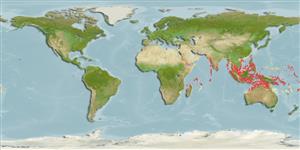
seewasser riff-verbunden; tiefenbereich 40 - 70 m (Ref. 37816). Tropical; 24°N - 21°S
Indo-West Pacific: off Kosi Bay in South Africa (Ref. 11228) eastward to the Solomon Islands, north to the Philippines, Palau, and the Marshall Islands (Ref. 33390).
Size / Gewicht / Alter
Geschlechtsreife: Lm ? range ? - ? cm
Max length : 21.0 cm TL Männchen/unbestimmt; (Ref. 5591); common length : 16.9 cm SL Männchen/unbestimmt; (Ref. 37816)
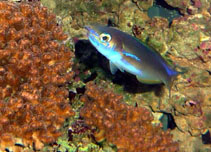
Rückenflossenstacheln (insgesamt) : 10; Rückenflossenweichstrahlen (insgesamt) : 13; Afterflossenstacheln: 2; Afterflossenweichstrahlen: 12; Wirbelzahl: 24. Body pale olive-grey, darker above, belly pale blue; bluish violet band joining eyes across front of snout; lips and cheeks blue; upper 1/3 of pectoral fins bluish white, remainder pale yellow (Ref. 5591). This rare species has the deepest body in the genus and a thicker tail than H. cuniculus and H. starcki (Ref. 37816).
Body shape (shape guide): fusiform / normal.
Inhabits sandy areas at bases of reefs (Ref. 9710). A rare species that schools above huge mounds of rubble that it apparently builds (up to 5.5 m long x 3 m wide over 1 m high). Solitary or in pairs (Ref 90102).
Life cycle and mating behavior
Geschlechtsreife | Fortpflanzung | Ablaichen | Eier | Fecundity | Larven
Displays obligate monogamy where a one-to-one pair is established irrespective of resource abundance (Ref. 52884).
Randall, J.E. and J.K. Dooley, 1974. Revision of the Indo-Pacific branchiostegid fish genus Hoplolatilus, with descriptions of two new species. Copeia 1974(2):457-471. (Ref. 9870)
IUCN Rote Liste Status (Ref. 130435: Version 2025-1)
Bedrohung für Menschen
Harmless
Nutzung durch Menschen
Fischereien: kommerziell; Aquarium: Kommerziell
Tools
Zusatzinformationen
Download XML
Internet Quellen
Estimates based on models
Preferred temperature (Ref.
123201): 26 - 28.4, mean 27.4 °C (based on 253 cells).
Phylogenetic diversity index (Ref.
82804): PD
50 = 0.5001 [Uniqueness, from 0.5 = low to 2.0 = high].
Bayesian length-weight: a=0.01122 (0.00514 - 0.02450), b=3.04 (2.87 - 3.21), in cm total length, based on all LWR estimates for this body shape (Ref.
93245).
Trophic level (Ref.
69278): 3.5 ±0.5 se; based on size and trophs of closest relatives
Fishing Vulnerability (Ref.
59153): Low vulnerability (11 of 100).
🛈