>
Eupercaria/misc (Various families in series Eupercaria) >
Labridae (Wrasses) > Corinae
Etymology: Thalassoma: Greek, thalassa = the sea + Greek, soma = body; the colour of the sea (Ref. 45335).
More on authors: Lay & Bennett.
Environment: milieu / climate zone / djupintervall / distribution range
Ekologi
marina revassocierade; djupintervall 0 - 30 m (Ref. 1602), usually 1 - 30 m (Ref. 27115). Subtropical; 24°C - 28°C (Ref. 27115); 30°N - 32°S
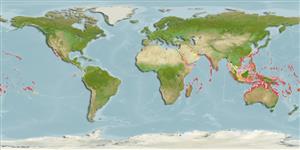
Indo-Pacific: Sri Lanka to Ducie Island, north to southern Japan and the Hawaiian Islands, south to southeastern Australia, Lord Howe Island, the Kermadec Islands, and Rapa. Replaced by Thalassoma grammaticum in the tropical eastern Pacific (Ref. 37816).
Size / Vikt / Age
Könsmognad: Lm ? range ? - ? cm
Max length : 30.0 cm TL hane/ej könsbestämd; (Ref. 9710)
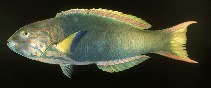
Taggstrålar i ryggfenan (totalt) : 8; Mjukstrålar i ryggfenan (totalt) : 13 - 14; Taggstrålar i analfenan: 3; Mjukstrålar i analfenan: 11. Body without longitudinal stripes. Initial phase body yellow with light vertical red lines. Terminal phase body abruptly blue to blue-green behind pink and green head. Reddish vertical lines on body. Pectoral fins yellow on basal half, blue to black distally (Ref 9823).
Body shape (shape guide): fusiform / normal; Cross section: compressed.
Occurs in groups (Ref. 90102) in clear outer lagoon and seaward reefs, over open sand and rubble as well as dense coral growth. Common is shallow exposed areas (Ref. 9710). Benthopelagic (Ref. 58302). Feeds mainly on shelled benthic invertebrates (crabs, shrimps, gastropods, bivalves, brittle stars, sea urchins), also on polychaete worms and fish eggs. Minimum depth reported taken from Ref. 128797.
Life cycle and mating behavior
Könsmognad | Reproduktion | Lek | Ägg | Fecundity | Larver
Pelagic spawner.
Randall, J.E., G.R. Allen and R.C. Steene, 1990. Fishes of the Great Barrier Reef and Coral Sea. University of Hawaii Press, Honolulu, Hawaii. 506 p. (Ref. 2334)
IUCN Red List Status (Ref. 130435: Version 2025-1)
Threat to humans
Harmless
Human uses
Fiskeri: mindre kommeriell; Akvarium: Kommersiell
Verktyg
Special reports
Download XML
Internet-källor
Estimates based on models
Preferred temperature (Ref.
123201): 24.3 - 28.9, mean 27.5 °C (based on 1148 cells).
Phylogenetic diversity index (Ref.
82804): PD
50 = 0.5000 [Uniqueness, from 0.5 = low to 2.0 = high].
Bayesian length-weight: a=0.01000 (0.00611 - 0.01635), b=3.05 (2.91 - 3.19), in cm total length, based on LWR estimates for this species & Genus-body shape (Ref.
93245).
Trofisk nivå (Ref.
69278): 3.7 ±0.4 se; based on diet studies.
Resiliens (Ref.
120179): Mellan, lägsta populationsfördubblingstid 1,4-4,4 år (Preliminary K or Fecundity.).
Fishing Vulnerability (Ref.
59153): Low vulnerability (20 of 100).
🛈
Nutrients (Ref.
124155): Calcium = 34 [16, 74] mg/100g; Iron = 0.585 [0.320, 1.149] mg/100g; Protein = 19.4 [16.5, 21.6] %; Omega3 = 0.217 [0.125, 0.383] g/100g; Selenium = 12.2 [6.0, 24.1] μg/100g; VitaminA = 72.2 [21.6, 300.0] μg/100g; Zinc = 0.907 [0.578, 1.527] mg/100g (wet weight);