This website uses cookies to enhance your browsing experience and ensure the functionality of our site. For more detailed information about the types of cookies we use and how we protect your privacy, please visit our Privacy Information page.
×
Cookie Settings
This website uses different types of cookies to enhance your experience. Please select your preferences below:
> Eupercaria/misc (Various families in series Eupercaria) > Labridae (Wrasses) > Julidinae
Etymology: Stethojulis:Greek, stetho, stethion = brest; literal = to prick a little breast + Greek, ioulis, a fish dealing with genera Coris or Thalassoma (Ref. 45335). More on author: Bennett.
Environnement : milieu / zone climatique / profondeur / gamme de distribution Écologie
Indo-Pacific: Red Sea and East Africa south to Algoa Bay, South Africa (Ref. 4392) and east to the Marshall and Tuamoto islands. In the western Pacific, extends from Sagami Bay, Honshu to New South Wales (Australia).
Taille / Poids / Âge
Maturité: Lm? range ? - ? cm Max length : 15.0 cm TL mâle / non sexé; (Ref. 2334); 7.0 cm TL (female)
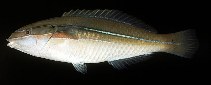
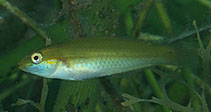
Épines dorsales (Total) : 9; Rayons mous dorsaux (Total) : 11; Épines anales: 3; Rayons mous anaux: 11. First spine of the anal fin is minute or imbedded (Ref. 1602). Terminal males of S. strigiventer and S. bandanensis are similar, but in S. strigiventer the uppermost lateral blue streak rather than the lowermost one extends to the tail (Ref. 1602). Body shape (shape guide): fusiform / normal; Cross section: compressed.
Inhabits seagrass beds and areas of mixed sand, rubble, and algae of inner reef flats and shallow lagoons. Female length is from Ref. 9137. Swims in small aggregations over large areas. Maximum depth reported taken from Ref. 48636.
Cycle de vie et comportement reproducteur Maturité | Reproduction | Frai | Œufs | Fécondité | Larves
Oviparous, distinct pairing during breeding (Ref. 205).
Randall, J.E., 2000. Revision of the Indo-Pacific labrid fishes of the genus Stethojulis, with descriptions of two new species. Indo-Pac. Fish. (31):42 p. (Ref. 36378)
Statut dans la liste rouge de l'IUCN (Ref. 130435: Version 2025-2 (Global))
Cycle de vie Reproduction Maturité Maturité/épines rel. Fécondité Frai Agrégats de frai Œufs Développement de l'œuf Larves Dynamique des populations larvaires
Physiologie Composition corporelle Nutriments Consommation d'oxygène Type de natation Vitesse de nage Pigments visuels Son de poisson Maladies et parasites Toxicité (CL50)
Température préférée (Réf. 123201): 24.9 - 29.3, mean 28.4 °C (based on 3102 cells).
Indice de diversité phylogénétique (Réf. 82804): PD50 = 0.5010 [Uniqueness, from 0.5 = low to 2.0 = high].
Bayesian length-weight: a=0.00813 (0.00493 - 0.01341), b=3.00 (2.86 - 3.14), in cm total length, based on LWR estimates for this species & Genus-body shape (Ref. 93245).
Niveau trophique (Réf. 69278): 3.1 ±0.1 se; based on diet studies.
Résilience (Réf. 120179): Haut, temps minimum de doublement de population inférieur à 15 mois (Preliminary K or Fecundity.).
Vulnérabilité de la pêche (Ref. 59153): Low vulnerability (10 of 100). 🛈