>
Centrarchiformes (Basses) >
Latridae (Trumpeters)
Etymology: Goniistius: Name from the Greek -gon for angled and 'istion' for sail; referring to the oblique bars found on many species.
b ars f o u n d o n m a n y s p e ci es.
More on author: Richardson.
Environment: milieu / climate zone / rango de profundidad / distribution range
Ecología
marino; salobre asociado a arrecife; rango de profundidad 1 - 20 m (Ref. 33839). Temperate
Eastern Indian Ocean and Southeast Pacific: Western Australia, Kermadec Island and Easter Island.
Tamaño / Peso / Age
Madurez: Lm ? range ? - ? cm
Max length : 30.0 cm TL macho / no sexado; (Ref. 33839)
Short description
Claves de identificación | Morfología | Morfometría
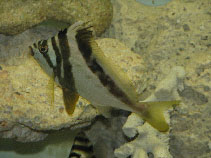
Espinas dorsales (total) : 17; Radios blandos dorsales (total) : 31 - 32; Espinas anales: 3; Radios blandos anales: 8. White with mostly oblique, black bands; three short bands across forehead; prominent band from each eye to pectoral fin base, second from nape to pectoral fin base, third angled downward from dorsal fin origin and fading behind pectoral fin, fourth arising on center of spinous portion of dorsal fin and tapering as it follows dorsal profile of body to upper side of caudal peduncle; pectoral fins yellow; other fins greyish with darker margins (Ref. 33839).
Body shape (shape guide): fusiform / normal.
Inhabits shallow protected reef and sandy areas, sometimes entering estuaries (Ref. 33839).
Life cycle and mating behavior
Madurez | Reproducción | Puesta | Huevos | Fecundidad | Larva
Gomon, M.F., C.J.M. Glover and R.H. Kuiter (eds.), 1994. The fishes of Australia's south coast. State Print, Adelaide. 992 p. (Ref. 33839)
IUCN Red List Status (Ref. 130435: Version 2025-1)
Threat to humans
Harmless
Human uses
Herramientas
Special reports
Download XML
Fuentes de Internet
Estimates based on models
Preferred temperature (Referencia
123201): 15.3 - 23.3, mean 17.9 °C (based on 211 cells).
Phylogenetic diversity index (Referencia
82804): PD
50 = 0.5020 [Uniqueness, from 0.5 = low to 2.0 = high].
Bayesian length-weight: a=0.01175 (0.00550 - 0.02508), b=3.04 (2.85 - 3.23), in cm total length, based on LWR estimates for this (Sub)family-body shape (Ref.
93245).
Nivel trófico (Referencia
69278): 2.8 ±0.25 se; based on food items.
Resiliencia (Referencia
120179): Medio, población duplicada en un tiempo mínimo de 1.4-4.4 años (Preliminary K or Fecundity.).
Fishing Vulnerability (Ref.
59153): Low vulnerability (20 of 100).
🛈
Nutrients (Ref.
124155): Calcium = 20.8 [7.1, 36.3] mg/100g; Iron = 0.213 [0.115, 0.370] mg/100g; Protein = 19.4 [17.4, 21.4] %; Omega3 = 0.342 [0.181, 0.648] g/100g; Selenium = 5.3 [2.2, 12.4] μg/100g; VitaminA = 57.9 [15.4, 231.5] μg/100g; Zinc = 0.886 [0.565, 1.426] mg/100g (wet weight);