>
Eupercaria/misc (Various families in series Eupercaria) >
Labridae (Wrasses) > Cheilininae
Etymology: Cheilinus: Greek, cheilos = lip (Ref. 45335).
More on author: Bloch.
Environment: milieu / climate zone / rango de profundidad / distribution range
Ecología
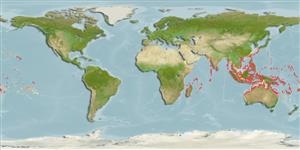
marino asociado a arrecife; rango de profundidad 1 - 30 m (Ref. 9823). Tropical; 32°N - 36°S, 25°E - 132°W
Indo-Pacific: East Africa to the Marquesan and Tuamoto islands, north to the Ryukyu Islands, south to New Caledonia and Rapa.
Tamaño / Peso / Age
Madurez: Lm ? range ? - ? cm
Max length : 45.0 cm TL macho / no sexado; (Ref. 9710)
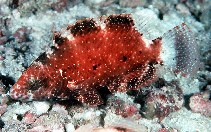
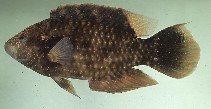
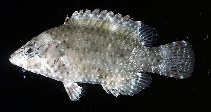
Espinas dorsales (total) : 10; Radios blandos dorsales (total) : 8 - 9; Espinas anales: 3; Radios blandos anales: 8. The only Cheilinus that has 10 dorsal spines. Exhibits a coloration very similar to C. trilobatus, but has black and white specks on its pelvic, anal and caudal fins, while C. trilobatus has vertical red, white and black streaks on its body scales. Large adults of both species have numerous red spots and streaks on the head and trilobed caudal fins.
Body shape (shape guide): fusiform / normal; Cross section: compressed.
Adults inhabit lagoon and coastal reefs, in areas with mixed sand, rubble, and coral (Ref. 9710). Occasionally in grassy areas. Feed mainly on benthic invertebrates such as mollusks and crustaceans. Oviparous, distinct pairing during breeding (Ref. 205).
Life cycle and mating behavior
Madurez | Reproducción | Puesta | Huevos | Fecundidad | Larva
Oviparous, distinct pairing during breeding (Ref. 205).
Westneat, M.W., 2001. Labridae. Wrasses, hogfishes, razorfishes, corises, tuskfishes. p. 3381-3467. In K.E. Carpenter and V. Niem (eds.) FAO species identification guide for fishery purposes. The living marine resources of the Western Central Pacific. Vol. 6. Bony fishes part 4 (Labridae to Latimeriidae), estuarine crocodiles. FAO, Rome. (Ref. 9823)
IUCN Red List Status (Ref. 130435: Version 2025-1)
Threat to humans
Harmless
Human uses
Pesquerías: escaso valor comercial; Acuario: Comercial
Herramientas
Special reports
Download XML
Fuentes de Internet
Estimates based on models
Preferred temperature (Referencia
123201): 25 - 29.3, mean 28.5 °C (based on 3199 cells).
Phylogenetic diversity index (Referencia
82804): PD
50 = 0.5039 [Uniqueness, from 0.5 = low to 2.0 = high].
Bayesian length-weight: a=0.01778 (0.01133 - 0.02790), b=2.94 (2.81 - 3.07), in cm total length, based on LWR estimates for this species & (Sub)family-body (Ref.
93245).
Nivel trófico (Referencia
69278): 3.5 ±0.52 se; based on food items.
Resiliencia (Referencia
120179): Medio, población duplicada en un tiempo mínimo de 1.4-4.4 años (Preliminary K or Fecundity.).
Fishing Vulnerability (Ref.
59153): Low to moderate vulnerability (35 of 100).
🛈
Nutrients (Ref.
124155): Calcium = 37.9 [21.2, 83.6] mg/100g; Iron = 0.614 [0.269, 1.382] mg/100g; Protein = 17.8 [13.6, 21.1] %; Omega3 = 0.0958 [, ] g/100g; Selenium = 32 [16, 69] μg/100g; VitaminA = 205 [38, 915] μg/100g; Zinc = 2.71 [1.53, 4.34] mg/100g (wet weight);