Environment: milieu / climate zone / Tiefenbereich / distribution range
Ökologie
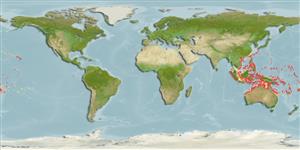
seewasser riff-verbunden; tiefenbereich 0 - 45 m (Ref. 9710). Tropical; 30°N - 18°S, 97°E - 150°W
Indo-Pacific: Christmas Island in the eastern Indian Ocean to the Line Islands, north to the Ryukyu Islands, south to Rowley Shoals and the northern Great Barrier Reef; throughout Micronesia. Replaced by Chaetodon guttatissimus in the Indian Ocean (Ref. 37816).
Size / Gewicht / Alter
Geschlechtsreife: Lm ? range ? - ? cm
Max length : 12.0 cm TL Männchen/unbestimmt; (Ref. 9710)
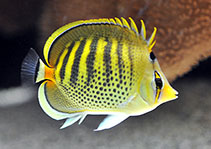
Rückenflossenstacheln (insgesamt) : 13 - 14; Rückenflossenweichstrahlen (insgesamt) : 22 - 25; Afterflossenstacheln: 3; Afterflossenweichstrahlen: 17 - 18. Overall color is brownish yellow with vertical rows of spots forming bands on the upper portions of the sides. A black-edged orange bar runs across the eye. The posterior edge of the caudal fin is transparent. Caudal peduncle is bright orange (Ref. 4855). Snout length 2.7-4.1 in HL. Body depth 1.6-1.8 in SL (Ref. 90102).
Body shape (shape guide): short and / or deep; Cross section: compressed.
Common in coral rich areas and clear waters of lagoon and seaward reefs. Sometimes found on outer subtidal reef flats (Ref. 1602). Juveniles secretive (Ref. 48636). Feed on filamentous algae, corals, and benthic invertebrates. Often in pairs during breeding (Ref. 205), monogamous (Ref. 52884). Oviparous (Ref. 205). Occasionally hybridize with C. pelewensis in the southern part of its range (Ref. 9710). Minimum depth reported taken from Ref. 128797.
Life cycle and mating behavior
Geschlechtsreife | Fortpflanzung | Ablaichen | Eier | Fecundity | Larven
Distinct pairing (Ref. 205). Monogamous mating is observed as both obligate and social (Ref. 52884).
Randall, J.E., G.R. Allen and R.C. Steene, 1990. Fishes of the Great Barrier Reef and Coral Sea. University of Hawaii Press, Honolulu, Hawaii. 506 p. (Ref. 2334)
IUCN Rote Liste Status (Ref. 130435: Version 2025-1)
Bedrohung für Menschen
Harmless
Nutzung durch Menschen
Fischereien: weniger kommerziell; Aquarium: Kommerziell
Tools
Zusatzinformationen
Download XML
Internet Quellen
Estimates based on models
Preferred temperature (Ref.
123201): 26 - 28.9, mean 27.8 °C (based on 344 cells).
Phylogenetic diversity index (Ref.
82804): PD
50 = 0.5000 [Uniqueness, from 0.5 = low to 2.0 = high].
Bayesian length-weight: a=0.02291 (0.01133 - 0.04632), b=3.00 (2.83 - 3.17), in cm total length, based on LWR estimates for this Genus-body shape (Ref.
93245).
Trophic level (Ref.
69278): 3.4 ±0.6 se; based on diet studies.
Widerstandsfähigkeit (Ref.
120179): hoch, Verdopplung der Population dauert weniger als 15 Monate. (Preliminary K or Fecundity.).
Fishing Vulnerability (Ref.
59153): Low vulnerability (10 of 100).
🛈
Nutrients (Ref.
124155): Calcium = 130 [66, 208] mg/100g; Iron = 0.967 [0.557, 1.662] mg/100g; Protein = 18.6 [17.4, 19.8] %; Omega3 = 0.129 [0.073, 0.224] g/100g; Selenium = 36.7 [18.9, 71.1] μg/100g; VitaminA = 49.2 [14.2, 174.1] μg/100g; Zinc = 1.65 [1.09, 2.43] mg/100g (wet weight);