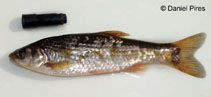
Classification / Names
Noms communs | Synonymes | Catalog of Fishes(Genre, Espèce) | ITIS | CoL | WoRMS | Cloffa
>
Cypriniformes (Carps) >
Leuciscidae (Minnows) > Leuciscinae
Etymology: aradensis: Named for its type locality, River Arade.
Environment: milieu / climate zone / profondeur / distribution range
Écologie
; eau douce benthopélagique. Subtropical; 38°N - 37°N, 9°W - 8°W
Europe: Arade, Algibre and Bordeira basins in the extreme south of Portugal (Ref. 28035). Reported from the Iberian Peninsula, Spain (Ref. 119049).
Taille / Poids / Âge
Maturité: Lm ? range ? - ? cm
Max length : 13.1 cm SL mâle / non sexé; (Ref. 28035)
Description synthétique
Clés d'identification | Morphologie | Morphométrie
Épines dorsales (Total) : 3; Rayons mous dorsaux (Total) : 8; Épines anales: 3; Rayons mous anaux: 7 - 8; Vertèbres: 37 - 38. Diagnosed from its congeners in Iberian Peninsula by having the following characters: infraorbitals 4 and 5 very large, completely fused; 33-40 + 2 scales on lateral line; snout rounded; mouth subterminal, upper jaw projecting; head length less than body depth; and 2½ -3 scale rows between lateral line and pelvic fin origin (Ref. 59043). Preopercular-mandibular canal communicates with infraorbital canal (Ref. 28035).
Body shape (shape guide): fusiform / normal.
An ubiquitous species which inhabits small to medium sized streams with Mediterranean water regime. May be restricted to very small pools during summer. Breeds in shallow riffle habitats in fast-flowing water (Ref. 59043).
Life cycle and mating behavior
Maturité | Reproduction | Frai | Œufs | Fécondité | Larves
Kottelat, M. and J. Freyhof, 2007. Handbook of European freshwater fishes. Publications Kottelat, Cornol and Freyhof, Berlin. 646 pp. (Ref. 59043)
Statut dans la liste rouge de l'IUCN (Ref. 130435: Version 2025-1)
Menace pour l'homme
Harmless
Utilisations par l'homme
Outils
Articles particuliers
Télécharger en XML
Sources Internet
Estimates based on models
Phylogenetic diversity index (Réf.
82804): PD
50 = 0.5000 [Uniqueness, from 0.5 = low to 2.0 = high].
Bayesian length-weight: a=0.00813 (0.00411 - 0.01607), b=3.13 (2.97 - 3.29), in cm total length, based on LWR estimates for this Genus-body shape (Ref.
93245).
Niveau trophique (Réf.
69278): 3.3 ±0.4 se; based on size and trophs of closest relatives
Résilience (Réf.
120179): Milieu, temps minimum de doublement de population : 1,4 à 4,4 années (Preliminary K or Fecundity.).
Fishing Vulnerability (Ref.
59153): Low vulnerability (10 of 100).
🛈