



Carasobarbus chantrei (Sauvage, 1882)
Antakya barbell
Envoyez vos Photos et vidéos
Images Google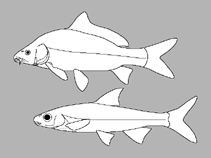 No image available for this species;
drawing shows typical species in Cyprinidae.
Images Google
drawing shows typical species in Cyprinidae.
Classification / Noms Noms communs | Synonymes | Catalog of Fishes(Genre, Espèce) | ITIS | CoL | WoRMS | Cloffa
> Cypriniformes (Carps) > Cyprinidae (Minnows or carps) > Torinae
Etymology: Carasobarbus: Latinization of , karass, karausche, European crucian carp + Latin, barbus = barbel (Ref. 45335).
Eponymy: Ernest Chantre (1843–1924) was a French naturalist, geologist, archaeologist and anthropologist in Asia Minor undertaking many trips accompanied by his wife (1890– 1894). [...] (Ref. 128868), visit book page.
More on author: Sauvage.
Etymology: Carasobarbus: Latinization of , karass, karausche, European crucian carp + Latin, barbus = barbel (Ref. 45335).
Eponymy: Ernest Chantre (1843–1924) was a French naturalist, geologist, archaeologist and anthropologist in Asia Minor undertaking many trips accompanied by his wife (1890– 1894). [...] (Ref. 128868), visit book page.
More on author: Sauvage.
Environnement : milieu / zone climatique / profondeur / gamme de distribution Écologie
; eau douce benthopélagique. Temperate
Distribution Territoires | Zones FAO | Écosystèmes | Occurrences | Carte par point | Introductions | Faunafri
Taille / Poids / Âge
Description synthétique Clés d'identification | Morphologie | Morphométrie
Épines dorsales (Total) : 3 - 4; Rayons mous dorsaux (Total) : 9 - 10. D III-IV, 9-10; A 2-3/(5) 6 (7); L.lat. (29) 30-35 (36); Sp. br. 12-15; D. phar. 5.3.2-2.3.5: Circum ped.scales 12 or 14 (2 1/2 or 3 1/2 above the lateral line scale and 2 l/2 below it on each side).
The average number of branched rays in the dorsal fin is 9.76 of the 61 specimens examined had six branched rays in the anal fin, two had five and one had seven. The last simple ray of the dorsal fin, moderately ossified, and its posterior margin is
denticulated, with denticles being slightly larger than in C. canis and C. luteus.
The upper and lower profiles of the body are similar, both being slightly convex. The mouth is subterminal; lips thick and smooth as in the other members of the genus; mouth small, its opening lies in front of the vertical through the anterior margin of the nostril. All specimens have short posterior barbels. In 57.3 % of the specimens from Turkey, there are also very short (rudimentary) anterior barbels; in 18.2, % the anterior barbels are lacking, whereas in 23.4 % there is a single anterior barbel, either on the right or one the left side. The presence or absence of anterior barbels is not correlated with the size of the specimen (Ref. 57642).
Cycle de vie et comportement reproducteur Maturité | Reproduction | Frai | Œufs | Fécondité | Larves
Référence principale
Téléchargez vos références | Références | Coordinateur | Collaborateurs
Ekmekçi, F.G. and P. Banarescu, 1998. A revision of the generic position of Barynotus (Systomus) verhoeffi, and the validity of the genera Carasobarbus, Kosswigobarbus and Mesopotamichthys (Pisces, Cyprinidae). Folia Zool. 47(Suppl. 1):87-96. (Ref. 57642)
Statut dans la liste rouge de l'IUCN (Ref. 130435: Version 2025-2 (Global))
Quasi-menacé (NT) ; Date assessed: 18 March 2013
CITES
Not Evaluated
Menace pour l'homme
Harmless
Utilisations par l'homme
Pêcheries: sans intérêt
FAO - Publication: search | FishSource |
Plus d'informations
Écologie trophique
Aliments (proies)
Composition du régime alimentaire
Consommation alimentaire
Rations alimentaires
Prédateurs
Aliments (proies)
Composition du régime alimentaire
Consommation alimentaire
Rations alimentaires
Prédateurs
Écologie
Écologie
Écologie
Dynamique des populations
Paramètres de croissance
Âges / tailles maximales
Longueur-poids rel.
Rel. longueur-longueur.
Fréquences de longueurs
Conversion de masse
Recrutement
Abondance
Paramètres de croissance
Âges / tailles maximales
Longueur-poids rel.
Rel. longueur-longueur.
Fréquences de longueurs
Conversion de masse
Recrutement
Abondance
Cycle de vie
Reproduction
Maturité
Maturité/épines rel.
Fécondité
Frai
Agrégats de frai
Œufs
Développement de l'œuf
Larves
Dynamique des populations larvaires
Reproduction
Maturité
Maturité/épines rel.
Fécondité
Frai
Agrégats de frai
Œufs
Développement de l'œuf
Larves
Dynamique des populations larvaires
Anatomie
Surface branchiale
Cerveau
Otolithe
Surface branchiale
Cerveau
Otolithe
Physiologie
Composition corporelle
Nutriments
Consommation d'oxygène
Type de natation
Vitesse de nage
Pigments visuels
Son de poisson
Maladies et parasites
Toxicité (CL50)
Composition corporelle
Nutriments
Consommation d'oxygène
Type de natation
Vitesse de nage
Pigments visuels
Son de poisson
Maladies et parasites
Toxicité (CL50)
Génétique
génôme
Génétique
Hétérozygotie
Héritabilité
Diversité génétique
génôme
Génétique
Hétérozygotie
Héritabilité
Diversité génétique
Liées à l'homme
Systèmes d'aquaculture
Profils d'aquaculture
Souches
Cas de ciguatera
Timbres, pièces de monnaie, divers
Systèmes d'aquaculture
Profils d'aquaculture
Souches
Cas de ciguatera
Timbres, pièces de monnaie, divers
Outils
E-book | Guide de terrain | Générateur de fréquences de longueur | Outil de dynamique de population | Carte par point |
Capture-MSY |
Articles particuliers
Télécharger en XML
Sources Internet
AFORO (otoliths) | Aquatic Commons | BHL | Cloffa | Websites from users | FishWatcher | CISTI | Catalog of Fishes: Genre, Espèce | DiscoverLife | ECOTOX | FAO - Publication: search | Faunafri | Fishipedia | Fishtrace | GloBI | Google Books | Google Scholar | Google | IGFA World Record | Bases de données nationales | OneZoom | Open Tree of Life | Otolith Atlas of Taiwan Fishes | PubMed | Reef Life Survey | Socotra Atlas | TreeBase | Arbre de Vie | Wikipedia: aller à, chercher | World Records Freshwater Fishing | Zoological Record
Estimations basées sur des modèles
Indice de diversité phylogénétique (Réf. 82804): PD50 = 0.5001 [Uniqueness, from 0.5 = low to 2.0 = high].
Bayesian length-weight: a=0.00955 (0.00430 - 0.02123), b=3.02 (2.83 - 3.21), in cm total length, based on LWR estimates for this (Sub)family-body shape (Ref. 93245).
Niveau trophique (Réf. 69278): 3.0 ±0.4 se; based on size and trophs of closest relatives
Résilience (Réf. 120179): Milieu, temps minimum de doublement de population : 1,4 à 4,4 années (Assuming Fec < 10,000).