Élasmobranches (requins et raies) (sharks and rays) >
Rhinopristiformes (Shovelnose rays) >
Rhinobatidae (Guitarfishes)
Eponymy: Henry von Prahl (1948–1989) was a pioneering Colombian marine biologist who studied Gorgona Island (the type locality) and whose family emigrated from Germany (1953). He was killed by a bomb, which exploded on Avianca Airlines Flight 203 over Bogotá. (Ref. 128868), visit book page.
Environment: milieu / climate zone / profondeur / distribution range
Écologie
marin démersal; profondeur ? - 70 m (Ref. 26282). Tropical; 14°N - 6°S, 92°W - 82°W (Ref. 114953)
Eastern Pacific: from Mexico and from north-western Costa Rica to northern Peru.
Taille / Poids / Âge
Maturité: Lm ? range ? - ? cm
Max length : 90.0 cm TL mâle / non sexé; (Ref. 101827); poids max. publié: 1.4 kg (Ref. 37888)
Description synthétique
Clés d'identification | Morphologie | Morphométrie
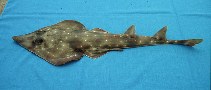
Rostral cartilage distally enlarged; anterior nasal prolongations reaching medial margin of nostrils; posterior margin of spiracle with 2 folds, the medial one rudimentary; a line of about 77 prickles between nuchal region and first dorsal fin; 3 or 4 prickles on shoulders, few tubercles on snout and small prickles on anterior margin of orbits; body covered dorsally with about 80 white dots (3 to 5 mm in diameter) over a brown body; underbody white except snout with a black diamond shape blotch, extending backward laterally (Ref. 13259).
Body shape (shape guide): elongated.
Living individuals reported to be in sandy and rocky environments near coral-reefs at 18-24 m depth of the Colombian coast (Ref. 101827). In contrast the type specimen was taken from a depth of 70 m (Ref. 26282). Ovoviviparous (Ref. 50449). Males mature at ca. 71 cm TL (Ref. 114953).
Life cycle and mating behavior
Maturité | Reproduction | Frai | Œufs | Fécondité | Larves
Exhibit ovoviparity (aplacental viviparity), with embryos feeding initially on yolk, then receiving additional nourishment from the mother by indirect absorption of uterine fluid enriched with mucus, fat or protein through specialised structures (Ref. 50449).
Compagno, L.J.V., 1999. Checklist of living elasmobranchs. p. 471-498. In W.C. Hamlett (ed.) Sharks, skates, and rays: the biology of elasmobranch fishes. Johns Hopkins University Press, Maryland. (Ref. 35766)
Statut dans la liste rouge de l'IUCN (Ref. 130435: Version 2025-1)
Menace pour l'homme
Harmless
Utilisations par l'homme
Pêcheries: sans intérêt
Outils
Articles particuliers
Télécharger en XML
Sources Internet
Estimates based on models
Phylogenetic diversity index (Réf.
82804): PD
50 = 0.5020 [Uniqueness, from 0.5 = low to 2.0 = high].
Bayesian length-weight: a=0.00275 (0.00163 - 0.00465), b=3.10 (2.95 - 3.25), in cm total length, based on LWR estimates for this species & Genus-body shape (Ref.
93245).
Niveau trophique (Réf.
69278): 3.6 ±0.5 se; based on size and trophs of closest relatives
Résilience (Réf.
120179): Faible, temps minimum de doublement de population : 4,5 à 14 années (Fec assumed to be <100).
Fishing Vulnerability (Ref.
59153): High vulnerability (56 of 100).
🛈