



Upeneus tragula Richardson, 1846
Freckled goatfish
Beobachtung melden im Fish Watcher
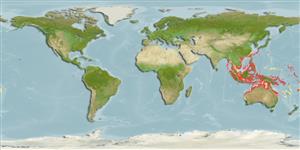
| Native range | All suitable habitat | Point map | Year 2050 |
|
| This map was computer-generated and has not yet been reviewed. |
| Upeneus tragula AquaMaps Data sources: GBIF OBIS |
Hochladen Photos und videos
Bilder | videos | Google Bild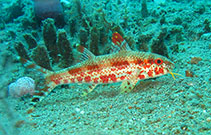 Upeneus tragula
Photo von Bailly, N.
Bilder | videos | Google Bild
Photo von Bailly, N.
Klassifizierung / Names Namen | Synonyme | Catalog of Fishes(Gattung, Arten) | ITIS | CoL | WoRMS | Cloffa
> Mulliformes (Goatfishes) > Mullidae (Goatfishes)
Etymology: Upeneus: Greek, ypene, -es = upper lip (Ref. 45335).
More on author: Richardson.
Etymology: Upeneus: Greek, ypene, -es = upper lip (Ref. 45335).
More on author: Richardson.
Umwelt: Milieu / Klimazone / Tiefenbereich / Verbreitungsgebiet Ökologie
seewasser; brackwasser riff-verbunden; ozeanodrom (Ref. 51243); tiefenbereich 0 - 42 m (Ref. 95469). Tropical; 30°N - 30°S, 92°E - 16°W
Verbreitung Territorien | FAO Gebiete | Ökosysteme | Vorkommen | Punkt Karte | Einführungen | Faunafri
Eastern Indian Ocean to Western Pacific: from Andaman Islands to E Australia and to Japan and New Caledonia.
Länge bei der ersten Reifung / Größe / Gewicht / Alter
Geschlechtsreife: Lm 11.0, range 10 - ? cm
Max length : 30.0 cm TL Männchen/unbestimmt; (Ref. 121202)
Max length : 30.0 cm TL Männchen/unbestimmt; (Ref. 121202)
Kurzbeschreibung Bestimmungsschlüssel | Morphologie | Morphometrie
Rückenflossenstacheln (insgesamt) : 8; Rückenflossenweichstrahlen (insgesamt) : 9; Afterflossenstacheln: 1; Afterflossenweichstrahlen: 6. This species is distinguished by the following characters: D VIII + 9; pectoral fins 12-14; gill rakers 4-7 + 15-19 = 20-25; lateral line scales 28-31; the following measurements are in %SL- body depth at first dorsal fin origin 21-28 and at anus 18-24; caudal-peduncle depth 9.5-12, width 3.1-4.9L; maximum head depth 18-24; head depth through eye 14-20; head length 26-32; postorbital length 9.9–13; orbit length 5.3-8.9; upper jaw length 9.8-14; barbel length 13-21; caudal-peduncle length 22-27, caudal-fin length 29-34; anal-fin height 16-20; pelvic-fin length 19-24; pectoral-fin length 17-22, width 3.5-5.3; first dorsal-fin height 20-25; second dorsal-fin height 17-21; postorbital length 1.4–2.0 times in anal-fin height; all fins with red, brown or black stripes, bars or blotches; 7–19 oblique bars on caudal fin, 3-9 bars on upper lobe, 4-10 on lower lobe; first dorsal fin with a large blotch around tip; one red, brown or black mid-lateral body stripe from tip of snout through eye to caudal base; body and head ground colour white or beige, slightly darker above lateral line, with irregular red, brown or black spots and/or blotches; yellow barbels but may be pale brown or orange in fresh fish; most of body and fin pigmentation retained on preserved fish (Ref. 95469).
Body shape (shape guide): fusiform / normal; Cross section: oval.
Body shape (shape guide): fusiform / normal; Cross section: oval.
Known to enter lower reaches of rivers. Usually found on sandy bottoms in nearshore areas; usually solitary (Ref. 68964). Forms small to moderately large aggregations at all sizes (Ref. 48636). Minimum depth from Ref. 3470.
Lebenszyklus und Paarungsverhalten Geschlechtsreife | Fortpflanzung | Ablaichen | Eier | Fruchtbarkeit | Larven
Hauptreferenz
Laden Sie Ihre Referenzen hoch | Referenzen | Koordinator : Randall, John E. | Partner
Uiblein, F. and G. Gouws, 2014. A new goatfish species of the genus Upeneus (Mullidae) based on molecular and morphological screening and subsequent taxonomic analysis. Mar. Biol. Res. 10(7):655-681. (Ref. 95469)
IUCN Rote Liste Status (Ref. 130435: Version 2025-2 (Global))
nicht bedroht (LC) ; Date assessed: 11 March 2015
CITES
Not Evaluated
Bedrohung für Menschen
Harmless
Nutzung durch Menschen
Fischereien: kommerziell; Aquarium: Kommerziell
FAO - Publication: search | FishSource |
Mehr Information
Trophische Ökologie
Lebensmittel (Beutetiere)
Nahrungszusammensetzung
Nahrungsaufnahme
Lebensmittelrationen
Räuber
Lebensmittel (Beutetiere)
Nahrungszusammensetzung
Nahrungsaufnahme
Lebensmittelrationen
Räuber
Populationsdynamik
Wachstumsparameter
Max. Alter/Größen
Länge-Gewicht-Rel.
Länge-Länge-Verhältnis.
Längenhäufigkeiten
Massenkonvertierung
Rekrutierung
Dichte
Wachstumsparameter
Max. Alter/Größen
Länge-Gewicht-Rel.
Länge-Länge-Verhältnis.
Längenhäufigkeiten
Massenkonvertierung
Rekrutierung
Dichte
Lebenszyklus
Fortpflanzung
Geschlechtsreife
Reifung/Kiemen rel.
Fruchtbarkeit
Ablaichen
Laichaggregationen
Eier
Eientwicklung
Larven
Larven Pop.Dyn.
Fortpflanzung
Geschlechtsreife
Reifung/Kiemen rel.
Fruchtbarkeit
Ablaichen
Laichaggregationen
Eier
Eientwicklung
Larven
Larven Pop.Dyn.
Physiologie
Körperliche Zusammensetzung
Nährstoffe
Sauerstoffverbrauch
Schwimmart
Schwimmgeschwindigkeit
Visuelle Pigmente
Fischgeräusche
Krankheiten und Parasiten
Toxizität (LC50s)
Körperliche Zusammensetzung
Nährstoffe
Sauerstoffverbrauch
Schwimmart
Schwimmgeschwindigkeit
Visuelle Pigmente
Fischgeräusche
Krankheiten und Parasiten
Toxizität (LC50s)
Menschenbezogen
Aquakultur-Systeme
Aquakultur Profile
Zuchtlinien
Ciguatera-Fälle
Briefmarken, Münzen, Verschiedenes.
Aquakultur-Systeme
Aquakultur Profile
Zuchtlinien
Ciguatera-Fälle
Briefmarken, Münzen, Verschiedenes.
Tools
Bio-Quiz | E-Book | Feldführer | Bestimmungsschlüssel | Längenhäufigkeits Tool | Lebensdaten Tool | Punkt Karte |
Catch-MSY |
Zusatzinformationen
Download XML
Zusammenfassung | Punktdaten | Namen | Photos
Internet Quellen
AFORO (otoliths) | Aquatic Commons | BHL | Cloffa | Websites from users | FishWatcher Einträge suchen | CISTI | Catalog of Fishes: Gattung, Arten | DiscoverLife | ECOTOX | FAO - Publication: search | Faunafri | Fishipedia | Fishtrace | GloBI | Google Books | Google Scholar | Google | IGFA World Record | Nationale Datenbanken | OneZoom | Open Tree of Life | Otolith Atlas of Taiwan Fishes | PubMed | Reef Life Survey | Socotra Atlas | TreeBase | Tree of Life | Wikipedia: Gehe zu, Suchen | World Records Freshwater Fishing | Zoobank | Zoologischer Rekord
Schätzungen auf der Grundlage von Modellen
Bevorzugte Temperatur (Ref. 123201): 24.8 - 29.1, mean 28.2 °C (based on 734 cells).
Phylogenetischer Diversitätsindex (Ref. 82804): PD50 = 0.5000 [Uniqueness, from 0.5 = low to 2.0 = high].
Bayesian length-weight: a=0.00933 (0.00761 - 0.01145), b=3.08 (3.05 - 3.11), in cm total length, based on LWR estimates for this species (Ref. 93245).
Trophische Ebene (Ref. 69278): 3.6 ±0.0 se; based on diet studies.
Generation time: 1.7 ( na - na) years. Estimated as median ln(3)/K based on 2 growth studies.
Widerstandsfähigkeit (Ref. 120179): mittel, Verdopplung der Population dauert 1,4 - 4,4 Jahre. (K=0.6-0.9; tm=1).
Nährstoffe (Ref. 124155): Calcium = 73.4 [39.9, 130.5] mg/100g; Iron = 0.663 [0.298, 1.134] mg/100g; Protein = 18.4 [16.3, 20.8] %; Omega3 = 0.181 [0.114, 0.334] g/100g; Selenium = 30.6 [16.7, 61.4] μg/100g; VitaminA = 72.9 [21.7, 265.2] μg/100g; Zinc = 1.49 [0.92, 2.09] mg/100g (wet weight);