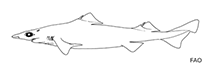
Elasmobranchii (hajar och rockor) (sharks and rays) >
Squaliformes (Sleeper and dogfish sharks) >
Centrophoridae (Gulper sharks)
Etymology: Centrophorus: centr[um] (L.), prickle or sharp point; phorus, from phoreus (Gr.), bearer or carrier, referring to grooved spines on dorsal fins (See ETYFish); isodon: iso-, from isos (Gr.), equal; odon (Gr.), tooth, referring to similarly-shaped teeth on both jaws (See ETYFish).
Environment: milieu / climate zone / djupintervall / distribution range
Ekologi
marina djupbottenlevande; djupintervall ? - 770 m (Ref. 47737). Tropical
Northwest Pacific: Xisha (Paracel) Islands and off the Zujiang River mouth, Hong Kong. A similar and perhaps identical species occurs off Maldives, Sri Lanka, and the Philippines.
Length at first maturity / Size / Vikt / Age
Könsmognad: Lm 98.5, range 97 - 100 cm
Max length : 108 cm hane/ej könsbestämd; (Ref. 58048)
Ovoviviparous (Ref. 50449). Diet poorly known, but stomachs examined contained fishes and cephalopods. Caught by demersal fisheries operating in deepwater areas. Utilized for its meat, fins (low value) and liver oil (very high value)(Ref.58048).
Life cycle and mating behavior
Könsmognad | Reproduktion | Lek | Ägg | Fecundity | Larver
Ovoviviparous, embryos feed solely on yolk (Ref. 50449). Distinct pairing with embrace (Ref. 205). Gives birth to litters of 2 pups after an unknown gestation period; no apparent reproductive synchronicity. Largest embryo recorded was 32 cm TL (Ref.58048).
Compagno, L.J.V. and V.H. Niem, 1998. Squalidae. Dogfish sharks. p. 1213-1232. In K.E. Carpenter and V.H. Niem (eds.) FAO Identification Guide for Fishery Purposes. The Living Marine Resources of the Western Central Pacific Vol. 2. Rome: FAO. (Ref. 31367)
IUCN Red List Status (Ref. 130435: Version 2025-1)
Threat to humans
Harmless
Human uses
Verktyg
Special reports
Download XML
Internet-källor
Estimates based on models
Phylogenetic diversity index (Ref.
82804): PD
50 = 0.5001 [Uniqueness, from 0.5 = low to 2.0 = high].
Bayesian length-weight: a=0.00245 (0.00116 - 0.00519), b=3.20 (3.02 - 3.38), in cm total length, based on LWR estimates for this (Sub)family-body shape (Ref.
93245).
Trofisk nivå (Ref.
69278): 4.3 ±0.3 se; based on size and trophs of closest relatives
Resiliens (Ref.
120179): Låg, lägsta populationsfördubblingstid 4,5-14 år (Fec assumed to be <100).
Fishing Vulnerability (Ref.
59153): High to very high vulnerability (67 of 100).
🛈