>
Cyprinodontiformes (Rivulines, killifishes and live bearers) >
Nothobranchiidae (African rivulines)
Etymology: Nothobranchius: Greek, nothos = false + Greek, brangchia = gill (Ref. 45335).
Eponymy: Dr Julius Vosseler (1861–1933) was a German zoologist. [...] (Ref. 128868), visit book page.
More on author: Ahl.
Environment: milieu / climate zone / rango de profundidad / distribution range
Ecología
; agua dulce bentopelágico; pH range: 7.5 - 8.3; no migratorio. Tropical; 23°C - 31°C (Ref. 96650)
Africa: Pangani River basin, Tanzania (Ref. 96650).
Tamaño / Peso / Age
Madurez: Lm ? range ? - ? cm
Max length : 4.5 cm SL macho / no sexado; (Ref. 96650)
Short description
Claves de identificación | Morfología | Morfometría
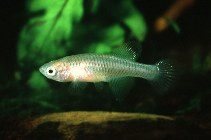
Espinas dorsales (total) : 0; Radios blandos dorsales (total) : 14 - 16; Espinas anales: 0; Radios blandos anales: 15 - 18. Diagnosis: Nothobranchius vosseleri is a member of a group of Nothobranchius species of relatively large size and with a slender body, less than 30% of standard length, compared to other species of the genus; and a distinct red caudal fin in male (Ref. 96650). It can be distinguished from other species of the so-called N. melanospilus group by a pointed snout, and the presence of a dark vertical bar through the iris (Ref. 96650).
Body shape (shape guide): fusiform / normal.
Nothobranchius vosseleri was observed from a wide variety of habitats, including ephemeral pools, temporary creeks, man-made ditches and small, probably permanent, streams; bordering vegetation of grasses and stands of Typha and Cyperus were found at all localities (Ref. 96650). It is an annual species, its annual reproduction was confirmed in the aquarium; eggs are, after a short courtship, deposited in the bottom substrate, which is mainly silt with an addition of decayed plant material (Ref. 96650). Like all other known Nothobranchius species, the eggs survive the dry season by delayed hatching; the majority of eggs are hatchable 8 to 10 weeks after spawning; growth is fast, after 6 to 7 weeks of age the young fishes may reproduce (Ref. 96650).
Life cycle and mating behavior
Madurez | Reproducción | Puesta | Huevos | Fecundidad | Larva
Wildekamp, R.H., B.R. Watters and I.F.N. Sainthouse, 1998. Redescription of Nothobranchius vosseleri (Cyprinodontiformes: Aplocheilidae), an annual fish from the Tanzanian coastal plains. Ichthyol. Explor. Freshwat. 8(4):289-298. (Ref. 96650)
IUCN Red List Status (Ref. 130435: Version 2025-1)
Threat to humans
Harmless
Human uses
Pesquerías: sin interés; Acuario: Comercial
Herramientas
Special reports
Download XML
Fuentes de Internet
Estimates based on models
Phylogenetic diversity index (Referencia
82804): PD
50 = 0.5000 [Uniqueness, from 0.5 = low to 2.0 = high].
Bayesian length-weight: a=0.01122 (0.00472 - 0.02669), b=2.94 (2.74 - 3.14), in cm total length, based on LWR estimates for this (Sub)family-body shape (Ref.
93245).
Nivel trófico (Referencia
69278): 3.2 ±0.4 se; based on size and trophs of closest relatives
Fishing Vulnerability (Ref.
59153): Low vulnerability (10 of 100).
🛈