أشلاق (القروش و الشفانين) (sharks and rays) >
Squatiniformes (Angel sharks) >
Squatinidae (Angel sharks)
Etymology: Squatina: Latin for skate, which angel sharks superficially resemble, presumably tautonymous with Squalus squatina Linnaeus 1758 (no species mentioned) (See ETYFish); occulta: Latin for hidden or concealed, referring to its identity having remained hidden among a group of morphologically similar sympatric species (See ETYFish).
Environment: milieu / climate zone / نطاق العمق / distribution range
البيئة
بحري القاع. Subtropical; 19°S - 34°S (Ref. 95520)
Southwest Atlantic: southern Brazil to southern Uruguay.
الحجم / وزن / العمر
النضج: Lm ? range ? - ? cm
Max length : 156.0 cm TL (female)
وصف مختصر
مفاتيح التعريف | الوصف الخارجي | قياسات المظهر الخارجي
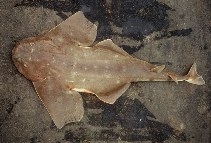
This species is distinguished by its unique dorsal color pattern, with a uniform light to dark brown background color, with numerous white to yellowish rounded, small spots on entire dorsal surface, some surrounded by many small black spots, forming irregular ocelli-like markings; differs from S. guggenheim by the smaller and more numerous white spots on entire dorsal surface, spot size one-half to eye-length (vs. less numerous spots about equal to eye to 1.5 eye-length in S. guggenheim), larger size at maturity > 100.0 cm (vs. 73.0-80.0 cm), dermal denticles over pectoral fins morphologically homogeneous, no sort of enlarged dermal denticle present (vs. a pair or more of enlarged dermal denticles close to dorsal pectoral origin), the dorsal midline with denticles morphologically similar to trunk denticles, or denticles over dorsal midline posterior to pectoral insertion slightly enlarged, the basal plate 1.5-2 times diameter of other dorsal denticles and organized in a row in some juveniles of S. occulta (vs. a row of enlarged, conical denticles over dorsal midline, morphologically distinct from other dorsal denticles, with basal plate 3-4 times that of other dorsal denticles, and a crown with several median ridges and acute non-ridged apex); differs from S. argentina by having a lighter background color, light to dark brown (vs. dark brown to reddish-brown), with a pair of enlarged, conical and morphologically distinct dermal denticles between spiracles, the basal plate 3-4 times diameter of other denticles, crown with several median ridges, and smooth and acute crown apex (vs. interspiracular surface covered by smaller dorsal denticles, without enlarged denticles), with lower number of tooth rows, 18-0 longitudinal tooth rows on upper jaw and 18-2 tooth rows on lower jaw, tooth formula: 9-9 to 10-10/9-9 to 11-11 (vs. 12-12/12-12 in S. argentina), and in almost all specimens, by anterior margin of pectoral fin straight to slightly convex (vs. anterior margin of pectoral fin convex in S. argentina) (Ref. 95520).
Cross section: angular.
Ovoviviparous (Ref. 50449). Max. length (Alfredo Carvalho Filho, pers. comm., 2002).
Life cycle and mating behavior
النضج | التكاثر | وضع البيض | بيض | الخصوبة | Larvae
Ovoviviparous, embryos feed solely on yolk (Ref. 50449).
Vaz, D.F.B. and M.R. De Carvalho, 2013. Morphological and taxonomic revision of species of Squatina from the Southwestern Atlantic Ocean (Chondrichthyes: Squatiniformes: Squatinidae). Zootaxa 3695(1):001-081. (Ref. 95520)
IUCN Red List Status (Ref. 130435: Version 2025-1)
استخدامات بشرية
أدوات
تقارير خاصة
Download XML
مصادر علي الأنترنت
Estimates based on models
Phylogenetic diversity index (مرجع
82804): PD
50 = 0.5000 [Uniqueness, from 0.5 = low to 2.0 = high].
Bayesian length-weight: a=0.00676 (0.00295 - 0.01551), b=3.07 (2.88 - 3.26), in cm total length, based on LWR estimates for this Genus-body shape (Ref.
93245).
مستوى غذائي (مرجع
69278): 4.1 ±0.6 se; based on size and trophs of closest relatives
المرونه (مرجع
120179): منخفض, الحد الزمني الأدني لتضاعف عدد أفراد المجتمع 4.5-14 سنة (Fec assumed to be <100).
Fishing Vulnerability (Ref.
59153): Very high vulnerability (90 of 100).
🛈