Environment: milieu / climate zone / profondeur / distribution range
Écologie
; eau douce démersal; potamodrome. Tropical; 11°S - 21°S
Africa: lower and middle Zambezi, Buzi, Pungwe (Ref. 52193), lower Sabi and Ludi Rivers (Ref. 42505), Luapula-Moero-Bangwelo (Zambian Congo system) (Ref. 42505, 52193). Also known from the Ruvuma and Rufiji rivers in Tanzania (Ref. 7248, 52193), lakes Malawi, Tanganyika (Ref. 4967, 52193) and Rukwa, and other eastward flowing rivers in Tanzania (Ref. 4967).
Length at first maturity / Taille / Poids / Âge
Maturité: Lm 34.0 range ? - ? cm
Max length : 75.0 cm SL mâle / non sexé; (Ref. 52193); poids max. publié: 10.0 kg (Ref. 52193)
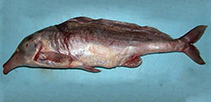
Épines dorsales (Total) : 0; Rayons mous dorsaux (Total) : 65 - 75; Épines anales: 0; Rayons mous anaux: 17 - 19. Diagnosis: dorsal fin greater than twice the length of anal fin; dorsal origin nearer tip of snout than caudal fin base; snout 2-2.5 times in head length; caudal peduncle less than 4 times in standard length (Ref. 52193).
Body shape (shape guide): fusiform / normal.
Found in caves and muddy areas, also hides among weeds (Ref. 13337). Favours quiet deep water with a soft muddy bottom (Ref. 52193). Forms shoals (Ref. 13337, 52193). Feeds on weeds (Ref. 5595) and insects but may also feed on small fishes (Ref. 5595, 52193) and fish eggs (Ref. 52193), blood worms (Ref. 13337), small crustaceans and mollusks (Ref. 13337, 52193). Active mainly at night; breeds during the rainy season, moving upstream in rivers after flood spates have receded (Ref. 52193). Migrations appears to occur at irregular interval as this fish is not a powerful swimmer and would not be able to cope with very high water current (Ref. 13337). Females carry 10,000-70,000 eggs; can give a mild shock when caught (Ref. 7248, 52193).
Life cycle and mating behavior
Maturité | Reproduction | Frai | Œufs | Fécondité | Larves
Gosse, J.-P., 1984. Mormyridae. p. 63-122. In J. Daget, J.-P. Gosse and D.F.E. Thys van den Audenaerde (eds.) Check-list of the freshwater fishes of Africa (CLOFFA). ORSTOM, Paris and MRAC, Tervuren. Vol. 1. (Ref. 3203)
Statut dans la liste rouge de l'IUCN (Ref. 130435: Version 2025-1)
Utilisations par l'homme
Pêcheries: commercial; pêche sportive: oui; Aquarium: Commercial
Outils
Articles particuliers
Télécharger en XML
Sources Internet
Estimates based on models
Phylogenetic diversity index (Réf.
82804): PD
50 = 0.5000 [Uniqueness, from 0.5 = low to 2.0 = high].
Bayesian length-weight: a=0.01288 (0.00707 - 0.02348), b=2.88 (2.72 - 3.04), in cm total length, based on LWR estimates for this species & Genus-body shape (Ref.
93245).
Niveau trophique (Réf.
69278): 3.3 ±0.46 se; based on food items.
Generation time: 4.9 ( na - na) years. Estimated as median ln(3)/K based on 1
growth studies.
Résilience (Réf.
120179): Milieu, temps minimum de doublement de population : 1,4 à 4,4 années (K=0.22).
Fishing Vulnerability (Ref.
59153): Moderate to high vulnerability (47 of 100).
🛈