Environment: milieu / Klimaatzone / Diepte / distribution range
Ecologie
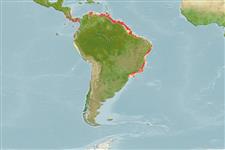
marien; zoet water; brak water pelagic-neritic; diepte 1 - 55 m, usually 5 - 30 m (Ref. 9298). Tropical; 14°N - 26°S, 87°W - 32°W (Ref. 189)
Western Atlantic: Panama to Trinidad and south to at least Santos, Brazil, perhaps further. Eastern Pacific: Costa Rica to the northern border of Peru at 3°34'S, perhaps further. Also found in freshwater.
Grootte / Gewicht / Leeftijd
Maturiteit: Lm ? range ? - ? cm
Max length : 24.0 cm TL mannelijk / geslacht onbekend; (Ref. 5217); common length : 20.0 cm TL mannelijk / geslacht onbekend; (Ref. 5217); max. gepubliceerd gewicht: 66.30 g (Ref. 118626)
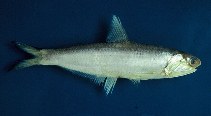
Dorsale stekels (totaal) : 0; Anale stekels: 0; Anale zachte stralen: 31 - 37. Snout about 3/4 eye diameter; maxilla long, tip pointed, reaching to or a little beyond edge of gill cover; anterior gill rakers mere stumps; hind border of gill cover with a small triangular projection; panamensis-type gill cover canals. Pectoral fin long; anal fin origin below midpoint of dorsal fin base. A silver stripe along flank in small individuals, disappearing with age (Ref. 189).
Body shape (shape guide): elongated; Cross section: oval.
A coastal species that apparently forms large schools. Enters brackish and fresh waters. Feeds on small fishes (including clupeoids) and prawns (Ref. 12225). Seems to spawn over an extended period in Costa Rica (small fishes caught in February, September and October). Marketed fresh (Ref. 9298).
Levenscyclus en paargedrag
Maturiteit | Voortplanting | Paaien | Eieren | Fecunditeit | Larven
Probably an extended spawning season in Costa Rica (small fishes caught in February, September and October (Ref. 189). Spawn in school (Ref. 205).
Whitehead, P.J.P., G.J. Nelson and T. Wongratana, 1988. FAO Species Catalogue. Vol. 7. Clupeoid fishes of the world (Suborder Clupeoidei). An annotated and illustrated catalogue of the herrings, sardines, pilchards, sprats, shads, anchovies and wolf-herrings. FAO Fish. Synop. 125(7/2):305-579. Rome: FAO. (Ref. 189)
Status op de Rode Lijst van het IUCN (Ref. 130435: Version 2025-1)
Gevaar voor de mens
Harmless
Gebruik door de mens
Visserij: van minder commercieel belang
Tools
Speciale rapporten
Download XML
Internetbronnen
Estimates based on models
Preferred temperature (Ref.
123201): 25.2 - 28.2, mean 27.4 °C (based on 122 cells).
Fylogenetische diversiteitsindex (Ref.
82804): PD
50 = 0.5000 [Uniqueness, from 0.5 = low to 2.0 = high].
Bayesian length-weight: a=0.00457 (0.00297 - 0.00704), b=3.17 (3.05 - 3.29), in cm total length, based on LWR estimates for this species & Genus-body shape (Ref.
93245).
Trofisch niveau (Ref.
69278): 4.1 ±0.71 se; based on food items.
Weerstandsvermogen (Ref.
120179): Hoog, minimale populatieverdubbelingstijd minder dan 15 maanden (Preliminary K or Fecundity.).
Fishing Vulnerability (Ref.
59153): Low vulnerability (14 of 100).
🛈
Nutrients (Ref.
124155): Calcium = 188 [109, 440] mg/100g; Iron = 1.38 [0.74, 2.46] mg/100g; Protein = 17.8 [15.4, 20.5] %; Omega3 = 0.338 [0.163, 0.725] g/100g; Selenium = 40.5 [18.0, 103.2] μg/100g; VitaminA = 19.3 [5.6, 54.8] μg/100g; Zinc = 1.51 [1.04, 2.18] mg/100g (wet weight);