This website uses cookies to enhance your browsing experience and ensure the functionality of our site. For more detailed information about the types of cookies we use and how we protect your privacy, please visit our Privacy Information page.
×
Cookie Settings
This website uses different types of cookies to enhance your experience. Please select your preferences below:
sub class Elasmobranchii (ฉลามและกระเบน) (sharks and rays) > Orectolobiformes (Carpet sharks) > Stegostomatidae (Zebra sharks)
Etymology: Stegostoma:stego (Gr.), cover; stoma (Gr.), mouth, referring to how “upper jaw is surmounted by a thick, membranous bulge” (translation), i.e., rounded snout conceals upper jaw and mouth opening (See ETYFish); tigrinum:Latin for of tigers, referring to the banded black-and-white pattern of juveniles [also known as S. fasciatum (Hermann 1783), a junior synonym] (See ETYFish). More on author: Forster.
Indo-West Pacific: Red Sea and East Africa to New Caledonia and Fiji, north to southern Japan, south to New South Wales, Australia. Recently recorded from Tonga (Ref. 53797). Also from Persian Gulf (Ref. 247).
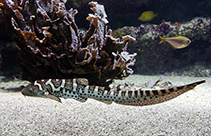
This species is distinguished by the following characters: a long caudal fin (49.9-54.2% TL), five dorsolateral ridges along the body, visible even in hatchlings; spiracles bean-shaped, large (length 0.4-1.7% TL); eyes small (length 0.9-2.1% TL); barbels two and short (0.6-2.8% TL); gill slits five, with fourth and fifth partly fused so only four noticeable from a distance; pectoral fins large (anterior margin length 10.4-19.1% TL), are broad and rounded; first dorsal fin originates far posteriorly above the pelvic fins; pectoral-fin rays of semi-plesodic structure, reaching ca. 66-88% of pectoral fin; vertebrae; total 207-262, monospondylous precaudal 43-49, diplospondylous precaudal 38-50, diplospondylous caudal 120-175, precaudal vertebrae 81-101; tooth rows on upper jaw 13-30, on lower jaw 22-30, and series count, upper jaw: 7-27, lower 8-16; ring-type intestine with 18-20 valvular turns. Two color morphs, with a three-stage ontogenetic color and pattern change: the Zebra morph with juveniles with dark brown background and cream colored bands (zebra-like), transitionals light brown with dark bands, broken up by dots and adults beige to yellow with spotted pattern (can be leopard-like); the sandy color morph: transitionals light beige background with swirly pattern of narrow, darker brown bands with tiny spots breaking up the pattern and with adults uniformly sandy beige with tiny dark brown freckles (Ref. 125658). Cross section: other (see remarks).
A tropical inshore shark found on sand, rubble, or coral bottoms of the continental and insular shelves (Ref. 247). Recorded to have entered freshwater (Ref. 4735). Rather sluggish at least during the day (Ref. 247). Probably nocturnal, feeds mainly on mollusks, but also small bony fishes (Ref. 9993). Also known to eat crustaceans (crabs and shrimps) and sea snakes (Ref. 43278). Oviparous (Ref. 43278, 50449). Slow-swimming and able to squirm into narrow cracks, crevices and channel in reefs while searching for food (Ref. 247). Readily kept in captivity (Ref. 247). May bite when provoked (Ref. 247). Utilized fresh and dried-salted for human consumption and also for fishmeal; livers processed for vitamins; fins dried for the oriental sharkfin trade; offal utilized for fishmeal (Ref. 247). Possibly reaching 354 cm TL (Ref. 9993, 47613). Caught in drift net intended for sharks (Ref. 47736). Reported from freshwater in the Philippines but needs to be confirmed (Ref. 43278).
Oviparous (Ref. 247). Egg cases are large, dark brown or purplish black, with longitudinal striations (Ref. 6871). Size at birth 20-26 cm TL (Ref. 9993).
Dahl, R.B., E.E. Sigsgaard, G. Mwangi, P.F. Thomsen, R.D. Jørgensen, F. de Oliveira Torquato, L. Olsen and P.R. Møller, 2019. The sandy zebra shark: A new color morph of the zebra shark Stegostoma tigrinum, with a redescription of the species and a revision of its nomenclature. Copeia, 107(3):524-541. (Ref. 125658)
สถานะบัญชีแดงของ IUCN (Ref. 130435: Version 2025-2 (Global))
อุณหภูมิที่ต้องการ (อ้างอิง 123201): 24.2 - 28.8, mean 27.6 °C (based on 956 cells).
ดัชนีความหลากหลายทางวิวัฒนาการ (อ้างอิง 82804): PD50 = 1.5000 [Uniqueness, from 0.5 = low to 2.0 = high].
Bayesian length-weight: a=0.00389 (0.00180 - 0.00842), b=3.12 (2.94 - 3.30), in cm total length, based on all LWR estimates for this body shape (Ref. 93245).
ระดับชั้นอาหาร (อ้างอิง 69278): 3.1 ±0.4 se; based on diet studies.
ความสามารถในการกลับคืนสู่ปกติ (อ้างอิง 120179): ต่ำ, เวลาต่ำสุดที่จะทำให้ประชากรเพิ่มขึ้นเป็น 2 เท่าใช้เวลา 4.5 - 14 ปี (Fec assumed to be <100).
ความเสี่ยงต่อการตกปลา (Ref. 59153): Very high vulnerability (90 of 100). 🛈