



Serranochromis jallae (Boulenger, 1896)
Nembwe
Sube tu fotos y Vídeos
Imágenes | Google image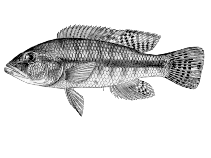 Serranochromis jallae
Foto de Mertens, P.
Imágenes | Google image
Foto de Mertens, P.
Clasificación / Nombres Nombres comunes | Sinónimos | Catalog of Fishes(Género, Especie) | ITIS | CoL | WoRMS | Cloffa
> Cichliformes (Cichlids, convict blennies) > Cichlidae (Cichlids) > Pseudocrenilabrinae
Etymology: Serranochromis: Latin, serra = saw + Greek, chromis = a fish, perhaps a perch (Ref. 45335).
Eponymy: Rev. Luigi (Louis) David Jalla (1860–1943) was an Italian protestant missionary for the Société des Missions Évangeliques, Paris. He was ordained (1886) and sent to Africa, being in Northern Rhodesia (Zambia) and Southern Rhodesia [...] (Ref. 128868), visit book page.
More on author: Boulenger.
Etymology: Serranochromis: Latin, serra = saw + Greek, chromis = a fish, perhaps a perch (Ref. 45335).
Eponymy: Rev. Luigi (Louis) David Jalla (1860–1943) was an Italian protestant missionary for the Société des Missions Évangeliques, Paris. He was ordained (1886) and sent to Africa, being in Northern Rhodesia (Zambia) and Southern Rhodesia [...] (Ref. 128868), visit book page.
More on author: Boulenger.
Entorno: milieu / zona climática / rango de profundidad / gama de distribución Ecología
; agua dulce demersal. Tropical
Distribución Territorios | Áreas FAO | Ecosistemas | Ocurrencias, apariciones | Mapa de puntos | Introducciones | Faunafri
Africa: Okavango, upper Zambezi, Kafue, Kasai and Zambian Congo systems (Ref. 11970, 13332, 94654, 97233, 97235, 128638), including upper Lualaba in Democratic Republic of the Congo (Ref. 97233) and Mweru-Bangweulu area of Upper Congo River basin (Ref. 95585, 97233); also Cunene River (Ref. 13332, 120641). It has been introduced to Lake Kariba and elsewhere in Zimbabwe (Ref. 94654, 128638), including Sabi River catchment (Ref. 13721), and to Shashi Dam in Botswana (Ref. 6465) and South Africa (Ref. 6465).
Tamaño / Peso / Edad
Madurez: Lm ? range ? - ? cm
Max length : 39.6 cm SL macho / no sexado; (Ref. 5693); peso máximo publicado: 4.0 kg (Ref. 128638)
Max length : 39.6 cm SL macho / no sexado; (Ref. 5693); peso máximo publicado: 4.0 kg (Ref. 128638)
Descripción breve Claves de identificación | Morfología | Morfometría
Espinas dorsales (total) : 15 - 17; Radios blandos dorsales (total) : 14 - 16; Espinas anales: 3; Radios blandos anales: 10 - 12. Diagnosis: The presence of four or five scale rows between the posterior margin of the orbit and the ascending arm of the preoperculum, the presence of widely set unicuspid teeth on the jaws, widely separated gill rakers, and anal fins with egg ocelli places this species in Serranochromis (Ref. 128638). Breeding males of S. jallae possess ocelli that are restricted to the posterior 4-5 membranes of the anal fin, which delimits them from all other Serranochromis species, which have ocelli throughout the anal fin in breeding males, with the exception of S. robustus (Ref. 128638). Serranochromis robustus generally has a longer lower jaw than S. jallae, 50.7-59.6% of head length vs. 49.2-52.7%; it is not as deep-bodied as S. jallae as evidenced by the distance between the posterior insertion of the dorsal fin and the posterior insertion of the anal fin, 13.4-15.1% of standard length in S. robustus vs. 14.9-18.4% in S. jallae; additionally, S. robustus has a narrower least caudal peduncle depth than S. jallae, 10.9-12.8% of standard length vs. 11.3-14.2%, the least caudal peduncle depth of all S. robustus was less than 12.8% of standard length while for S. jallae, except for the smallest specimen, the least caudal peduncle depth was greater than 13.2%; Serranochromis robustus has a smaller horizontal eye diameter than S. jallae, 17.7-27.4% of head length vs. 18.6-25.5%; in general, S. robustus has more teeth in the outer row of the left lower jaw than S. jallae, 14-23 vs. 13-14 (Ref. 128638). Adults in breeding colour of Serranochromis robustus are blue/green laterally with a narrow yellow marginal band on the dorsal fin and usually a small yellowish tip to the upper caudal-fin lobe; adults in breeding colour of S. jallae are yellow/green laterally with a bright orange marginal band on the dorsal and caudal fins in fish from the Okavango River system, but creamy yellow bands in fish from the upper Zambezi River system; the throat and belly of S. jallae becomes more intensely yellow-orange in breeding dress hence the local name 'yellow-belly'; rarely, specimens from the Okavango River in Namibia also have yellow rather than orange marginal bands (Ref. 128638).
Juveniles occur mostly on the floodplain and in lagoons and secondary channels, but larger adults appear to prefer mainstream habitats, like deep main channels and permanent lagoons,and are associated with in-stream structures such as woody debris, macrophyte beds, reeds, and eroded clay cliffs on outside bends of the rivers (Ref. 7248, 94654, 128638). Large specimens patrol open water of rivers and lakes, never very far from shore (Ref. 246) and live in well-vegetated quiet waters or near submerged trees or rocks in the lee of the river’s main current, lunging out to capture prey (Ref. 5614). Predator on fish but also feeds on aquatic and terrestrial insects, shrimps and small crabs (Ref. 13337). Adults often feed on squeakers (Ref. 7248, 13337, 94654). Mouthbrooder (Ref. 246, 13337, 13721) and multiple spawner (Ref. 13337). Constructs shallow nest on sandy or muddy substrate in shallow water (Ref. 13337). Reported to have adverse impact on native fish species in Zimbabwe (Ref. 94654).
Ciclo vital y comportamiento de apareamiento Madurez | Reproducción | Puesta | Huevos | Fecundidad | Larva
Incubates eggs in the mouth. Constructs a shallow concave nest on a sandy or muddy substrate in fairly shallow water.
Referencia principal
Suba sus referencias | Referencias | Coordinador : Kullander, Sven O. | Colaboradores
Stauffer, J.R. Jr., R. Bills, P.H. Skelton and O.L.F. Weyl, 2020. Re-evaluation to species level and redescription of Serranochromis jallae and Serranochromis robustus (Teleostei: Cichlidae). Zootaxa 4858(1):126-134. (Ref. 128638)
Situación en la Lista Roja de la UICN (Ref. 130435: Version 2025-2 (Global))
Least Concern (LC) ; Date assessed: 01 May 2009
CITES
Not Evaluated
Amenaza para el ser humano
Harmless
Usos humanos
Pesquerías: escaso valor comercial; Acuario: Comercial
FAO - Publication: search | FishSource |
Más información
Ecología Trófica
Alimentos (presas)
Composición de la dieta
consumo de alimento
Raciones de comida
Despredadores
Alimentos (presas)
Composición de la dieta
consumo de alimento
Raciones de comida
Despredadores
Dinámica de la población
Coeficiente del crecimiento para
Edades / tallas máximas
Longitud-peso rel.
Longitud-longitud rel.
Longitud-frecuencias
Conversión de masas
Reclutamiento
Abundancia
Coeficiente del crecimiento para
Edades / tallas máximas
Longitud-peso rel.
Longitud-longitud rel.
Longitud-frecuencias
Conversión de masas
Reclutamiento
Abundancia
Ciclo de vida
Reproducción
Madurez
Madurez/Gills rel.
Fecundidad
Puesta
Agregaciones de desove
Huevos
Desarrollo de los huevos
Larva
Dinámica larvaria
Reproducción
Madurez
Madurez/Gills rel.
Fecundidad
Puesta
Agregaciones de desove
Huevos
Desarrollo de los huevos
Larva
Dinámica larvaria
Distribución
Territorios
Áreas FAO
Ecosistemas
Ocurrencias, apariciones
Introducciones
BRUVS - Vídeos
Territorios
Áreas FAO
Ecosistemas
Ocurrencias, apariciones
Introducciones
BRUVS - Vídeos
Anatomía
Superficie branquial
Cerebro
Otolito
Superficie branquial
Cerebro
Otolito
Fisiología
Composición corporal
Nutrientes
Consumo del oxígeno
Tipo de natación
Velocidad de natación
Pigmentos visuales
Sonido de peces
Enfermedades y parásitos
Toxicidad (CL50)
Composición corporal
Nutrientes
Consumo del oxígeno
Tipo de natación
Velocidad de natación
Pigmentos visuales
Sonido de peces
Enfermedades y parásitos
Toxicidad (CL50)
Relacionados con el ser humano
Sistemas de acuicultura
Perfiles de acuicultura
Razas
Ciguatera cases
Sellos, monedas, varios
Sistemas de acuicultura
Perfiles de acuicultura
Razas
Ciguatera cases
Sellos, monedas, varios
Herramientas
Libro electrónico | Guía de campo | Asistente para frecuencias de tallas | Herramienta de ciclo de vida | Mapa de puntos |
Catch-MSY |
Informes especiales
Comprobar el mantenimiento del acuario | Buscar fichas sobre especies | Consulte las hojas informativas sobre acuicultura
Descargar XML
Fuentes de Internet
AFORO (otoliths) | Alien/Invasive Species database | Aquatic Commons | BHL | Cloffa | Websites from users | Check FishWatcher | CISTI | Catalog of Fishes: Género, Especie | DiscoverLife | ECOTOX | FAO - Publication: search | Faunafri | Fishipedia | Fishtrace | GloBI | Google Books | Google Scholar | Google | IGFA World Record | OneZoom | Open Tree of Life | Otolith Atlas of Taiwan Fishes | PubMed | Reef Life Survey | Socotra Atlas | TreeBase | Árbol de la vida | Wikipedia: Go, búsqueda | World Records Freshwater Fishing | Expediente Zoológico
Estimaciones basadas en modelos
Índice de diversidad filogenética (Referencia 82804): PD50 = 0.5000 [Uniqueness, from 0.5 = low to 2.0 = high].
Bayesian length-weight: a=0.01413 (0.00689 - 0.02895), b=3.01 (2.84 - 3.18), in cm total length, based on LWR estimates for this species & (Sub)family-body (Ref. 93245).
Nivel trófico (Referencia 69278): 4.1 ±0.7 se; based on size and trophs of closest relatives
Resiliencia (Referencia 120179): Medio, población duplicada en un tiempo mínimo de 1.4-4.4 años (Preliminary K or Fecundity.).