Environment: milieu / climate zone / نطاق العمق / distribution range
البيئة
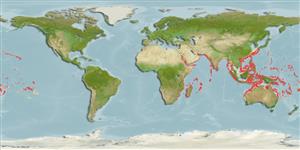
بحري مرتبطة بالشعاب; غير مهاجرة; نطاق العمق 80 - 370 m (Ref. 5222). Tropical; 31°N - 31°S, 30°E - 134°W (Ref. 5222)
Indo-Pacific: Red Sea and East Africa to the central Pacific. Epinephelus poecilonotus, Epinephelus radiatus, and Epinephelus tuamotoensis are sometimes referred to as this species.
الحجم / وزن / العمر
النضج: Lm ? range ? - ? cm
Max length : 90.0 cm TL ذكر/ مختلط الجنس; (Ref. 2871); common length : 60.0 cm TL ذكر/ مختلط الجنس; (Ref. 9137); أعلا وزن تم نشرة: 6.7 kg (Ref. 40637)
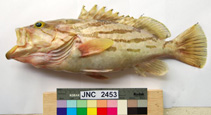
الأشواك الظهرية (المجموع) : 11; الأشعة الظهرية الناعمة (المجموع) : 14 - 15; شوكة شرجية: 3; أشعه شرجية لينه: 7 - 8. Distinguished by the following characteristics: head and body tan, with dark brown bands: bifurcate band that begins at rear edge of eye, upper branch extending to a dark brown saddle blotch on the nape just in front of dorsal fin, lower branch running to lower opercular spine and continuing on body as midlateral band that bifurcates above the pectoral fin, upper branch of this band running to a dark blotch at the base of 3rd to 7th dorsal fin rays; dark band from the upper edge of the operculum to base of 5th to 9th dorsal fin spines; narrow band from lower edge of eye to pectoral fin base, continued as broken band along lower part of body and curving up to the dorsal part of peduncle; broad band from maxillary groove to posterior end of interopercle; small dark brown spots often present in the pale areas between bands; depth of body contained 2.8-3.1 times in SL; head length 2.3-2.5 times in SL; flat to moderately convex interorbital area, dorsal head profile slightly convex; shallow indentation on preopercle just above the enlarged serrae at the angle; upper edge of operculum almost straight; maxilla reaches to or past vertical at rear edge of eye; 2 rows of teeth on midlateral part of lower jaw (Ref. 89707).
Body shape (shape guide): fusiform / normal; Cross section: oval.
Found in deep waters from 80-370 m on slopes of islands, sea mounts or continental shelves. Feeds on benthic fishes and large invertebrates (Ref. 89707). Considered rare in Tahiti but quite common in atolls (Ref. 4821). The species is easily confused with E. poecilonotus, E. radiatus, or E. tuamotuensis, three closely related deep-water groupers. Known to be ciguatoxic at Mauritius. Uncommon in local markets (probably due to it deep-water habitat).
Life cycle and mating behavior
النضج | التكاثر | وضع البيض | بيض | الخصوبة | Larvae
Heemstra, P.C. and J.E. Randall, 1993. FAO Species Catalogue. Vol. 16. Groupers of the world (family Serranidae, subfamily Epinephelinae). An annotated and illustrated catalogue of the grouper, rockcod, hind, coral grouper and lyretail species known to date. Rome: FAO. FAO Fish. Synop. 125(16):382 p. (Ref. 5222)
IUCN Red List Status (Ref. 130435: Version 2025-1)
خطر للأنسان
Reports of ciguatera poisoning (Ref. 5222)
استخدامات بشرية
مصائد: غير مهمة تجارياً; لعبة سمكه: نعم
أدوات
تقارير خاصة
Download XML
مصادر علي الأنترنت
Estimates based on models
Preferred temperature (مرجع
123201): 14.2 - 23.1, mean 19 °C (based on 305 cells).
Phylogenetic diversity index (مرجع
82804): PD
50 = 0.5000 [Uniqueness, from 0.5 = low to 2.0 = high].
Bayesian length-weight: a=0.01318 (0.00806 - 0.02156), b=3.03 (2.90 - 3.16), in cm total length, based on LWR estimates for this species & Genus-body shape (Ref.
93245).
مستوى غذائي (مرجع
69278): 4.0 ±0.65 se; based on food items.
Generation time: 5.0 ( na - na) years. Estimated as median ln(3)/K based on 1
growth studies.
المرونه (مرجع
120179): وسيط, الحد الزمني الأدني لتضاعف عدد أفراد المجتمع 1.4-4.4 سنة (Preliminary K or Fecundity.).
Fishing Vulnerability (Ref.
59153): Moderate vulnerability (43 of 100).
🛈
Climate Vulnerability (Ref.
125649): Very high vulnerability (86 of 100).
🛈
Nutrients (Ref.
124155): Calcium = 18.5 [8.7, 39.6] mg/100g; Iron = 0.44 [0.23, 0.88] mg/100g; Protein = 18.6 [17.1, 20.0] %; Omega3 = 0.138 [0.085, 0.226] g/100g; Selenium = 58.6 [32.9, 107.1] μg/100g; VitaminA = 123 [34, 423] μg/100g; Zinc = 1.01 [0.70, 1.43] mg/100g (wet weight);