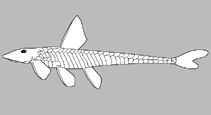
>
Siluriformes (Catfishes) >
Loricariidae (Armored catfishes) > Hypostominae
Etymology: Cordylancistrus: Greek, kordyle, -es = young tunna + Greek, agkistron = hook (Ref. 45335); perijae: The name perijae is derived from the geographical region of the type locality, the foothill rivers of the Sierra de Perijá, a branch of the Eastern Andes Mountains (Ref. 40935).
Issue
No later work.
Environment: milieu / Zona climática / intervalo de profundidade / distribution range
Ecologia
; Água doce demersal. Tropical; 18°C - 24°C (Ref. 40935)
South America: Palmar and Socuy River basins in the Lake Maracaibo drainage, Venezuela.
Tamanho / Peso / Idade
Maturidade: Lm ? range ? - ? cm
Max length : 12.7 cm SL macho/indeterminado; (Ref. 40935)
Descrição suscinta
Chaves de identificação | Morfologia | Morfometria
C. perijae can be distinguished from C. torbesensis by the combination of the following characters: Head and caudal peduncle less depressed, 17.93% and 11.02% respectively; odontodes of the interopercular area short, the longest not reaching beyond the base of the pectoral fin; four plates between the supraoccipital and the origin of the dorsal fin; uniform color pattern, brown or dark brown to black.
Body shape (shape guide): elongated; Cross section: angular.
Collected from mountain rivers associated to humid tropical areas. From transparent waters, with strong to moderate current with river beds formed by rocks, small stones and sand, scarce or absent aquatic vegetation (Ref. 40935).
Ciclo de vida ou comportamento de acasalamento
Maturidade | Reprodução | Desova | Ovos | Fecundidade | Larvas
Fisch-Muller, S., 2003. Loricariidae-Ancistrinae (Armored catfishes). p. 373-400. In R.E. Reis, S.O. Kullander and C.J. Ferraris, Jr. (eds.) Checklist of the Freshwater Fishes of South and Central America. Porto Alegre: EDIPUCRS, Brasil. (Ref. 36713)
Status na Lista Vermelha da UICN (Ref. 130435: Version 2025-1)
Ameaça para os humanos
Harmless
Uso pelos humanos
Pescarias: sem interesse
Ferramentas
Relatórios especiais
Baixar XML
Fontes da internet
Estimates based on models
Índice de diversidade filogenética (Ref.
82804): PD
50 = 0.5156 [Uniqueness, from 0.5 = low to 2.0 = high].
Bayesian length-weight: a=0.01549 (0.00719 - 0.03336), b=2.98 (2.81 - 3.15), in cm total length, based on LWR estimates for this (Sub)family-body shape (Ref.
93245).
Resiliência (Ref.
120179): médio(a), tempo mínimo de duplicação da população 1,4 - 4,4 anos (Preliminary K or Fecundity.).
Fishing Vulnerability (Ref.
59153): Low vulnerability (10 of 100).
🛈