>
Holocentriformes (Squirrelfishes, soldierfishes) >
Holocentridae (Squirrelfishes, soldierfishes) > Holocentrinae
Etymology: Sargocentron: Greek, sargos = sargus + Greek, kentron = sting (Ref. 45335).
More on author: Bleeker.
Environment: milieu / Zona climática / intervalo de profundidade / distribution range
Ecologia
marinhas associadas(os) a recifes; intervalo de profundidade 5 - 90 m (Ref. 27370). Tropical; 30°N - 24°S
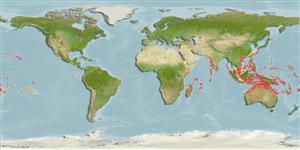
Indo-Pacific: Red Sea (Ref. 12541), Zanzibar (Tanzania), Aldabra and Seychelles to the Marshall Islands and American Samoa, north to Taiwan, southern Japan and the Ogasawara Islands, south to the southern Great Barrier Reef and the Chesterfield Islands. Replaced by Sargocentron marisrubri in the Red Sea (Ref. 37816).
Tamanho / Peso / Idade
Maturidade: Lm ? range ? - ? cm
Max length : 25.0 cm TL macho/indeterminado; (Ref. 90102)
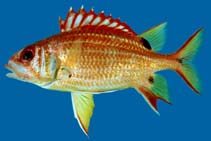
Espinhos dorsais (total) : 11; Raios dorsais (total) : 12 - 14; Espinhos anais: 4; Raios anais : 9 - 10. Body with red and white stripes following the scale rows; black blotch at base of soft dorsal, anal, and caudal fins, but may be faint or absent in caudal and anal fins (Ref. 4201, 48635). Uniformly small ctenii on posterior margin of scales of body. Inferior mouth due to hypertrophy of median part of upper lip (front of upper lip thickened and slightly protruding) (Ref. 3079). Five oblique scale rows on cheek; body depth 2.7-2.95 in SL; head length (HL) 2.6-2.9 in SL; snout length 3.6-4.4 in HL; interorbital width 4.4-5.25 in HL; slender caudal peduncle, depth 3.9-4.65 in HL; maxilla extending from below center of the eye to a vertical at rear edge of pupil, upper jaw length 2.25-2.4 in HL; premaxillary groove ending above or slightly posterior to a vertical at the front edge of orbit; anterior end of nasal bone ending with a small spine; surface or medial edge of nasal bone spineless; nasal fossa with 1 to 4 spinules on posterior edge; preopercular spine 3.45-3.65 in HL; longest dorsal spine 1.95-2.4 in HL; 3rd anal spine 1.5-1.75 in HL (Ref. 27370).
Body shape (shape guide): fusiform / normal; Cross section: compressed.
A relatively uncommon inhabitant of rocky reefs and coral-rich areas. Spine of preopercle venomous. Usually seen solitary , but sometimes forms schools in deep water in oceanic locations (Ref. 48635). Found in seaward slopes in 5-90 m (Ref. 90102).
Ciclo de vida ou comportamento de acasalamento
Maturidade | Reprodução | Desova | Ovos | Fecundidade | Larvas
Randall, J.E., 1998. Revision of the Indo-Pacific squirrelfishes (Beryciformes: Holocentridae: Holocentrinae) of the genus Sargocentron, with descriptions of four new species. Indo-Pac. Fish. (27):105 p. (Ref. 27370)
Status na Lista Vermelha da UICN (Ref. 130435: Version 2025-1)
Uso pelos humanos
Ferramentas
Relatórios especiais
Baixar XML
Fontes da internet
Estimates based on models
Preferred temperature (Ref.
123201): 24.8 - 28.9, mean 27.6 °C (based on 630 cells).
Índice de diversidade filogenética (Ref.
82804): PD
50 = 0.5000 [Uniqueness, from 0.5 = low to 2.0 = high].
Bayesian length-weight: a=0.01660 (0.00788 - 0.03495), b=2.97 (2.80 - 3.14), in cm total length, based on LWR estimates for this Genus-body shape (Ref.
93245).
Nível Trófico (Ref.
69278): 4.0 ±0.66 se; based on food items.
Resiliência (Ref.
120179): Elevada, tempo mínimo de duplicação da população menor que 15 meses (Preliminary K or Fecundity.).
Fishing Vulnerability (Ref.
59153): Low vulnerability (15 of 100).
🛈
Nutrients (Ref.
124155): Calcium = 51.8 [20.0, 215.6] mg/100g; Iron = 0.497 [0.196, 1.509] mg/100g; Protein = 18.8 [17.6, 19.9] %; Omega3 = 0.167 [0.073, 0.378] g/100g; Selenium = 36.5 [21.0, 70.9] μg/100g; VitaminA = 78.1 [30.5, 218.1] μg/100g; Zinc = 1.62 [0.67, 3.04] mg/100g (wet weight);