



Channichthys panticapaei Shandikov, 1995
Charcoal icefish
Uploaden van uw Foto's en video's
Afbeeldingen | Google afbeelding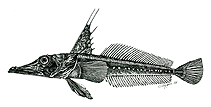 Channichthys panticapaei
Male Afbeelding van Shandikov, G.A.
Afbeeldingen | Google afbeelding
Male Afbeelding van Shandikov, G.A.
Classificatie / Namen Lokale namen | Synoniemen | Catalog of Fishes(Genus, Soort(en)) | ITIS | CoL | WoRMS | Cloffa
> Perciformes/Notothenioidei (Icefishes) > Channichthyidae (Crocodile icefishes)
Etymology: Channichthys: Greek, channe, -es = an anchovy + Greek, ichthys = fish (Ref. 45335).
Etymology: Channichthys: Greek, channe, -es = an anchovy + Greek, ichthys = fish (Ref. 45335).
Taxonomic Remarks
Validity of species questionnable (Ref. 45488).
Milieu: milieu / Klimaatzone / Diepte / verspreidingsgebied Ecologie
marien demersaal; diepte 112 - 154 m (Ref. 90860). Deep-water
Verspreiding Gebieden | FAO regio's | Ecosystemen | Voorkomen | Verspreidingskaart | Introducties | Faunafri
Southern Ocean, Sub-Antarctic: Kerguelen Islands.
Grootte / Gewicht / Leeftijd
Maturiteit: Lm ? range ? - ? cm
Max length : 40.2 cm TL mannelijk / geslacht onbekend; (Ref. 90860); 36.1 cm TL (female)
Max length : 40.2 cm TL mannelijk / geslacht onbekend; (Ref. 90860); 36.1 cm TL (female)
Korte beschrijving Determinatiesleutels | Morfologie | Morfometrie
Dorsale stekels (totaal) : 6 - 8; Dorsale zachte stralen (totaal) : 32 - 34; Anale zachte stralen: 29 - 32; Wervels: 55 - 57. This species is characterized by the following: D VI-VIII,32-34 (total); A 29-32; pectoral-fin rays 20-22; vertebrae: 55-57. It is distinguished by the following characters: interorbital width wide, 4.4-5.4 times in HL, wider than horizontal orbit diameter; eyes moderate in size, orbit 5.4-6.5 times in HL, and 2.6-3.1 in snout length and 1.1-1/4 in interorbital width; posterior edge of maxilla extending below 1/2 of the orbit diameter; two rows of rakers on the lower part of 1st gill arch on ceratobranchial and hypobranchial: 11-17 rakers in anterior row, 6-15 in posterior row, 18-31 total; first dorsal fin high, 3.2-5.1 times in SL, with 1st to 3rd spine longest; fin membrane of D1 not reaching tips of longest spines; well separated dorsal fins, posterior edge of D1 fin membrane not reaching 1st ray base of D2; very developed thick rounded bony plates in anterior part of median lateral line; strong bony tuberculation on frontals, dorsal spines, branchiostegals, pelvic rays, maxilla and dentary. Coloration dark-gray to uniformly blackish. (Ref. 90860, 90861, 90862).
Body shape (shape guide): elongated.
Body shape (shape guide): elongated.
A thalassobathyal, and planktivorous species. Stomach contents contain macroplankton, Parathemisto gaudichaudi and Thysanoessa macrura. It matures at about 30 cm TL (27 cm SL) and spawning probably takes place in June-July. Caught by bottom trawls. (Ref. 90860).
Levenscyclus en paargedrag Maturiteit | Voortplanting | Paaien | Eieren | Fecunditeit | Larven
Hoofdreferentie
Upload uw referenties | Referenties | Coördinator | Medewerkers
Shandikov, G.A., 1995. A new species of icefish, Channichthys panticapaei sp. n. (Channichthyidae, Notothenioidei) from the Kerguelen Island (Antarctica). Proceedings of the Southern Scientific Research Institute of Marine Fisheries & Oceanography (YugNIRO). Kerch. Special issue (1):1-9. (Ref. 90860)
CITES
Not Evaluated
Gevaar voor de mens
Harmless
Gebruik door de mens
FAO - Publication: search | FishSource |
Meer informatie
Trofische ecologie
Voedsel (prooien)
Dieetsamenstelling
Voedselconsumptie
Voedselrantsoenen
Predatoren
Voedsel (prooien)
Dieetsamenstelling
Voedselconsumptie
Voedselrantsoenen
Predatoren
Populatiedynamica
Groeiparameters
Max. leeftijden / maten
Lengte-gewicht rel.
Lengte-lengte rel.
Lengtefrequenties
Massaconversie
Rekrutering
Abundantie
Groeiparameters
Max. leeftijden / maten
Lengte-gewicht rel.
Lengte-lengte rel.
Lengtefrequenties
Massaconversie
Rekrutering
Abundantie
Levenscyclus
Voortplanting
Maturiteit
Rijpheid/kieuwen rel.
Fecunditeit
Paaien
Paaibestanden
Eieren
Ontwikkeling van de eieren
Larven
Larvale populatiedynamiek
Voortplanting
Maturiteit
Rijpheid/kieuwen rel.
Fecunditeit
Paaien
Paaibestanden
Eieren
Ontwikkeling van de eieren
Larven
Larvale populatiedynamiek
Anatomie
Kieuwoppervlak
Hersenen
Otoliet
Kieuwoppervlak
Hersenen
Otoliet
Fysiologie
Lichaamssamenstelling
Voedingsstoffen
Zuurstofverbruik
Type zwemmen
Zwemsnelheid
Visuele pigmenten
Vis geluid
Ziekten en parasieten
Toxiciteit (LC50)
Lichaamssamenstelling
Voedingsstoffen
Zuurstofverbruik
Type zwemmen
Zwemsnelheid
Visuele pigmenten
Vis geluid
Ziekten en parasieten
Toxiciteit (LC50)
Genetica
genoom
Genetica
Heterozygositeit
Erfelijkheid
Genetische diversiteit
genoom
Genetica
Heterozygositeit
Erfelijkheid
Genetische diversiteit
Menselijk gerelateerd
Aquacultuursystemen
Aquacultuurprofielen
Kweeklijnen
Ciguatera gevallen
Postzegels, munten, diversen.
Aquacultuursystemen
Aquacultuurprofielen
Kweeklijnen
Ciguatera gevallen
Postzegels, munten, diversen.
Tools
Speciale rapporten
Bekijk gegevens voor het houden in een aquarium | Bekijk Fact Sheets voor de soort | Bekijk Aquacultuur Fact Sheets
Download XML
Internetbronnen
AFORO (otoliths) | Aquatic Commons | BHL | Cloffa | Websites from users | Bekijk FishWatcher | CISTI | Catalog of Fishes: Genus, Soort(en) | DiscoverLife | ECOTOX | FAO - Publication: search | Faunafri | Fishipedia | Fishtrace | GloBI | Google Books | Google Scholar | Google | IGFA World Record | OneZoom | Open Tree of Life | Otolith Atlas of Taiwan Fishes | PubMed | Reef Life Survey | Socotra Atlas | TreeBase | Tree of Life | Wikipedia: ga naar, zoek | World Records Freshwater Fishing | Zoobank | Zoological Record
Schattingen op basis van modellen
Fylogenetische diversiteitsindex (Ref. 82804): PD50 = 0.5020 [Uniqueness, from 0.5 = low to 2.0 = high].
Bayesian length-weight: a=0.00129 (0.00059 - 0.00280), b=3.46 (3.28 - 3.64), in cm total length, based on LWR estimates for this (Sub)family-body shape (Ref. 93245).
Trofisch niveau (Ref. 69278): 3.7 ±0.6 se; based on size and trophs of closest relatives
Weerstandsvermogen (Ref. 120179): Gemiddeld, minimale populatieverdubbelingstijd 1,4-4,4 jaar (Preliminary K or Fecundity.).