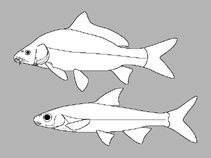
Classification / Names
आम नाम | उपशब्द | Catalog of Fishes(वर्ग, प्रजाति) | ITIS | CoL | WoRMS | Cloffa
>
Cypriniformes (Carps) >
Cyprinidae (Minnows or carps) > Smiliogastrinae
Etymology: Hampala: Local name from Java; in Van Hasselt, "Poissons of Java", 1823.
Eponymy: G A Lopez was a collector for the Philippines Bureau of Science. [...] (Ref. 128868), visit book page.
More on author: Herre.
Environment: milieu / climate zone / गहराई सीमा / distribution range
पारिस्थितिकी
; स्वच्छ जल, अलवण जल बेनथोपिलाजिक. Tropical
Asia: Borneo to Indo-China and Siam; Langbuan, Busuanga, Philippines.
आकार / वज़न / Age
परिपक्व अवधि: Lm ? range ? - ? cm
Max length : 8.5 cm SL पुल्लिंग / अलिंग; (Ref. 2929)
Short description
पहचान कुंजी | आकृति विज्ञान | मौरफोमैटरिक्स
पृष्ठीय रीढ़ (सम्पूर्ण) : 3; पृष्ठीय सौफट रेज़ (सम्पूर्ण) : 8; गुदा कांटा: 3; ऐनल सौफट रेज़: 5. Preserved color very dark dorsally, silver gray to brown on sides, pale below, whitish belly, yellowish glints under head and tail; tip of pointed snout black; fins hyaline. Upper lip strongly protractile. 10 scales from nape to dorsal.
Body shape (shape guide): elongated; Cross section: compressed.
Life cycle and mating behavior
परिपक्व अवधि | पुनरुत्पत्ति | मछलीऔ का अंडे देना | अंडे | Fecundity | लार्वा
Herre, A.W.C.T., 1924. Distribution of the true freshwater fishes in the Philippines. I. The Philippine Cyprinidae. Philipp. J. Sci. 24(3):249-307. (Ref. 2929)
IUCN Red List Status (Ref. 130435: Version 2025-1)
Threat to humans
Harmless
Human uses
साधन
Special reports
Download XML
इंटरनेट स्रोत
Estimates based on models
Phylogenetic diversity index (संदर्भ
82804): PD
50 = 0.5039 [Uniqueness, from 0.5 = low to 2.0 = high].
Bayesian length-weight: a=0.00562 (0.00253 - 0.01250), b=3.09 (2.89 - 3.29), in cm total length, based on LWR estimates for this (Sub)family-body shape (Ref.
93245).
Trophic level (संदर्भ
69278): 3.5 ±0.6 se; based on size and trophs of closest relatives
लौटाव (संदर्भ
120179): ऊंचा, न्यूनतम जनसंख्या दुगनी समय अवलागत 15 महीने। (Preliminary K or Fecundity.).
Fishing Vulnerability (Ref.
59153): Low vulnerability (10 of 100).
🛈