>
Blenniiformes (Blennies) >
Tripterygiidae (Triplefin blennies) > Tripterygiinae
Etymology: Enneapterygius: Greek, ennea = nine times + Greek, pterygion = little fin (Ref. 45335).
More on author: Fricke.
Environment: milieu / climate zone / rango de profundidad / distribution range
Ecología
marino asociado a arrecife; rango de profundidad 0 - 18 m (Ref. 27223). Tropical
Western Pacific: Japan, Taiwan, Philippines, Indonesia, Papua New Guinea, Australia, Palau, and Guam.
Tamaño / Peso / Age
Madurez: Lm ? range ? - ? cm
Max length : 4.0 cm TL macho / no sexado; (Ref. 90102)
Short description
Claves de identificación | Morfología | Morfometría
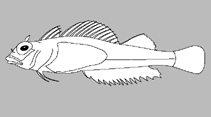
Espinas dorsales (total) : 14 - 18; Radios blandos dorsales (total) : 6 - 11; Espinas anales: 1; Radios blandos anales: 16 - 20. Male with reddish head and body, row of white blotches along side, additional row of white saddles on back, blackish tail, and black "mask" on front and lower half of head. Female translucent yellowish or orange with faint dark saddles/streaks on back. Dorsal rays III + XI-XV + 6-11; anal rays I,16-20; pectoral rays 16-18; pelvic rays I,2; lateral line interrupted, 13-20 + 13-22; head, chest, and pectoral-fin base scaleless; simple orbital tentacle present; mandibular pores 3-6 + 2-8 + 3-6. Maximum size to 4 cm TL (Ref. 90102).
Body shape (shape guide): elongated.
Adults occur in shallow waters, mainly on the reef flat or crest. They are found on shady vertical rock walls with some current and relatively high oxygen level (Ref. 27223). Eggs are hemispherical and covered with numerous sticky threads that anchor them in the algae on the nesting sites (Ref. 240). Larvae are planktonic which occur primarily in shallow, nearshore waters (Ref. 94114).
Life cycle and mating behavior
Madurez | Reproducción | Puesta | Huevos | Fecundidad | Larva
Fricke, R., 1997. Tripterygiid fishes of the western and central Pacific, with descriptions of 15 new species, including an annotated checklist of world Tripterygiidae (Teleostei). Theses Zool. 29:1-607. (Ref. 27223)
IUCN Red List Status (Ref. 130435: Version 2025-1)
Threat to humans
Harmless
Human uses
Pesquerías: sin interés
Herramientas
Special reports
Download XML
Fuentes de Internet
Estimates based on models
Preferred temperature (Referencia
123201): 24.7 - 29.3, mean 28.5 °C (based on 1586 cells).
Phylogenetic diversity index (Referencia
82804): PD
50 = 0.5000 [Uniqueness, from 0.5 = low to 2.0 = high].
Bayesian length-weight: a=0.00617 (0.00288 - 0.01322), b=3.04 (2.86 - 3.22), in cm total length, based on LWR estimates for this (Sub)family-body shape (Ref.
93245).
Nivel trófico (Referencia
69278): 3.1 ±0.3 se; based on size and trophs of closest relatives
Resiliencia (Referencia
120179): Alto, población duplicada en un tiempo mínimo inferior a 15 meses (Preliminary K or Fecundity.).
Fishing Vulnerability (Ref.
59153): Low vulnerability (10 of 100).
🛈