



Uploaden van uw Foto's en video's
Afbeeldingen | Google afbeelding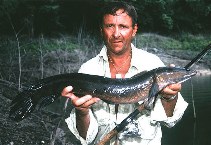 Channa marulius
Afbeelding van Jean-Francois Helias / Fishing Adventures Thailand
Afbeeldingen | Google afbeelding
Afbeelding van Jean-Francois Helias / Fishing Adventures Thailand
Classificatie / Namen Lokale namen | Synoniemen | Catalog of Fishes(Genus, Soort(en)) | ITIS | CoL | WoRMS | Cloffa
> Anabantiformes (Gouramies, snakeheads) > Channidae (Snakeheads)
Etymology: Channa: Greek, channe, -es = an anchovy (Ref. 45335).
More on author: Hamilton.
Etymology: Channa: Greek, channe, -es = an anchovy (Ref. 45335).
More on author: Hamilton.
Milieu: milieu / Klimaatzone / Diepte / verspreidingsgebied Ecologie
Verspreiding Gebieden | FAO regio's | Ecosystemen | Voorkomen | Verspreidingskaart | Introducties | Faunafri
Grootte / Gewicht / Leeftijd
Maturiteit: Lm ? range ? - ? cm
Max length : 183 cm TL mannelijk / geslacht onbekend; (Ref. 6351); common length : 46.0 cm TL mannelijk / geslacht onbekend; (Ref. 4833); max. gepubliceerd gewicht: 30.0 kg (Ref. 4833)
Max length : 183 cm TL mannelijk / geslacht onbekend; (Ref. 6351); common length : 46.0 cm TL mannelijk / geslacht onbekend; (Ref. 4833); max. gepubliceerd gewicht: 30.0 kg (Ref. 4833)
Korte beschrijving Determinatiesleutels | Morfologie | Morfometrie
Body shape (shape guide): elongated.
Obligate air-breathing (Ref. 126274); Adults occur in sluggish or standing water in canals, lakes, and swamps (Ref. 12693). Theyinhabit waters with submerged aquatic vegetation (Ref. 12693). Usually found only in deep pools in rivers and occasionally in lakes. They enter flooded forest (Ref. 9497). Carnivorous and subsist on fish, frogs, snakes, insects, earthworms and tadpoles (Ref. 1479). There are reports of this species taking water birds, snakes, and rodents. Males are territorial. May bite when caught (Elliot Bligh, pers. comm., 2001).
Levenscyclus en paargedrag Maturiteit | Voortplanting | Paaien | Eieren | Fecunditeit | Larven
Builds floating nest of weeds and leaves where the orange-yellow eggs are deposited. Eggs hatch in 36 to 48 hours and fry remain in the nest for about 10 days after hatching. Parents guards the fry for about a month.
Hoofdreferentie
Upload uw referenties | Referenties | Coördinator | Medewerkers
Kottelat, M., 2013. The fishes of the inland waters of Southeast Asia: a catalogue and core bibliography of the fishes known to occur in freshwaters, mangroves and estuaries. The Raffles Bulletin of Zoology 2013 (Suppl. 27):1-663. (Ref. 94476)
Status op de Rode Lijst van het IUCN (Ref. 130435: Version 2025-2 (Global))
Niet bedreigd (LC) ; Date assessed: 06 October 2009
CITES
Not Evaluated
Gevaar voor de mens
Traumatogenic
Gebruik door de mens
Visserij: commercieel; Aquacultuur: commercieel; sportvis: ja; Aquarium: Publieke aquaria
FAO - Publication: search | FishSource |
Meer informatie
Trofische ecologie
Voedsel (prooien)
Dieetsamenstelling
Voedselconsumptie
Voedselrantsoenen
Predatoren
Voedsel (prooien)
Dieetsamenstelling
Voedselconsumptie
Voedselrantsoenen
Predatoren
Populatiedynamica
Groeiparameters
Max. leeftijden / maten
Lengte-gewicht rel.
Lengte-lengte rel.
Lengtefrequenties
Massaconversie
Rekrutering
Abundantie
Groeiparameters
Max. leeftijden / maten
Lengte-gewicht rel.
Lengte-lengte rel.
Lengtefrequenties
Massaconversie
Rekrutering
Abundantie
Levenscyclus
Voortplanting
Maturiteit
Rijpheid/kieuwen rel.
Fecunditeit
Paaien
Paaibestanden
Eieren
Ontwikkeling van de eieren
Larven
Larvale populatiedynamiek
Voortplanting
Maturiteit
Rijpheid/kieuwen rel.
Fecunditeit
Paaien
Paaibestanden
Eieren
Ontwikkeling van de eieren
Larven
Larvale populatiedynamiek
Anatomie
Kieuwoppervlak
Hersenen
Otoliet
Kieuwoppervlak
Hersenen
Otoliet
Fysiologie
Lichaamssamenstelling
Voedingsstoffen
Zuurstofverbruik
Type zwemmen
Zwemsnelheid
Visuele pigmenten
Vis geluid
Ziekten en parasieten
Toxiciteit (LC50)
Lichaamssamenstelling
Voedingsstoffen
Zuurstofverbruik
Type zwemmen
Zwemsnelheid
Visuele pigmenten
Vis geluid
Ziekten en parasieten
Toxiciteit (LC50)
Menselijk gerelateerd
Aquacultuursystemen
Aquacultuurprofielen
Kweeklijnen
Ciguatera gevallen
Postzegels, munten, diversen.
Aquacultuursystemen
Aquacultuurprofielen
Kweeklijnen
Ciguatera gevallen
Postzegels, munten, diversen.
Tools
Biologische quiz | E-boek | Veldgids | Lengtefrequentie Tool | Levenscyclus tool | Verspreidingskaart |
Vangst-MSY |
Speciale rapporten
Bekijk gegevens voor het houden in een aquarium | Bekijk Fact Sheets voor de soort | Bekijk Aquacultuur Fact Sheets
Download XML
Internetbronnen
AFORO (otoliths) | Exoten/Invasieve soorten database | Aquatic Commons | BHL | Cloffa | Websites from users | Bekijk FishWatcher | CISTI | Catalog of Fishes: Genus, Soort(en) | DiscoverLife | ECOTOX | FAO - Publication: search | Faunafri | Fishipedia | Fishtrace | GloBI | Google Books | Google Scholar | Google | IGFA World Record | OneZoom | Open Tree of Life | Otolith Atlas of Taiwan Fishes | PubMed | Reef Life Survey | Socotra Atlas | TreeBase | Tree of Life | Wikipedia: ga naar, zoek | World Records Freshwater Fishing | Zoological Record
Schattingen op basis van modellen
Fylogenetische diversiteitsindex (Ref. 82804): PD50 = 0.5000 [Uniqueness, from 0.5 = low to 2.0 = high].
Bayesian length-weight: a=0.00708 (0.00435 - 0.01153), b=2.92 (2.78 - 3.06), in cm total length, based on LWR estimates for this species & Genus-body shape (Ref. 93245).
Trofisch niveau (Ref. 69278): 4.5 ±0.80 se; based on food items.
Generation time: 4.8 ( na - na) years. Estimated as median ln(3)/K based on 1 growth studies.
Weerstandsvermogen (Ref. 120179): Gemiddeld, minimale populatieverdubbelingstijd 1,4-4,4 jaar (K=0.23).
Voedingsstoffen (Ref. 124155): Calcium = 34 [15, 87] mg/100g; Iron = 0.767 [0.514, 1.242] mg/100g; Protein = 18.3 [17.3, 19.4] %; Omega3 = 0.198 [0.080, 0.492] g/100g; Selenium = 54.1 [21.9, 128.7] μg/100g; VitaminA = 55.8 [20.4, 150.1] μg/100g; Zinc = 0.697 [0.481, 1.074] mg/100g (wet weight); based on nutrient studies.