>
Gadiformes (Cods) >
Bathygadidae (Rattails)
Etymology: Bathygadus: Greek, bathys = deep + Latin, gadus = a fish; cod? (Ref. 45335).
Eponymy: Professor Léon Louis Vaillant (1834–1914) was a French herpetologist, ichthyologist and malacologist at the Muséum National d’Histoire Naturelle, Paris, well known for his researches in East Indian ichthyology. [...] (Ref. 128868), visit book page.
More on author: Vaillant.
Environment: milieu / climate zone / profondeur / distribution range
Écologie
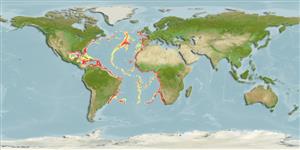
marin bathydémersal; non migrateur; profondeur 400 - 2600 m (Ref. 3587), usually 700 - 1400 m (Ref. 3587). Deep-water; 53°N - 34°S, 98°W - 20°E
Atlantic Ocean: Eastern Atlantic: Ireland to South Africa. Western Atlantic: Gulf of Mexico, Caribbean Sea, off Suriname (Ref. 3587). Often confused with Bathygadus favosus Goode & Bean, 1886.
Taille / Poids / Âge
Maturité: Lm ? range ? - ? cm
Max length : 50.0 cm TL mâle / non sexé; (Ref. 6187)
This species does not have light organs. The head is large; eyes are large, about equal in diameter to the interorbital space. The snout is blunt with the lower jaw slightly projecting. The body tapers quite abruptly from behind the pectoral fin. Body color is light brown. The fin membranes, branchiostegal membrane, gill chamber and body cavity color is black. Also Ref. 2800.
Body shape (shape guide): elongated; Cross section: oval.
Feeds on mysids, pelagic copepods, chaetognaths and small shrimps (Ref. 3587). Minimum depth reported from Ref. 1371.
Life cycle and mating behavior
Maturité | Reproduction | Frai | Œufs | Fécondité | Larves
Cohen, D.M., T. Inada, T. Iwamoto and N. Scialabba, 1990. FAO species catalogue. Vol. 10. Gadiform fishes of the world (Order Gadiformes). An annotated and illustrated catalogue of cods, hakes, grenadiers and other gadiform fishes known to date. FAO Fish. Synop. 125(10). Rome: FAO. 442 p. (Ref. 1371)
Statut dans la liste rouge de l'IUCN (Ref. 130435: Version 2025-1)
Menace pour l'homme
Harmless
Utilisations par l'homme
Pêcheries: sans intérêt
Outils
Articles particuliers
Télécharger en XML
Sources Internet
Estimates based on models
Preferred temperature (Réf.
123201): 3.5 - 9.8, mean 5.1 °C (based on 223 cells).
Phylogenetic diversity index (Réf.
82804): PD
50 = 0.5001 [Uniqueness, from 0.5 = low to 2.0 = high].
Bayesian length-weight: a=0.00372 (0.00141 - 0.00976), b=3.11 (2.88 - 3.34), in cm total length, based on LWR estimates for this (Sub)family-body shape (Ref.
93245).
Niveau trophique (Réf.
69278): 3.3 ±0.42 se; based on food items.
Fishing Vulnerability (Ref.
59153): Moderate vulnerability (40 of 100).
🛈
Nutrients (Ref.
124155): Calcium = 23.4 [13.6, 60.4] mg/100g; Iron = 0.471 [0.202, 0.993] mg/100g; Protein = 16.3 [14.5, 17.9] %; Omega3 = 0.236 [0.110, 0.500] g/100g; Selenium = 26.7 [10.1, 63.7] μg/100g; VitaminA = 14.5 [2.8, 71.9] μg/100g; Zinc = 0.41 [0.25, 0.66] mg/100g (wet weight);