>
Perciformes/Scorpaenoidei (Scorpionfishes) >
Sebastidae (Rockfishes, rockcods and thornyheads) > Sebastinae
Etymology: Sebastes: Greek, sebastes = august, venerable (Ref. 45335); entomelas: Species name from the Greek ento and melas, meaning 'within' and 'black' (Ref. 27436).
More on authors: Jordan & Gilbert.
Environment: milieu / climate zone / rango de profundidad / distribution range
Ecología
marino pelagic-neritic; rango de profundidad 0 - 549 m (Ref. 27437). Temperate; 60°N - 32°N
Northeast Pacific: middle Albatross Bank in the Gulf of Alaska to Todos Santos Bay, Baja California, Mexico.
Length at first maturity / Tamaño / Peso / Age
Madurez: Lm 36.0, range 29 - ? cm
Max length : 60.0 cm TL macho / no sexado; (Ref. 9015); edad máxima reportada: 60 años (Ref. 39247)
Short description
Claves de identificación | Morfología | Morfometría
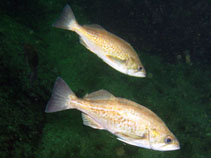
Espinas dorsales (total) : 13; Radios blandos dorsales (total) : 14 - 16; Espinas anales: 3; Radios blandos anales: 8 - 10. Head spines weak - nasal, preocular spines present, parietals usually present, supraocular, postocular and tympanic spines usually absent, coronal and nuchal spines absent (Ref. 27437). Interorbital space convex, sloped; no symphyseal knob; caudal peduncle narrow; anal fin with a strong posterior slant (Ref. 27437). Caudal fin indented (Ref. 6885). Gold brown to dusky, light ventrally; membranes of fins dark, lighter on spinous dorsal (Ref. 27437).
Body shape (shape guide): fusiform / normal.
A generally active and free-swimming rockfish found in midwater above a rocky reef or steep shoreline; occasionally huddling motionless among caves and crevices (Ref. 27436). Young are found in shallow water (Ref. 2850). Form schools (Ref. 2850). Feed mostly on small pelagic crustaceans and fishes (Ref. 2850). Viviparous (Ref. 34817). Marketed fresh and frozen; eaten pan-fried, boiled, microwaved and baked (Ref. 9988).
Eschmeyer, W.N., E.S. Herald and H. Hammann, 1983. A field guide to Pacific coast fishes of North America. Boston (MA, USA): Houghton Mifflin Company. xii+336 p. (Ref. 2850)
IUCN Red List Status (Ref. 130435: Version 2025-1)
Threat to humans
Harmless
Human uses
Pesquerías: comercial; pesca deportiva: si; Acuario: Acuarios públicos
Herramientas
Special reports
Download XML
Fuentes de Internet
Estimates based on models
Preferred temperature (Referencia
123201): 3.4 - 8.6, mean 5.6 °C (based on 213 cells).
Phylogenetic diversity index (Referencia
82804): PD
50 = 0.5000 [Uniqueness, from 0.5 = low to 2.0 = high].
Bayesian length-weight: a=0.01000 (0.00495 - 0.02022), b=3.09 (2.92 - 3.26), in cm total length, based on LWR estimates for this Genus-body shape (Ref.
93245).
Nivel trófico (Referencia
69278): 3.7 ±0.3 se; based on diet studies.
Resiliencia (Referencia
120179): Muy bajo, población duplicada en un tiempo mínimo superior a 14 años (tm=6; tmax=60; also Musick et al. 2000 (Ref.
36717)).
Prior r = 0.06, 95% CL = 0.04 - 0.09, Based on 1 full stock assessment.
Fishing Vulnerability (Ref.
59153): Moderate vulnerability (44 of 100).
🛈
Climate Vulnerability (Ref.
125649): Low to moderate vulnerability (35 of 100).
🛈
Nutrients (Ref.
124155): Calcium = 18.8 [8.2, 52.3] mg/100g; Iron = 0.271 [0.116, 0.604] mg/100g; Protein = 18.2 [17.0, 19.4] %; Omega3 = 1.33 [0.53, 3.32] g/100g; Selenium = 35.7 [14.5, 90.3] μg/100g; VitaminA = 24.4 [8.0, 73.0] μg/100g; Zinc = 0.394 [0.214, 0.705] mg/100g (wet weight);