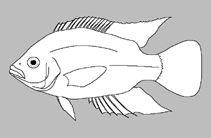
Klassifizierung / Names
Namen | Synonyme | Catalog of Fishes(Gattung, Arten) | ITIS | CoL | WoRMS | Cloffa
>
Cichliformes (Cichlids, convict blennies) >
Cichlidae (Cichlids) > Pseudocrenilabrinae
Etymology: Mchenga: Name from Chichewa, the indigenous language of Malawi; mchenga (sand), was chosen to indicate the type of bowers constructed by the members of this genus. Gender is feminine.
Environment: milieu / climate zone / Tiefenbereich / distribution range
Ökologie
; süßwasser benthopelagisch; tiefenbereich 10 - 15 m (Ref. 58018). Tropical
Africa: Lake Malawi.
Size / Gewicht / Alter
Geschlechtsreife: Lm ? range ? - ? cm
Max length : 7.8 cm SL Männchen/unbestimmt; (Ref. 27597)
Rückenflossenstacheln (insgesamt) : 16 - 17; Rückenflossenweichstrahlen (insgesamt) : 10 - 12; Afterflossenweichstrahlen: 9. Diagnosis: yellow ocelli on anal fin of females and non-breeding males; juveniles and females with hyaline fins; breeding male without black markings in caudal fin (Ref. 57549). 10-16 gill rakers on first ceratobranchial (Ref. 57549), 4-5 on epibranchial (Ref. 27597). Teeth in outer rows on dentary and premaxilla of mature males small and bicuspid (Ref. 57549).
Body shape (shape guide): fusiform / normal.
Forages in the water column, feeding mainly on zooplankton (Ref. 27597).
Life cycle and mating behavior
Geschlechtsreife | Fortpflanzung | Ablaichen | Eier | Fecundity | Larven
Male builds cone-shaped bowers in breeding arenas on the rock/sand interface at water depths of 15-25 m.
Stauffer, J.R. Jr., T.J. LoVullo and K.R. McKaye, 1993. Three new sand-dwelling cichlids from Lake Malawi, Africa, with a discussion of the status of the genus Copadichormis (Teleostei: Cichlidae). Copeia 1993(4):1017-1027. (Ref. 27597)
IUCN Rote Liste Status (Ref. 130435: Version 2025-1)
Bedrohung für Menschen
Harmless
Nutzung durch Menschen
Tools
Zusatzinformationen
Download XML
Internet Quellen
Estimates based on models
Phylogenetic diversity index (Ref.
82804): PD
50 = 0.5156 [Uniqueness, from 0.5 = low to 2.0 = high].
Bayesian length-weight: a=0.01445 (0.00674 - 0.03099), b=2.99 (2.82 - 3.16), in cm total length, based on LWR estimates for this (Sub)family-body shape (Ref.
93245).
Trophic level (Ref.
69278): 3.4 ±0.45 se; based on food items.
Widerstandsfähigkeit (Ref.
120179): hoch, Verdopplung der Population dauert weniger als 15 Monate. (Preliminary K or Fecundity.).
Fishing Vulnerability (Ref.
59153): Low vulnerability (10 of 100).
🛈