



Envoyez vos Photos et vidéos
Images | Images Google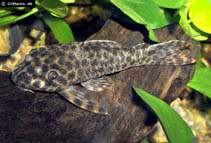 Peckoltia bachi
Photo de JJPhoto
Images | Images Google
Photo de JJPhoto
Classification / Noms Noms communs | Synonymes | Catalog of Fishes(Genre, Espèce) | ITIS | CoL | WoRMS | Cloffa
> Siluriformes (Catfishes) > Loricariidae (Armored catfishes) > Hypostominae
Etymology: Peckoltia: Because of Gustavo Peckolt,member of the Natural History Commission of Rondon (Ref. 45335).
Eponymy: Gustavo Peckolt (1861–1923) was a Brazilian-born German botanist and pharmacist. [...] (Ref. 128868), visit book page.
More on author: Boulenger.
Etymology: Peckoltia: Because of Gustavo Peckolt,member of the Natural History Commission of Rondon (Ref. 45335).
Eponymy: Gustavo Peckolt (1861–1923) was a Brazilian-born German botanist and pharmacist. [...] (Ref. 128868), visit book page.
More on author: Boulenger.
Environnement : milieu / zone climatique / profondeur / gamme de distribution Écologie
; eau douce démersal. Tropical
Distribution Territoires | Zones FAO | Écosystèmes | Occurrences | Carte par point | Introductions | Faunafri
South America: throughout the upper Amazon and its tributaries in Brazil, Colombia, Ecuador, and Peru. A single specimen collected from the Río Meta system near Villavicencio, Colombia seems questionable since no other specimens have been collected in the Orinoco basin.
Taille / Poids / Âge
Description synthétique Clés d'identification | Morphologie | Morphométrie
Épines dorsales (Total) : 2; Rayons mous dorsaux (Total) : 7; Épines anales: 1; Rayons mous anaux: 4. Can be distinguished by its one unique characteristic in having deep pockets ventrally on the pelvic girdle for the insertion of hypertrophied pelvic adductor muscles. In whole specimens, pelvic fins fold ventrally such that the pelvic-fin spines run parallel with the ventral surface body. Can be further diagnosed from all congeners by having the following characters: presence of widened pelvic-fin spines; enlarged plates on the abdomen; eye low on the head; and opercle generally with a patch of odontodes at all ages (vs. opercle maximally with a single row of odontodes with odontodes disappearing with size). Differs also from all other congeners except Peckoltia caemosa by being mottled (vs. the presence of dorsal saddles or spots), and can be separated from Peckoltia caenosa by having diffuse, large spots on the head and the abdomen without markings (vs. head and abdomen with vermiculations) (Ref. 77026).
Body shape (shape guide): elongated.
Body shape (shape guide): elongated.
Facultative air-breathing in the genus (Ref. 126274); Occurs at the edge of medium to large rivers among submerged twigs and grasses, usually in flow (Ref. 77026).
Cycle de vie et comportement reproducteur Maturité | Reproduction | Frai | Œufs | Fécondité | Larves
Référence principale
Téléchargez vos références | Références | Coordinateur : Fisch-Muller, Sonia | Collaborateurs
Armbruster, J.W., 2008. The genus Peckoltia with the description of two new species and a reanalysis of the phylogeny of the genera of the Hypostominae (Siluriformes: Loricariidae). Zootaxa 1822:1-76. (Ref. 77026)
Statut dans la liste rouge de l'IUCN (Ref. 130435: Version 2025-2 (Global))
Préoccupation mineure (LC) ; Date assessed: 27 October 2020
CITES
Not Evaluated
Menace pour l'homme
Harmless
Utilisations par l'homme
FAO - Publication: search | FishSource |
Plus d'informations
Écologie trophique
Aliments (proies)
Composition du régime alimentaire
Consommation alimentaire
Rations alimentaires
Prédateurs
Aliments (proies)
Composition du régime alimentaire
Consommation alimentaire
Rations alimentaires
Prédateurs
Écologie
Écologie
Écologie
Dynamique des populations
Paramètres de croissance
Âges / tailles maximales
Longueur-poids rel.
Rel. longueur-longueur.
Fréquences de longueurs
Conversion de masse
Recrutement
Abondance
Paramètres de croissance
Âges / tailles maximales
Longueur-poids rel.
Rel. longueur-longueur.
Fréquences de longueurs
Conversion de masse
Recrutement
Abondance
Cycle de vie
Reproduction
Maturité
Maturité/épines rel.
Fécondité
Frai
Agrégats de frai
Œufs
Développement de l'œuf
Larves
Dynamique des populations larvaires
Reproduction
Maturité
Maturité/épines rel.
Fécondité
Frai
Agrégats de frai
Œufs
Développement de l'œuf
Larves
Dynamique des populations larvaires
Anatomie
Surface branchiale
Cerveau
Otolithe
Surface branchiale
Cerveau
Otolithe
Physiologie
Composition corporelle
Nutriments
Consommation d'oxygène
Type de natation
Vitesse de nage
Pigments visuels
Son de poisson
Maladies et parasites
Toxicité (CL50)
Composition corporelle
Nutriments
Consommation d'oxygène
Type de natation
Vitesse de nage
Pigments visuels
Son de poisson
Maladies et parasites
Toxicité (CL50)
Génétique
génôme
Génétique
Hétérozygotie
Héritabilité
Diversité génétique
génôme
Génétique
Hétérozygotie
Héritabilité
Diversité génétique
Liées à l'homme
Systèmes d'aquaculture
Profils d'aquaculture
Souches
Cas de ciguatera
Timbres, pièces de monnaie, divers
Systèmes d'aquaculture
Profils d'aquaculture
Souches
Cas de ciguatera
Timbres, pièces de monnaie, divers
Outils
E-book | Guide de terrain | Générateur de fréquences de longueur | Outil de dynamique de population | Carte par point |
Capture-MSY |
Articles particuliers
Télécharger en XML
Sources Internet
AFORO (otoliths) | Aquatic Commons | BHL | Cloffa | Websites from users | FishWatcher | CISTI | Catalog of Fishes: Genre, Espèce | DiscoverLife | ECOTOX | FAO - Publication: search | Faunafri | Fishipedia | Fishtrace | GloBI | Google Books | Google Scholar | Google | IGFA World Record | OneZoom | Open Tree of Life | Otolith Atlas of Taiwan Fishes | Aquariums publics | PubMed | Reef Life Survey | Socotra Atlas | TreeBase | Arbre de Vie | Wikipedia: aller à, chercher | World Records Freshwater Fishing | Zoological Record
Estimations basées sur des modèles
Indice de diversité phylogénétique (Réf. 82804): PD50 = 0.5000 [Uniqueness, from 0.5 = low to 2.0 = high].
Bayesian length-weight: a=0.01549 (0.00726 - 0.03306), b=2.96 (2.79 - 3.13), in cm total length, based on LWR estimates for this (Sub)family-body shape (Ref. 93245).
Résilience (Réf. 120179): Haut, temps minimum de doublement de population inférieur à 15 mois (Preliminary K or Fecundity.).