>
Siluriformes (Catfishes) >
Loricariidae (Armored catfishes) > Loricariinae
Etymology: Rineloricaria: Greek, rhinos = nose + Latin, lorica, loricare = cuirass of corslet of leather; 1706 (Ref. 45335).
More on author: Regan.
Environment: milieu / climate zone / rango de profundidad / distribution range
Ecología
; agua dulce demersal; pH range: 5.8 - 7.8; dH range: ? - 20. Tropical; 22°C - 26°C (Ref. 1672)
South America: Laguna dos Patos basin (Ref. 36389). Reported from the Paraná basin in Argentina (Ref. 56308).
Tamaño / Peso / Age
Madurez: Lm ? range ? - ? cm
Max length : 19.3 cm SL macho / no sexado; (Ref. 75788)
Short description
Claves de identificación | Morfología | Morfometría
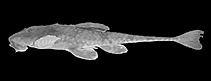
Possesses the characters of the rocky group and can be diagnosed within the species of the rocky group by the following characters: asymmetrical tooth cusps (vs. almost symmetrical cusps in Rineloricaria aequalicuspis); spotted color pattern in all fins (vs. a unique color pattern composed of one dark, wide band covering most of the distal one-half of all fins in Rineloricaria baliola); narrower head, head width 74.7-83.5 (vs. 83.7-93.6% of head length in Rineloricaria jaraguensis); 5-11 teeth in both dentary and premaxilla (vs. 12-16 teeth in each jaw in Rineloricaria latirostris); plated abdomen (vs. naked or almost naked in Rineloricaria malabarbai and Rineloricaria maquinensis); and short dorsal unbranched principal caudal-fin ray (vs. dorsal unbranched principal caudal-fin ray produced in a filament in Rineloricaria pentamaculata) (Ref. 75788).
Body shape (shape guide): elongated.
Facultative air-breathing in the genus (Ref. 126274); Occurs in watercourses with slow to fast flow, clear to brown water with rocky, sandy, or muddy bottom (Ref. 75788). Encountered in polluted waters (Ref. 75788).
Life cycle and mating behavior
Madurez | Reproducción | Puesta | Huevos | Fecundidad | Larva
Assumed to be like Rineloricaria fallax.
Rodriguez, M.S. and R.E. Reis, 2008. Taxonomic review of Rineloricaria (Loricariidae: Loricariinae) from the Laguna dos Patos drainage, Southern Brazil, with the descriptions of two new species and the recognition of two species groups. Copeia 2008(2):333-349. (Ref. 75788)
IUCN Red List Status (Ref. 130435: Version 2025-1)
Threat to humans
Harmless
Human uses
Pesquerías: comercial; Acuario: Comercial
Herramientas
Special reports
Download XML
Fuentes de Internet
Estimates based on models
Phylogenetic diversity index (Referencia
82804): PD
50 = 0.5000 [Uniqueness, from 0.5 = low to 2.0 = high].
Bayesian length-weight: a=0.00447 (0.00268 - 0.00744), b=3.11 (2.97 - 3.25), in cm total length, based on LWR estimates for this species & Genus-body shape (Ref.
93245).
Nivel trófico (Referencia
69278): 2.5 ±0.2 se; based on size and trophs of closest relatives
Resiliencia (Referencia
120179): Medio, población duplicada en un tiempo mínimo de 1.4-4.4 años (Preliminary K or Fecundity.).
Fishing Vulnerability (Ref.
59153): Low vulnerability (14 of 100).
🛈