>
Holocentriformes (Squirrelfishes, soldierfishes) >
Holocentridae (Squirrelfishes, soldierfishes) > Holocentrinae
Etymology: Sargocentron: Greek, sargos = sargus + Greek, kentron = sting (Ref. 45335).
More on author: Bleeker.
Environment: milieu / climate zone / djupintervall / distribution range
Ekologi
marina revassocierade; djupintervall 0 - 100 m (Ref. 128797), usually 1 - 15 m (Ref. 27370). Tropical; 30°N - 24°S
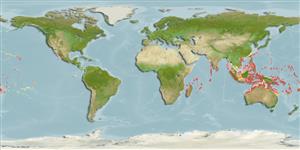
Indo-Pacific: Aldabra and the Laccadive Islands (Ref. 4201) to the Society Islands (Ref. 9710), north to Ryukyu Islands, south to the southern Great Barrier Reef; Palau to the eastern Caroline and Marshall Islands in Micronesia.
Size / Vikt / Age
Könsmognad: Lm ? range ? - ? cm
Max length : 45.0 cm TL hane/ej könsbestämd; (Ref. 8631)
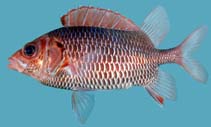
Taggstrålar i ryggfenan (totalt) : 11; Mjukstrålar i ryggfenan (totalt) : 12 - 15; Taggstrålar i analfenan: 4; Mjukstrålar i analfenan: 9. Body color brownish to purplish red; head primarily red; upper part of opercular membrane blackish; each scale with vertical silvery white line. Four to five oblique scale rows on cheek; body depth 2.3-2.7 in SL; head length (HL) 2.4-2.85 in SL; snout length 3.75-4.35 in HL; maxilla extending posteriorly from below front of pupil to below center of the eye, upper jaw length 2.7-2.85 in HL; premaxillary groove about a vertical at front edge of orbit; anterior end of nasal bone with 2 diverging spines; medial margin of nasal bone spineless (however, a Seychelles specimen 20.6 cm has one small spinule on the edge); 1-3 spinules on anterior and posterior margins of nasal fossa; suborbital bones' upper edge smooth anteriorly, becoming slightly serrate posteriorly (serrae as recumbent spinules); adults' preopercular spines long, 2.85-3.8 in HL (at least equal to orbit diameter). 2 opercular spines with the lower nearly as long or equal to the upper spine; 4th dorsal spine longest, .5-2.95 in HL; membranes of spinous dorsal fin not incised; 3rd anal spine 1.5-1.7 in HL (Ref. 27370). Has a high body similar to S. spiniferum, but differs in coloration and does not get as large.
Body shape (shape guide): fusiform / normal; Cross section: compressed.
Uncommon in atoll reef flats, lagoon patch reefs, and steep outer reef slopes. Solitary and secretive species, occasionally seen in small crevices in clear water habitats (Ref. 48635). Strictly nocturnal, feeds mainly on benthic crabs and shrimps. Spine of preopercle is venomous. Usually among rich coral growth (Ref 90102).
Life cycle and mating behavior
Könsmognad | Reproduktion | Lek | Ägg | Fecundity | Larver
Randall, J.E., 1998. Revision of the Indo-Pacific squirrelfishes (Beryciformes: Holocentridae: Holocentrinae) of the genus Sargocentron, with descriptions of four new species. Indo-Pac. Fish. (27):105 p. (Ref. 27370)
IUCN Red List Status (Ref. 130435: Version 2025-1)
Human uses
Verktyg
Special reports
Download XML
Internet-källor
Estimates based on models
Preferred temperature (Ref.
123201): 25.4 - 29.3, mean 28.5 °C (based on 2812 cells).
Phylogenetic diversity index (Ref.
82804): PD
50 = 0.5000 [Uniqueness, from 0.5 = low to 2.0 = high].
Bayesian length-weight: a=0.01660 (0.00788 - 0.03495), b=2.97 (2.80 - 3.14), in cm total length, based on LWR estimates for this Genus-body shape (Ref.
93245).
Trofisk nivå (Ref.
69278): 3.6 ±0.59 se; based on food items.
Resiliens (Ref.
120179): Mellan, lägsta populationsfördubblingstid 1,4-4,4 år (Preliminary K or Fecundity.).
Fishing Vulnerability (Ref.
59153): Low to moderate vulnerability (35 of 100).
🛈
Nutrients (Ref.
124155): Calcium = 36.9 [15.0, 137.7] mg/100g; Iron = 0.432 [0.170, 1.218] mg/100g; Protein = 18.7 [17.6, 19.9] %; Omega3 = 0.128 [0.057, 0.285] g/100g; Selenium = 32.5 [20.2, 58.3] μg/100g; VitaminA = 64.4 [25.9, 163.6] μg/100g; Zinc = 1.53 [0.64, 2.83] mg/100g (wet weight);