



Hypostomus hermanni (Ihering, 1905)
Hochladen Photos und videos
Google Bild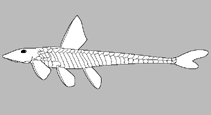 No image available for this species;
drawing shows typical species in Loricariidae.
Google Bild
drawing shows typical species in Loricariidae.
Klassifizierung / Names Namen | Synonyme | Catalog of Fishes(Gattung, Arten) | ITIS | CoL | WoRMS | Cloffa
> Siluriformes (Catfishes) > Loricariidae (Armored catfishes) > Hypostominae
Etymology: Hypostomus: Greek, hypo = under + Greek, stoma = mouth (Ref. 45335).
Eponymy: Hermann von Ihering (1850–1930). (See Ihering, HFA) (Ref. 128868), visit book page.
Etymology: Hypostomus: Greek, hypo = under + Greek, stoma = mouth (Ref. 45335).
Eponymy: Hermann von Ihering (1850–1930). (See Ihering, HFA) (Ref. 128868), visit book page.
Umwelt: Milieu / Klimazone / Tiefenbereich / Verbreitungsgebiet Ökologie
; süßwasser demersal. Tropical
Verbreitung Territorien | FAO Gebiete | Ökosysteme | Vorkommen | Punkt Karte | Einführungen | Faunafri
South America: Brazil.
Größe / Gewicht / Alter
Kurzbeschreibung Bestimmungsschlüssel | Morphologie | Morphometrie
This species is distinguished from the species of the super-group H. cochliodon by having viliform teeth and dentaries usually angled more than 100° (vs. spoon- or shovel-shaped teeth and dentary rami angled to each other up to 80°; differs from the species of the super-group H. hemiurus by having round dark blotches (vs. somewhat horizontally elongate dark blotches); differs from the species of the super-group H. plecostomus by lacking rows of odontodes on keels along lateral series of plates (vs. with moderate to well-developed rows of odontodes); differs from H. nematopterusa by lacking elongate dorsal-fin ray (vs. extremely elongate dorsal-fin ray); differs from its congeners of the H. auroguttatus super-group by having dark spots or blotches on a clear background (vs. pale spots or vermiculations on a darker background); differs from asperatus, brevicauda, johnii, leucophaeus, nigropunctatus, uruguayensis by having large dark blotches, similar to or larger than eye diameter on trunk and fins (vs. small spots, similar to or smaller than eye pupil diameter); differs from atropinnis, denticulatus, freirei, goyazensis, iheringii, macrops, latirostris, ternetzi by having parieto-supraoccipital and predorsal region flat (vs. parieto-supraoccipital medially raised and with raised parallel keels on predorsal region); differs from brevis, garmani, goyazensis, lima, topavae ( by having parieto-supraoccipital and predorsal region flat (vs. predorsal region high and convex in frontal view); differs from denticulatus, jaguar, latirostris, mutucae, paulinus, ternetzi by having tooth number less than 46 on each premaxillary or dentary (vs. more than 50); differs from agna, angipinnatus, latifrons, luetkeni by having a single predorsal plate bordering parieto-supraoccipital (vs. two to three plates); differs from perdido by having bicuspid teeth (vs. unicuspid teeth); differs from peckoltoides by having dark large blotches on body and fins (vs. wide dark transverse bars on body and bands on fins); differs from guajupia by having conspicuous blotches or marks on body and fins (vs. lacking conspicuous blotches or marks);
differs from heraldo by having pectoral-fin spine length smaller than pelvic-fin unbranched ray (vs. larger than); differs from nigromaculatus by lacking a curved club-shaped pectoral-fin spine (vs. curved club-shaped pectoral-fin spine); differs from wuchereri by having abdomen plated in specimens about 100 mm SL (vs. abdomen mostly naked in specimens up to 150 mm SL); differs from yuka by lacking hypertrophied odontodes on laterals of trunk (vs. mature males with hypertrophied odontods on laterals of trunk); differs from garmani, guajupia by the compressed caudal peduncle, almost triangular shaped, lateral surface of caudal peduncle straight (vs. oval-shaped caudal peduncle, lateral surface of caudal peduncle convex) (Ref. 124595)..
differs from species of the super-group H. cochliodon by having large dark is distinguished from the Kner, 1854 by having viliform teeth and dentaries usually angled more than 100° (vs. spoon- or shovel-shaped teeth and dentary rami angled to each other up to 80°; from the species of the super-group H. hemiurus (Eigenmann, 1912) by having round dark blotches (vs. somewhat horizontally elongate dark blotches); from the species of the super-group H. plecostomus (Ihering, 1905) by lacking rows of odontodes on keels along lateral series of plates (vs. with moderate to well-developed rows of odontodes on keels); from H. nematopterus Isbrücker & Nijssen, 1984 by lacking elongate dorsal-fin ray (vs. extremely elongate dorsal-fin ray). From the congeners of
the H. auroguttatus Kner, 1854 super-group Hypostomus hermanni is diagnosed from H.
alatus Castelnau, 1855, H. albopunctatus (Regan, 1908), H. arecuta Cardoso, Almirón,
Casciotta, Aichino, Lizarralde & Montoya-Burgos, 2012, H. faveolus Zawadzki,
Birindelli & Lima, 2008, H. fluviatilis (Schubart, 1964), H. francisci (Lütken, 1874), H.
krishnamurtii Zawadzki, Penido & Lucinda, 2020, H. luteomaculatus (Devincenzi, 1942),
H. luteus (Godoy, 1980), H. margaritifer (Regan, 1908), H. meleagris (Marini, Nichols &
LaMonte, 1933), H. microstomus Weber, 1987, H. multidens Jerep, Shibatta & Zawadzki,
2007, H. regani (Ihering, 1905), H. roseopunctatus Reis, Weber & Malabarba, 1990, H.
strigaticeps (Regan, 1908), H. tietensis (Ihering, 1905) and H. variipictus (Ihering, 1911)
by having dark spots or blotches on a clear background (vs. pale spots or vermiculations
on a darker background); from H. asperatus Castelnau, 1855, H. brevicauda (Günther,
1864), H. johnii (Steindachner, 1877), H. leucophaeus Zanata & Pitanga, 2016, H.
nigropunctatus Garavello, Britski & Zawadzki, 2012, H. renestoi Zawadzki, da Silva &
Troy, 2018 and H. uruguayensis Reis, Weber & Malabarba, 1990 by having large dark is distinguished from the species of the supergroup H. cochliodon Kner, 1854 by having viliform teeth and dentaries usually angled more than 100° (vs. spoon- or shovel-shaped teeth and dentary rami angled to each other up to 80°; from the species of the super-group H. hemiurus (Eigenmann, 1912) by having round dark blotches (vs. somewhat horizontally elongate dark blotches); from the species of the super-group H. plecostomus (Ihering, 1905) by lacking rows of odontodes on keels along lateral series of plates (vs. with moderate to well-developed
rows of odontodes on keels); from H. nematopterus Isbrücker & Nijssen, 1984 by lacking
elongate dorsal-fin ray (vs. extremely elongate dorsal-fin ray). From the congeners of
the H. auroguttatus Kner, 1854 super-group Hypostomus hermanni is diagnosed from H.
alatus Castelnau, 1855, H. albopunctatus (Regan, 1908), H. arecuta Cardoso, Almirón,
Casciotta, Aichino, Lizarralde & Montoya-Burgos, 2012, H. faveolus Zawadzki,
Birindelli & Lima, 2008, H. fluviatilis (Schubart, 1964), H. francisci (Lütken, 1874), H.
krishnamurtii Zawadzki, Penido & Lucinda, 2020, H. luteomaculatus (Devincenzi, 1942),
H. luteus (Godoy, 1980), H. margaritifer (Regan, 1908), H. meleagris (Marini, Nichols &
LaMonte, 1933), H. microstomus Weber, 1987, H. multidens Jerep, Shibatta & Zawadzki,
2007, H. regani (Ihering, 1905), H. roseopunctatus Reis, Weber & Malabarba, 1990, H.
strigaticeps (Regan, 1908), H. tietensis (Ihering, 1905) and H. variipictus (Ihering, 1911)
by having dark spots or blotches on a clear background (vs. pale spots or vermiculations
on a darker background); from H. asperatus Castelnau, 1855, H. brevicauda (Günther,
1864), H. johnii (Steindachner, 1877), H. leucophaeus Zanata & Pitanga, 2016, H.
nigropunctatus Garavello, Britski & Zawadzki, 2012, H. renestoi Zawadzki, da Silva &
Troy, 2018 and H. uruguayensis Reis, Weber & Malabarba, 1990 by having large dark blotches, that is, similar to or larger than eye diameter on trunk and fins (vs. small
spots, similar to or smaller than eye pupil diameter); from H. atropinnis (Eigenmann
& Eigenmann, 1890), H. denticulatus Zawadzki, Weber & Pavanelli, 2008, H. freirei
Penido, Pessali & Zawadzki, 2021, H. goyazensis (Regan, 1908), H. iheringii (Regan,
1908), H. macrops (Eigenmann & Eigenmann, 1890), H. latirostris (Regan, 1904) and H.
ternetzi (Boulenger, 1895) by having parieto-supraoccipital and predorsal region flat (vs.
parieto-supraoccipital medially raised and with raised parallel keels on predorsal region);
from H. brevis (Nichols, 1919), H. garmani (Regan, 1904), H. goyazensis (Regan, 1908),
H. lima (Lütken, 1874) and H. topavae (Godoy, 1969) by having parieto-supraoccipital
and predorsal region flat (vs. predorsal region high and convex in frontal view); from
H. denticulatus, H. jaguar Zanata, Sardeiro & Zawadzki, 2013, H. latirostris, H. mutucae
Knaack, 1999, H. paulinus (Ihering, 1905) and H. ternetzi by having tooth number less
than 46 on each premaxillary or dentary (vs. more than 50); from H. agna (Miranda
Ribeiro, 1907), H. angipinnatus (Leege, 1922), H. isbrueckeri Reis, Weber & Malabarba,
1990, H. latifrons Weber, 1986, H. luetkeni (Steindachner, 1877) and by having a single
predorsal plate bordering parieto-supraoccipital (vs. two to three plates); from and H.
perdido Zawadzki, Tencatt & Froehlich, 2014 by having bicuspid teeth (vs. unicuspid
teeth); from H. peckoltoides Zawadzki, Weber & Pavanelli, 2010 by having dark large
blotches on body and fins (vs. wide dark transverse bars on body and bands on fins);
from H. guajupia Penido, Pessali & Zawadzki, 2021 by having conspicuous blotches or
marks on body and fins (vs. lacking conspicuous blotches or marks); from H. heraldoi
Zawadzki, Weber & Pavanelli, 2008 by having pectoral-fin spine length smaller than
pelvic-fin unbranched ray (vs. larger than); from H. nigromaculatus (Schubart, 1964)
by lacking curved club-shaped pectoral-fin spine (vs. curved club-shaped pectoral-fin
spine); H. wuchereri (Günther, 1864) by having abdomen plated in specimens about
100 mm SL (vs. abdomen mostly naked in specimens up to 150 mm SL); from H. yaku Martins, Langeani & Zawadzki, 2014 by lacking hypertrophied odontodes on laterals of
trunk (vs. mature males with hypertrophied odontods on laterals of trunk) and from H.
garmani and H. guajupia by compressed caudal peduncle, almost triangular shaped, lateral
surface of caudal peduncle straight (vs. oval-shaped caudal peduncle, lateral surface of
caudal peduncle convex) (Ref. 124595).
Body shape (shape guide): elongated; Cross section: oval.
Body shape (shape guide): elongated; Cross section: oval.
Facultative air-breathing in the genus (Ref. 126274); Usually found in shallow to moderately shallow running waters (Ref. 124595).
Lebenszyklus und Paarungsverhalten Geschlechtsreife | Fortpflanzung | Ablaichen | Eier | Fruchtbarkeit | Larven
Hauptreferenz
Laden Sie Ihre Referenzen hoch | Referenzen | Koordinator : Fisch-Muller, Sonia | Partner
Dias, A.C. and C.H. Zawadzki, 2021. Hypostomus hermanni redescription and a new species of Hypostomus (Siluriformes: Loricariidae) from Upper Paraná River basin, Brazil. Neotrop. Ichthyol. 19(2). (Ref. 124595)
IUCN Rote Liste Status (Ref. 130435: Version 2025-2 (Global))
nicht bedroht (LC) ; Date assessed: 07 November 2018
CITES
Not Evaluated
Bedrohung für Menschen
Harmless
Nutzung durch Menschen
Fischereien: nicht kommerziell
FAO - Publication: search | FishSource |
Mehr Information
Trophische Ökologie
Lebensmittel (Beutetiere)
Nahrungszusammensetzung
Nahrungsaufnahme
Lebensmittelrationen
Räuber
Lebensmittel (Beutetiere)
Nahrungszusammensetzung
Nahrungsaufnahme
Lebensmittelrationen
Räuber
Ökologie
Ökologie
Ökologie
Populationsdynamik
Wachstumsparameter
Max. Alter/Größen
Länge-Gewicht-Rel.
Länge-Länge-Verhältnis.
Längenhäufigkeiten
Massenkonvertierung
Rekrutierung
Dichte
Wachstumsparameter
Max. Alter/Größen
Länge-Gewicht-Rel.
Länge-Länge-Verhältnis.
Längenhäufigkeiten
Massenkonvertierung
Rekrutierung
Dichte
Lebenszyklus
Fortpflanzung
Geschlechtsreife
Reifung/Kiemen rel.
Fruchtbarkeit
Ablaichen
Laichaggregationen
Eier
Eientwicklung
Larven
Larven Pop.Dyn.
Fortpflanzung
Geschlechtsreife
Reifung/Kiemen rel.
Fruchtbarkeit
Ablaichen
Laichaggregationen
Eier
Eientwicklung
Larven
Larven Pop.Dyn.
Anatomie
Kiemenoberfläche
Gehirn
Otolith
Kiemenoberfläche
Gehirn
Otolith
Physiologie
Körperliche Zusammensetzung
Nährstoffe
Sauerstoffverbrauch
Schwimmart
Schwimmgeschwindigkeit
Visuelle Pigmente
Fischgeräusche
Krankheiten und Parasiten
Toxizität (LC50s)
Körperliche Zusammensetzung
Nährstoffe
Sauerstoffverbrauch
Schwimmart
Schwimmgeschwindigkeit
Visuelle Pigmente
Fischgeräusche
Krankheiten und Parasiten
Toxizität (LC50s)
Genetik
Genom
Genetik
Heterozygotie
Vererbbarkeit
Genetische Vielfalt
Genom
Genetik
Heterozygotie
Vererbbarkeit
Genetische Vielfalt
Menschenbezogen
Aquakultur-Systeme
Aquakultur Profile
Zuchtlinien
Ciguatera-Fälle
Briefmarken, Münzen, Verschiedenes.
Aquakultur-Systeme
Aquakultur Profile
Zuchtlinien
Ciguatera-Fälle
Briefmarken, Münzen, Verschiedenes.
Tools
Zusatzinformationen
Download XML
Zusammenfassung | Punktdaten | Namen | Photos
Internet Quellen
AFORO (otoliths) | Aquatic Commons | BHL | Cloffa | Websites from users | FishWatcher Einträge suchen | CISTI | Catalog of Fishes: Gattung, Arten | DiscoverLife | ECOTOX | FAO - Publication: search | Faunafri | Fishipedia | Fishtrace | GloBI | Google Books | Google Scholar | Google | IGFA World Record | OneZoom | Open Tree of Life | Otolith Atlas of Taiwan Fishes | PubMed | Reef Life Survey | Socotra Atlas | TreeBase | Tree of Life | Wikipedia: Gehe zu, Suchen | World Records Freshwater Fishing | Zoologischer Rekord
Schätzungen auf der Grundlage von Modellen
Phylogenetischer Diversitätsindex (Ref. 82804): PD50 = 0.5000 [Uniqueness, from 0.5 = low to 2.0 = high].
Bayesian length-weight: a=0.01585 (0.00726 - 0.03460), b=2.95 (2.78 - 3.12), in cm total length, based on LWR estimates for this Genus-body shape (Ref. 93245).
Widerstandsfähigkeit (Ref. 120179): mittel, Verdopplung der Population dauert 1,4 - 4,4 Jahre. (Fec= 132).