Environment: milieu / climate zone / Tiefenbereich / distribution range
Ökologie
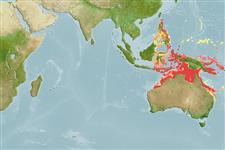
seewasser riff-verbunden; tiefenbereich 5 - 100 m (Ref. 6390). Tropical; 21°N - 28°S, 117°E - 159°E (Ref. 5222)
Western Pacific: Thailand, Singapore, Philippines, Indonesia, Papua New Guinea, the Arafura Sea (Ref. 9819), Solomon Islands, and Australia (from Houtman Abrolhos in Western Australia to Gladstone, Queensland) (Ref. 3150). This species was formerly listed as occurring in the western Indian Ocean based on a misidentification of Plectropomus pessuliferus.
Length at first maturity / Size / Gewicht / Alter
Geschlechtsreife: Lm ? range ? - ? cm
Max length : 125 cm TL Männchen/unbestimmt; (Ref. 90102); max. veröff. Gewicht: 25.0 kg (Ref. 5222)
Rückenflossenstacheln (insgesamt) : 7 - 8; Rückenflossenweichstrahlen (insgesamt) : 10 - 12; Afterflossenstacheln: 3; Afterflossenweichstrahlen: 8.
Body shape (shape guide): fusiform / normal; Cross section: oval.
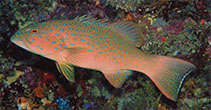
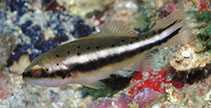
Found in protected coastal reef in mixed algae and coral habitat (Ref. 48635). Common on inshore coastal reefs but absent in clear offshore reefs (Ref. 9710). Juveniles have a demersal existence in shallow water in reef habitats, especially around coral rubble (Ref. 27259). Migrate over short distances to spawn, forming aggregations (Ref. 6390). May move into shallow water to feed (Ref. 6390). Eggs float just below the water surface (Ref. 6390). Pelagic larvae are found in habitats similar to those of the adults (Ref. 27260). Juveniles feed on small fish and invertebrates such as crustaceans and squid (Ref. 27261). Commonly used for food. Its flesh is delicate and well appreciated (Ref. 5503). Solitary (Ref 90102).
Confirmed for diandry (Ref. 103751).
Heemstra, P.C. and J.E. Randall, 1993. FAO Species Catalogue. Vol. 16. Groupers of the world (family Serranidae, subfamily Epinephelinae). An annotated and illustrated catalogue of the grouper, rockcod, hind, coral grouper and lyretail species known to date. Rome: FAO. FAO Fish. Synop. 125(16):382 p. (Ref. 5222)
IUCN Rote Liste Status (Ref. 130435: Version 2025-1)
Bedrohung für Menschen
Reports of ciguatera poisoning (Ref. 30298)
Nutzung durch Menschen
Fischereien: kommerziell; Aquakultur: kommerziell; Sportfisch: ja
Tools
Zusatzinformationen
Download XML
Internet Quellen
Estimates based on models
Preferred temperature (Ref.
123201): 26.1 - 28.8, mean 27.8 °C (based on 466 cells).
Phylogenetic diversity index (Ref.
82804): PD
50 = 0.5039 [Uniqueness, from 0.5 = low to 2.0 = high].
Bayesian length-weight: a=0.01122 (0.00581 - 0.02169), b=3.05 (2.89 - 3.21), in cm total length, based on LWR estimates for this species & (Sub)family-body (Ref.
93245).
Trophic level (Ref.
69278): 4.1 ±0.70 se; based on food items.
Generation time: 5.3 ( na - na) years. Estimated as median ln(3)/K based on 1
growth studies.
Widerstandsfähigkeit (Ref.
120179): mittel, Verdopplung der Population dauert 1,4 - 4,4 Jahre. (K=0.21; tm=2-3).
Fishing Vulnerability (Ref.
59153): Moderate to high vulnerability (51 of 100).
🛈
Nutrients (Ref.
124155): Calcium = 20.9 [13.3, 35.2] mg/100g; Iron = 0.483 [0.267, 0.780] mg/100g; Protein = 18.7 [16.9, 20.3] %; Omega3 = 0.133 [0.089, 0.206] g/100g; Selenium = 47.8 [28.7, 84.8] μg/100g; VitaminA = 75.7 [28.7, 229.0] μg/100g; Zinc = 0.7 [0.5, 1.0] mg/100g (wet weight);