



Genypterus blacodes (Forster, 1801)
Pink cusk-eel
Beobachtung melden im Fish Watcher
| Native range | All suitable habitat | Point map | Year 2050 |

|
| This map was computer-generated and has not yet been reviewed. |
| Genypterus blacodes AquaMaps Data sources: GBIF OBIS |
Hochladen Photos und videos
Bilder | Google Bild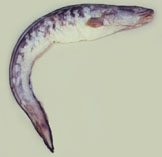 Genypterus blacodes
Photo von Carvalho Filho, A.
Bilder | Google Bild
Photo von Carvalho Filho, A.
Klassifizierung / Names Namen | Synonyme | Catalog of Fishes(Gattung, Arten) | ITIS | CoL | WoRMS | Cloffa
> Ophidiiformes (Cusk eels) > Ophidiidae (Cusk-eels) > Ophidiinae
Etymology: Genypterus: Greek, geny, -yos = face, jaw + Greek, pteron, = wing, fin (Ref. 45335).
More on author: Forster.
Etymology: Genypterus: Greek, geny, -yos = face, jaw + Greek, pteron, = wing, fin (Ref. 45335).
More on author: Forster.
Umwelt: Milieu / Klimazone / Tiefenbereich / Verbreitungsgebiet Ökologie
seewasser bathydemersal; ozeanodrom (Ref. 51243); tiefenbereich 22 - 1000 m (Ref. 58489), usually 300 - 550 m (Ref. 6390). Deep-water; 17°S - 57°S, 114°E - 30°W (Ref. 34024)
Verbreitung Territorien | FAO Gebiete | Ökosysteme | Vorkommen | Punkt Karte | Einführungen | Faunafri
Southwest Pacific: southern Australia and around New Zealand. Southeast Pacific: Chile (Ref. 9068). Southwest Atlantic: Brazil (Ref. 4517).
Länge bei der ersten Reifung / Größe / Gewicht / Alter
Geschlechtsreife: Lm 72.0 range ? - ? cm
Max length : 200 cm SL Männchen/unbestimmt; (Ref. 34024); common length : 100.0 cm TL Männchen/unbestimmt; (Ref. 9258); max. veröff. Gewicht: 25.0 kg (Ref. 34024); max. veröff. Alter: 46 Jahre (Ref. 128769)
Max length : 200 cm SL Männchen/unbestimmt; (Ref. 34024); common length : 100.0 cm TL Männchen/unbestimmt; (Ref. 9258); max. veröff. Gewicht: 25.0 kg (Ref. 34024); max. veröff. Alter: 46 Jahre (Ref. 128769)
Kurzbeschreibung Bestimmungsschlüssel | Morphologie | Morphometrie
Rückenflossenstacheln (insgesamt) : 0; Rückenflossenweichstrahlen (insgesamt) : 141 - 164; Afterflossenstacheln: 0; Afterflossenweichstrahlen: 101 - 126; Wirbelzahl: 68 - 70. Body pinkish yellow, marbled with irregular reddish brown blotches dorsally (Ref. 27363).
Body shape (shape guide): elongated; Cross section: compressed.
Body shape (shape guide): elongated; Cross section: compressed.
Common species (Ref. 34024). Found between depths of 22 m (Ref. 58489) and 1000 m (Ref. 33848). Feed mainly on crustaceans such as Munida and scampi and also on fish. Also caught above the bottom when feeding on hoki (Macruronus novaezelandiae) during the hoki spawning season. Available all year round. Juveniles are found in shallower shelf waters (Ref. 6390). Oviparous, with oval pelagic eggs floating in a gelatinous mass (Ref. 205). Utilized fresh, frozen or smoked; can be fried and baked (Ref. 9988, 34024).
Lebenszyklus und Paarungsverhalten Geschlechtsreife | Fortpflanzung | Ablaichen | Eier | Fruchtbarkeit | Larven
Hauptreferenz
Laden Sie Ihre Referenzen hoch | Referenzen | Koordinator | Partner
Nielsen, J.G., D.M. Cohen, D.F. Markle and C.R. Robins, 1999. Ophidiiform fishes of the world (Order Ophidiiformes). An annotated and illustrated catalogue of pearlfishes, cusk-eels, brotulas and other ophidiiform fishes known to date. FAO Fish. Synop. 125(18):178p. Rome: FAO. (Ref. 34024)
IUCN Rote Liste Status (Ref. 130435: Version 2025-2 (Global))
Verwundbar (VU) (A2bd); Date assessed: 04 March 2024
CITES
Not Evaluated
Bedrohung für Menschen
Harmless
Nutzung durch Menschen
Fischereien: hoch kommerziell
FAO - Fischereien: landungen, Artbeschreibung; Publication: search | FIRMS - Stock assessments | FishSource | Das Meer um uns herum
Mehr Information
Trophische Ökologie
Lebensmittel (Beutetiere)
Nahrungszusammensetzung
Nahrungsaufnahme
Lebensmittelrationen
Räuber
Lebensmittel (Beutetiere)
Nahrungszusammensetzung
Nahrungsaufnahme
Lebensmittelrationen
Räuber
Populationsdynamik
Wachstumsparameter
Max. Alter/Größen
Länge-Gewicht-Rel.
Länge-Länge-Verhältnis.
Längenhäufigkeiten
Massenkonvertierung
Rekrutierung
Dichte
Wachstumsparameter
Max. Alter/Größen
Länge-Gewicht-Rel.
Länge-Länge-Verhältnis.
Längenhäufigkeiten
Massenkonvertierung
Rekrutierung
Dichte
Lebenszyklus
Fortpflanzung
Geschlechtsreife
Reifung/Kiemen rel.
Fruchtbarkeit
Ablaichen
Laichaggregationen
Eier
Eientwicklung
Larven
Larven Pop.Dyn.
Fortpflanzung
Geschlechtsreife
Reifung/Kiemen rel.
Fruchtbarkeit
Ablaichen
Laichaggregationen
Eier
Eientwicklung
Larven
Larven Pop.Dyn.
Anatomie
Kiemenoberfläche
Gehirn
Otolith
Kiemenoberfläche
Gehirn
Otolith
Physiologie
Körperliche Zusammensetzung
Nährstoffe
Sauerstoffverbrauch
Schwimmart
Schwimmgeschwindigkeit
Visuelle Pigmente
Fischgeräusche
Krankheiten und Parasiten
Toxizität (LC50s)
Körperliche Zusammensetzung
Nährstoffe
Sauerstoffverbrauch
Schwimmart
Schwimmgeschwindigkeit
Visuelle Pigmente
Fischgeräusche
Krankheiten und Parasiten
Toxizität (LC50s)
Genetik
Genom
Genetik
Heterozygotie
Vererbbarkeit
Genetische Vielfalt
Genom
Genetik
Heterozygotie
Vererbbarkeit
Genetische Vielfalt
Menschenbezogen
Aquakultur-Systeme
Aquakultur Profile
Zuchtlinien
Ciguatera-Fälle
Briefmarken, Münzen, Verschiedenes.
Aquakultur-Systeme
Aquakultur Profile
Zuchtlinien
Ciguatera-Fälle
Briefmarken, Münzen, Verschiedenes.
Tools
Zusatzinformationen
Download XML
Zusammenfassung | Punktdaten | Namen | Photos
Internet Quellen
AFORO (otoliths) | Aquatic Commons | BHL | Cloffa | Websites from users | FishWatcher Einträge suchen | CISTI | Catalog of Fishes: Gattung, Arten | DiscoverLife | ECOTOX | FAO - Fischereien: landungen, Artbeschreibung; Publication: search | Faunafri | Fishipedia | Fishtrace | GloBI | Google Books | Google Scholar | Google | IGFA World Record | Nationale Datenbanken | OneZoom | Open Tree of Life | Otolith Atlas of Taiwan Fishes | PubMed | Reef Life Survey | Socotra Atlas | TreeBase | Tree of Life | Wikipedia: Gehe zu, Suchen | World Records Freshwater Fishing | Zoologischer Rekord
Schätzungen auf der Grundlage von Modellen
Bevorzugte Temperatur (Ref. 123201): 3.3 - 12.7, mean 7.2 °C (based on 279 cells).
Phylogenetischer Diversitätsindex (Ref. 82804): PD50 = 0.5156 [Uniqueness, from 0.5 = low to 2.0 = high].
Bayesian length-weight: a=0.00219 (0.00133 - 0.00361), b=3.16 (3.01 - 3.31), in cm total length, based on LWR estimates for this species & (Sub)family-body (Ref. 93245).
Trophische Ebene (Ref. 69278): 4.2 ±0.76 se; based on food items.
Generation time: 11.0 (8.6 - 12.6) years. Estimated as median ln(3)/K based on 10 growth studies.
Widerstandsfähigkeit (Ref. 120179): niedrig, Verdopplung der Population dauert 4,5 - 14 Jahre. (K=0.1-0.23; tmax=30; tm=5-7).
Prior r = 0.25, 95% CL = 0.16 - 0.37, Based on 4 full stock assessments.
Nährstoffe (Ref. 124155): Calcium = 11.8 [7.2, 25.7] mg/100g; Iron = 0.365 [0.190, 0.713] mg/100g; Protein = 15.6 [13.6, 17.7] %; Omega3 = 0.255 [0.136, 0.502] g/100g; Selenium = 31.6 [14.3, 70.0] μg/100g; VitaminA = 6.94 [1.54, 32.25] μg/100g; Zinc = 0.234 [0.157, 0.351] mg/100g (wet weight); based on nutrient studies.