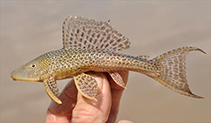
>
Siluriformes (Catfishes) >
Loricariidae (Armored catfishes) > Hypostominae
Etymology: Pterygoplichthys: Greek, pterygion, diminutive of pteryx = wing, fin + Greek, hoplon = weapon + Greek, ichthys = fish (Ref. 45335).
Issue
New combination in Günther (1864:238). Redescription in Weber (1992:9). Mitochondrial D-loop sequences used in a molecular phylogeny of Hypostomus and related genera by Montoya-Burgos and Weber (in press, fig 2; EMBL/GenBank AJ318361).
Environment: milieu / climate zone / rango de profundidad / distribution range
Ecología
; agua dulce demersal; pH range: 6.5 - 7.8; dH range: 4 - 20. Tropical; 23°C - 27°C (Ref. 1672); 10°N - 1°N, 68°W - 61°W
South America: Orinoco River basin. Reported from Argentina (Ref. 9086). Introduced and have established in Taiwan, mainland USA and Hawaii (Refs. 5723, 44091, 58503).
Length at first maturity / Tamaño / Peso / Age
Madurez: Lm 32.5, range 25 - 40 cm
Max length : 50.0 cm TL macho / no sexado; (Ref. 2059)
Short description
Claves de identificación | Morfología | Morfometría
Facultative air-breathing (Ref. 126274); Occurs in streams and lakes (Ref. 44091) and in weedy, mud-bottomed canals (Ref. 5723). Benthic (Ref. 58302). Nocturnal, feeds on algae (Ref. 13371), but will also feed on worms, insect larvae, and other bottom-dwelling aquatic animals (Ref. 44091). Spawning period peaks once a year (Ref. 56986). Reproductive behavior includes digging of burrows for egg laying (Ref. 82067). May exhibit male parental care (Ref. 56986).
Parental care may be exhibited by males (Ref. 56986).
Burgess, W.E., 1989. An atlas of freshwater and marine catfishes. A preliminary survey of the Siluriformes. T.F.H. Publications, Inc., Neptune City, New Jersey (USA). 784 p. (Ref. 6868)
IUCN Red List Status (Ref. 130435: Version 2025-1)
Threat to humans
Harmless
Human uses
Pesquerías: sin interés; Acuario: Comercial
Herramientas
Special reports
Download XML
Fuentes de Internet
Estimates based on models
Phylogenetic diversity index (Referencia
82804): PD
50 = 0.5000 [Uniqueness, from 0.5 = low to 2.0 = high].
Bayesian length-weight: a=0.02455 (0.01270 - 0.04744), b=2.91 (2.75 - 3.07), in cm total length, based on LWR estimates for this species & Genus-body shape (Ref.
93245).
Nivel trófico (Referencia
69278): 2.2 ±0.12 se; based on food items.
Resiliencia (Referencia
120179): Medio, población duplicada en un tiempo mínimo de 1.4-4.4 años (tm=1; Fec = 1,983).
Fishing Vulnerability (Ref.
59153): Moderate vulnerability (40 of 100).
🛈