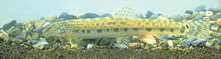
Cobitis sinensis, Siberian spiny loach

You can sponsor this page

Cobitis sinensis Sauvage & Dabry de Thiersant, 1874

Siberian spiny loach
Upload your photos and videos
Bilder | Google image
Image of Cobitis sinensis (Siberian spiny loach)
Cobitis sinensis
Picture by CAFS

Classification / Names Populärnamn | synonymer | Catalog of Fishes(Släkte, Arter) | ITIS | CoL | WoRMS | Cloffa

> Cypriniformes (Carps) > Cobitidae (Spined loaches)
Etymology: Cobitis: Greek, kobitis, -idos = a kind of sardine; also related with the voice Greek, kobios, Latin gobius = gudgeon (Ref. 45335).
More on authors: Sauvage & DabrydeThiersant.

Environment: milieu / climate zone / djupintervall / distribution range Ekologi

; sötvatten bentopelagisk. Subtropical

Utbredning Länder | FAO områden | Ekosystem | Förekomster | Prickkarta | Utplanteringar | Faunafri

Asia: China (Ref. 33389) and Korea (Ref. 58345).

Size / Vikt / Age

Könsmognad: Lm ?  range ? - ? cm
Max length : 15.3 cm TL hane/ej könsbestämd; (Ref. 111646); common length : 7.2 cm SL hane/ej könsbestämd; (Ref. 35840)

Biologi     Ordlista (t.ex. epibenthic)

Oviparous, with distinct pairing during breeding (Ref. 205).

Life cycle and mating behavior Könsmognad | Reproduktion | Lek | Ägg | Fecundity | Larver

Main reference Upload your references | referenser | Koordinator | Medarbetare

Ye, G., 1991. Cobitidae. p. 239-256. In J.-H. Pan, L. Zhong, C.-Y. Zheng, H.-L. Wu and J.-H. Liu (eds). 1991. The freshwater fishes of Guangdong Province. Guangdong Science and Technology Press, Guangzhou. 589 p. (Ref. 33389)

IUCN Red List Status (Ref. 130435: Version 2025-1)

  Least Concern (LC) ; Date assessed: 12 January 2011

CITES

Not Evaluated

CMS (Ref. 116361)

Not Evaluated

Threat to humans

  Harmless


Human uses

FAO - Publication: search | FishSource |

Ytterligare information

Trophic ecology
Food items (preys)
Födosammansättning
Födointag
Food rations
Predatorer
Ekologi
Ekologi
Home ranges
Population dynamics
Tillväxtparametrar
Max. ages / sizes
Length-weight rel.
Length-length rel.
Length-frequencies
Mass conversion
Rekrytering
Abundans
Life cycle
Reproduktion
Könsmognad
Maturity/Gills rel.
Fecundity
Lek
Spawning aggregations
Ägg
Egg development
Larver
Larvdynamik
Utbredning
Länder
FAO områden
Ekosystem
Förekomster
Utplanteringar
BRUVS - Videos
Anatomy
Gälyta
Brain
Otolith
Physiology
Body composition
Nutrients
Syreförbrukning
Swimming type
Simhastighet
Visual pigments
Fish sound
Diseases & Parasites
Toxicity (LC50s)
Genetik
Genome
Genetik
Heterozygosity
Ärftlighet
Human related
Aquaculture systems
Vattenbruksprofiler
Avelslinjer
Ciguatera cases
Stamps, coins, misc.
Outreach
Medarbetare
referenser
referenser

Verktyg

Special reports

Download XML

Internet-källor

AFORO (otoliths) | Aquatic Commons | BHL | Cloffa | Websites from users | Check FishWatcher | CISTI | Catalog of Fishes: Släkte, Arter | DiscoverLife | ECOTOX | FAO - Publication: search | Faunafri | Fishipedia | Fishtrace | GloBI | Google Books | Google Scholar | Google | IGFA World Record | OneZoom | Open Tree of Life | Otolith Atlas of Taiwan Fishes | PubMed | Reef Life Survey | Socotra Atlas | TreeBase | Tree of Life | Wikipedia: Go, sök | Zoobank | Zoological Record

Estimates based on models

Phylogenetic diversity index (Ref. 82804):  PD50 = 0.5000   [Uniqueness, from 0.5 = low to 2.0 = high].
Bayesian length-weight: a=0.00589 (0.00368 - 0.00942), b=3.03 (2.90 - 3.16), in cm total length, based on LWR estimates for this species & Genus-body shape (Ref. 93245).
Trofisk nivå (Ref. 69278):  3.3   ±0.4 se; based on size and trophs of closest relatives
Resiliens (Ref. 120179):  Mellan, lägsta populationsfördubblingstid 1,4-4,4 år (Assumed Fec < 10,000).
Fishing Vulnerability (Ref. 59153):  Low vulnerability (10 of 100). 🛈