



Pimephales promelas Rafinesque, 1820
Fathead minnow
Ladda upp din foton och Videor
Bilder | Google image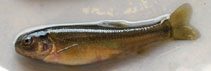 Pimephales promelas
Male Bild av Divino, J.N.
Bilder | Google image
Male Bild av Divino, J.N.
Klassificering / Namn Populärnamn | synonymer | Catalog of Fishes(Släkte, Arter) | ITIS | CoL | WoRMS | Cloffa
> Cypriniformes (Carps) > Leuciscidae (Minnows) > Pogonichthyinae
Etymology: Pimephales: Greek, pimeles, -es = fat + Greek, phales = whale; if the root is Greek, phales, -etos = penis (Ref. 45335); promelas: From the words pro, meaning forward; and melas, black (referring to the black head of nuptial males) (Ref. 10294).
More on author: Rafinesque.
Etymology: Pimephales: Greek, pimeles, -es = fat + Greek, phales = whale; if the root is Greek, phales, -etos = penis (Ref. 45335); promelas: From the words pro, meaning forward; and melas, black (referring to the black head of nuptial males) (Ref. 10294).
More on author: Rafinesque.
Miljö: miljö / Klimatzon / djupintervall / distributionsområde Ekologi
; sötvatten bottenlevande; ej vandrande (Ref. 126106). Subtropical; 0°C - 33°C (Ref. 35682); 61°N - 29°N
Utbredning Territorier | FAO områden | Ekosystem | Förekomster | Prickkarta | Utplanteringar | Faunafri
North and Central America: Over much of North America from Quebec to Northwest Territories and British Columbia in Canada and south to Alabama, Texas in USA, and Mexico. Widely introduced, including in Colorado River drainage in Arizona and New Mexico, USA. Not present on Atlantic and Gulf slopes between Potomac River in Virginia and Trinity River in Texas. Several countries report adverse ecological impact after introduction.
Storlek / Vikt / Ålder
Könsmognad: Lm ? range ? - ? cm
Max length : 10.1 cm TL hane/ej könsbestämd; (Ref. 10294); common length : 7.3 cm TL hane/ej könsbestämd; (Ref. 12193); rapporterad maxålder: 5 år (Ref. 58435)
Max length : 10.1 cm TL hane/ej könsbestämd; (Ref. 10294); common length : 7.3 cm TL hane/ej könsbestämd; (Ref. 12193); rapporterad maxålder: 5 år (Ref. 58435)
Kort beskrivning Bestämningsnycklar | Morfologi | Morfometri
Taggstrålar i ryggfenan (totalt) : 0; Mjukstrålar i ryggfenan (totalt) : 8; Taggstrålar i analfenan: 0; Mjukstrålar i analfenan: 7. The only species of genus introduced to Europe which differs from other cyprinid species in Europe by the following characters: prominent pad of spongy tissue on nape in males; dorsal fin origin about above pelvic fin origin; anal fin with 7½ branched rays; second simple dorsal ray spinous, about 50% length of the third one; lateral line incomplete, usually not reaching dorsal origin; weak midlateral stripe; 41-54 + 2 scales in midlateral row; and mouth terminal (Ref. 59043).
Body shape (shape guide): fusiform / normal.
Body shape (shape guide): fusiform / normal.
Adults inhabit muddy pools of headwaters, creeks, small rivers, and ponds (Ref. 5723, 86798). Also found in lakes (Ref. 10294). Can tolerate conditions (e.g., turbid, hot, poorly oxygenated, intermittent streams) unsuitable for most fishes (Ref. 5723, 86798). They feed on detritus and algae (Ref. 10294). Spawning occurs in still-water habitats along shores (Ref. 59043). Introductions consequently caused the spread of the enteric red-mouth disease throughout northern Europe which infected wild and cultured trouts and eels (Ref. 1739). Maintained a relatively high metabolic rate and level of activity under hypoxic conditions (Ref. 77050). Individuals that survived the hypoxic conditions during winter had rapid growth rates after ice-off (Ref. 77048).
Livscykel och parningsbeteende Könsmognad | Reproduktion | Lek | Ägg | Fekunditet | Larver
"Males defend territories and eggs, and clean plants, stone or other materials by rubbing them with the spongy nape pad and dorsal fin, which contain mucus-secreting cells and taste buds. The mucus may have fungicidal properties" (Ref. 59043).
Huvudreferens
Ladda upp dina referenser | referenser | Koordinator | Medarbetare
Page, L.M. and B.M. Burr, 2011. A field guide to freshwater fishes of North America north of Mexico. Boston : Houghton Mifflin Harcourt, 663p. (Ref. 86798)
Status på IUCN:s rödlista (Ref. 130435: Version 2025-2 (Global))
Least Concern (LC) ; Date assessed: 02 July 2018
CITES
Not Evaluated
Hot mot människor
Potential pest
Mänskliga användningsområden
Fiskeri: kommersiell; Akvarium: Kommersiell; bete: usually
FAO - Publication: search | FishSource |
Ytterligare information
Populationsdynamik
Tillväxtparametrar
Max. åldrar / storlekar
Längd-vikt rel.
Längd-längd rel.
Längd-frekvenser
Massakonvertering
Rekrytering
Abundans
Tillväxtparametrar
Max. åldrar / storlekar
Längd-vikt rel.
Längd-längd rel.
Längd-frekvenser
Massakonvertering
Rekrytering
Abundans
Livscykel
Reproduktion
Könsmognad
Mognad/Gills rel.
Fekunditet
Lek
Lekande aggregat
Ägg
Utveckling av ägg
Larver
Larvdynamik
Reproduktion
Könsmognad
Mognad/Gills rel.
Fekunditet
Lek
Lekande aggregat
Ägg
Utveckling av ägg
Larver
Larvdynamik
Anatomi
Gälyta
Hjärna
Otolit
Gälyta
Hjärna
Otolit
Fysiologi
Kroppssammansättning
Näringsämnen
Syreförbrukning
Typ av simning
Simhastighet
Visuella pigment
Ljud från fisk
Sjukdomar & Parasiter
Toxicitet (LC50)
Kroppssammansättning
Näringsämnen
Syreförbrukning
Typ av simning
Simhastighet
Visuella pigment
Ljud från fisk
Sjukdomar & Parasiter
Toxicitet (LC50)
Människorelaterad
Vattenbrukssystem
Vattenbruksprofiler
Avelslinjer
Ciguatera-fall
Frimärken, mynt, diverse.
Vattenbrukssystem
Vattenbruksprofiler
Avelslinjer
Ciguatera-fall
Frimärken, mynt, diverse.
Verktyg
Organisk frågesport | E-bok | Fälthandbok | Bestämningsnycklar | Längdfördelnings-verktyg | Livshistorie-verktyg | Prickkarta |
Fångst-MSY |
Särskilda rapporter
Kontrollera för underhåll av akvarium | Kontrollera om det finns faktablad om arter | Kontrollera om det finns faktablad om vattenbruk
Ladda ner XML
Internet-källor
AFORO (otoliths) | Alien/Invasive Species database | Aquatic Commons | BHL | Cloffa | Websites from users | Check FishWatcher | CISTI | Catalog of Fishes: Släkte, Arter | DiscoverLife | ECOTOX | FAO - Publication: search | Faunafri | Fishipedia | Fishtrace | GloBI | Google Books | Google Scholar | Google | IGFA World Record | Nationella databaser | OneZoom | Open Tree of Life | Otolith Atlas of Taiwan Fishes | PubMed | Reef Life Survey | Socotra Atlas | TreeBase | Tree of Life | Wikipedia: Go, sök | World Records Freshwater Fishing | Zoobank | Zoologiskt register
Uppskattningar baserade på modeller
Index för fylogenetisk mångfald (Ref. 82804): PD50 = 0.5625 [Uniqueness, from 0.5 = low to 2.0 = high].
Bayesian length-weight: a=0.00871 (0.00669 - 0.01134), b=3.07 (3.00 - 3.14), in cm total length, based on LWR estimates for this species (Ref. 93245).
Trofisk nivå (Ref. 69278): 2.4 ±0.1 se; based on diet studies.
Resiliens (Ref. 120179): Hög, lägsta populationsfördubblingstid mindre än 15 månader (tmax=2).