



添加你自己的观测位置在 Fish Watcher
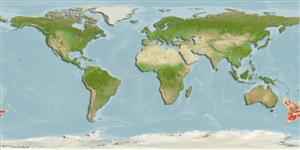
| Native range | All suitable habitat | Point map | Year 2050 |
|
| This map was computer-generated and has not yet been reviewed. |
| Bathyraja shuntovi AquaMaps Data sources: GBIF OBIS |
分类 / 名称 俗名 | 同种异名 | Catalog of Fishes(属, 种) | ITIS | CoL | WoRMS | Cloffa
Elasmobranchii 板鳃亚纲 (鲨鱼与 鱼) (sharks and rays) > Rajiformes (Skates and rays) > Arhynchobatidae (Softnose skates)
Etymology: Bathyraja: Greek, bathys = deep + Latin, raja, -ae = a ray (Raja sp) (Ref. 45335).
Eponymy: Dr Vyacheslav Petrovich Shuntov (d: 1937) is an ichthyologist with an interest in marine ornithology. [...] (Ref. 128868), visit book page.
Etymology: Bathyraja: Greek, bathys = deep + Latin, raja, -ae = a ray (Raja sp) (Ref. 45335).
Eponymy: Dr Vyacheslav Petrovich Shuntov (d: 1937) is an ichthyologist with an interest in marine ornithology. [...] (Ref. 128868), visit book page.
环境:氛围 / 气候带 / 深度上下限 / 分布范围 生态学
海洋 深海底的; 深度上下限 300 - 1470 m (Ref. 26346). 深水域
分布 领土 | FAO区域 | 生态系 | 标本纪录 | 分布图 | 简介 | Faunafri
Southwest Pacific: endemic to New Zealand.
西南太平洋: 紐西蘭的特有種。
西南太平洋: 紐西蘭的特有種。
大小 / 重量 / 年龄
简单描述 检索表 | 型态特徵 | 形态测量图
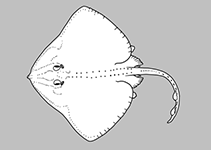
Dark brown to grey in color (Ref. 26346). Juveniles covered with small prickles dorsally; adults smooth, thin-bodied and with a greatly elongated snout (Ref. 26346).
Body shape (shape guide): other.
深褐色的到灰色的颜色.(参考文献 26346) 稚鱼覆盖着小的刺背面了; 成鱼平滑的, 细瘦的而且非常具有一个细长的吻部.(参考文献 26346)
Body shape (shape guide): other.
深褐色的到灰色的颜色.(参考文献 26346) 稚鱼覆盖着小的刺背面了; 成鱼平滑的, 细瘦的而且非常具有一个细长的吻部.(参考文献 26346)
Adults inhabit the continental slope (Ref. 26346). Oviparous. Distinct pairing with embrace. Young may tend to follow large objects, such as their mother (Ref. 205). Eggs are oblong capsules with stiff pointed horns at the corners deposited in sandy or muddy flats (Ref. 205). Egg capsules are 8.8 cm long and 4.7 cm wide (Ref. 41249).
成鱼栖息于大陆斜坡。 (参考文献 26346) 卵生的。 明显的成对出现。 幼鱼可能倾向跟随大的个体, 例如他们的母亲.(参考文献 205) 卵为长方形鞘囊具有僵硬的触角沈积在沙滩或泥滩的角落.(参考文献 205) 卵鞘是 8.8 公分长与 4.7 公分宽的.(参考文献 41249)
成鱼栖息于大陆斜坡。 (参考文献 26346) 卵生的。 明显的成对出现。 幼鱼可能倾向跟随大的个体, 例如他们的母亲.(参考文献 205) 卵为长方形鞘囊具有僵硬的触角沈积在沙滩或泥滩的角落.(参考文献 205) 卵鞘是 8.8 公分长与 4.7 公分宽的.(参考文献 41249)
生命周期和交配行为 成熟度 | 繁殖 | 产卵场 | 卵 | 孕卵数 | 仔鱼
Oviparous (Ref. 26346). Paired eggs are laid. Embryos feed solely on yolk (Ref. 50449). Distinct pairing with embrace. Young may tend to follow large objects, such as their mother (Ref. 205). Eggs have horn-like projections on the shell (Ref. 205).西南太平洋: 紐西蘭的特有種。
主要参考文献
上传您的参考资料 | 参考文献 | 合作者 : McEachran, John | 合作者
McEachran, J.D. and K.A. Dunn, 1998. Phylogenetic analysis of skates, a morphologically conservative clade of elasmobranchs (Chondrichthyes: Rajidae). Copeia 1998(2):271-290. (Ref. 27314)
CITES
Not Evaluated
对人类的威胁
无害处的
人类利用
FAO - Publication: search | FishSource |
更多信息
解剖学
鳃区
大脑
耳石
鳃区
大脑
耳石
生理学
身体成分
营养素
耗氧量
游泳类型
游泳速度
视觉色素
鱼声
疾病与寄生虫
毒性(半数致死浓度)
身体成分
营养素
耗氧量
游泳类型
游泳速度
视觉色素
鱼声
疾病与寄生虫
毒性(半数致死浓度)
遗传学
基因组
遗传学
异质性
遗传率
基因多样性
基因组
遗传学
异质性
遗传率
基因多样性
工具
特别资料
下载 XML
网络资源
AFORO (otoliths) | Aquatic Commons | BHL | Cloffa | Websites from users | 核实 FishWatcher | CISTI | Catalog of Fishes: 属, 种 | DiscoverLife | ECOTOX | FAO - Publication: search | Faunafri | Fishipedia | Fishtrace | GloBI | Google Books | Google Scholar | Google | IGFA World Record | OneZoom | Open Tree of Life | Otolith Atlas of Taiwan Fishes | PubMed | Reef Life Survey | Socotra Atlas | TreeBase | 树状分类阶层 | Wikipedia: 转至, 搜寻 | World Records Freshwater Fishing | Zoobank | 动物学的记录
基于模型的估算
首选温度 (参考文献 123201): 5 - 9.5, mean 7.1 °C (based on 197 cells).
系统发育多样性指数 (参考文献 82804): PD50 = 0.5000 [Uniqueness, from 0.5 = low to 2.0 = high].
Bayesian length-weight: a=0.00562 (0.00296 - 0.01067), b=3.13 (2.97 - 3.29), in cm total length, based on LWR estimates for this Genus-body shape (Ref. 93245).
营养阶层 (参考文献 69278): 4.1 ±0.7 se; based on size and trophs of closest relatives
回复力 (参考文献 120179): 低的, 最小族群倍增时间4.5 - 14 年 (Fec assumed to be <100).