This website uses cookies to enhance your browsing experience and ensure the functionality of our site. For more detailed information about the types of cookies we use and how we protect your privacy, please visit our Privacy Information page.
×
Cookie Settings
This website uses different types of cookies to enhance your experience. Please select your preferences below:
Central Caribbean: along the Central American coast from Cozumel (Yucatan, Mexico) south to Belize, Utila, and Roatan to Panama; in the western Caribbean, on the islands of the Corn Islands of Nicaragua and Cayman Islands and across to the northern Antilles (i.e. Dominican Republic, Puerto Rico and Virgin Islands and Nevis and St. Kitts, stopping before Dominica). Apparently absent from the southern Caribbean east of Panama (i.e. Colombia, Aruba, Bonaire, Curaçao, Venezuela, Trinidad, and the Windward (southern) Lesser Antilles (Dominica, Martinique, St. Lucia, Barbados, St. Vincent and Grenadines, Grenada, and Tobago), and to the north, absent from the Gulf of Mexico, Florida, and the Bahamas.
Bộ gần gũi / Khối lượng (Trọng lượng) / Tuổi
Chín muồi sinh dục: Lm? range ? - ? cm Max length : 2.2 cm SL con đực/không giới tính; (Ref. 51458)
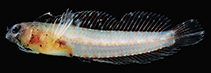
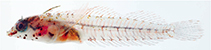
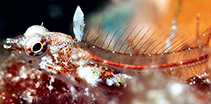
Các vây lưng mềm (tổng cộng) : 10 - 13; Tia cứng vây hậu môn: 2. Species distinguished by: first dorsal-fin spine same length as, or shorter than, subsequent spines; supraorbital cirrus on each eye, arising from a single base, shorter than eye diameter; 10 to 13 segmented dorsal-fin rays; total dorsal-fin elements 30 to 38; pectoral-fin rays 13; head smooth anteriorly, never spiny; tip of lower jaw not projecting beyond tip of upper jaw and without fleshy projection; one row of teeth on each palatine bone; edge of opercle with series of small, round dark spots, or uniformly pigmented; no stripe or series of dark blotches on head and body. Common amongst Chaenopsids: small elongate fishes; largest species about 12 cm SL, most under 5 cm SL. Head usually with cirri or fleshy flaps on anterior nostrils, eyes, and sometimes laterally on nape; gill membranes continuous with each other across posteroventral surface of head. Each jaw with canine-like or incisor-like teeth anteriorly; teeth usually also present on vomer and often on palatines (roof of mouth). Dorsal-fin spines flexible, usually outnumbering the segmented soft rays, spinous and segmented-rayed portions forming a single, continuous fin; 2 flexible spines in anal fin; pelvic fins inserted anterior to position of pectoral fins, with 1 spine not visible externally and only 2 or 3 segmented (soft) rays; all fin rays, including caudal-fin rays, unbranched (simple). Lateral line absent. Scales absent (Ref.52855). Body shape (shape guide): elongated.
Observed to mainly perch on live coral surfaces and terminal phase males in holes, also typically within live coral heads. It has been reported to be widely distributed down to 20 m in Cayman Islands (Ref. 125603).
Vòng đời và hành vi giao phối Chín muồi sinh dục | Sự tái sinh sản | Đẻ trứng | Các trứng | Sự sinh sản | Ấu trùng
Victor, B.C., 2020. Review of the glass blennies (Teleostei: Chaenopsidae: Emblemariopsis) with two new species from the Caribbean Sea. J. Ocean Sci. Found. 37:1-122. (Ref. 125603)
Tình trạng Sách đỏ IUCN (Ref. 130435: Version 2025-2 (Global))
Sinh thái dinh dưỡng Thức ăn (con mồi) Thành phần thức ăn Thành phần thức ăn Khẩu phần ăn Các động vật ăn mồi
Sinh thái học Sinh thái học
Biến động dân số Các thông số tăng trưởng Độ tuổi / kích thước tối đa Chiều dài-trọng lượng tương đối Chiều dài-chiều dài tương đối. Chiều dài-tần số Chuyển đổi khối lượng Bổ xung Sự phong phú
Vòng đời Sự tái sinh sản Chín muồi sinh dục Độ trưởng thành/Mang liên quan Sự sinh sản Đẻ trứng Tập hợp sinh sản Các trứng Sự phát triển của trứng Ấu trùng Sự biến động ấu trùng
Chỉ số đa dạng phát sinh loài (Tài liệu tham khảo 82804): PD50 = 0.5001 [Uniqueness, from 0.5 = low to 2.0 = high].
Bayesian length-weight: a=0.00525 (0.00224 - 0.01232), b=3.07 (2.86 - 3.28), in cm total length, based on LWR estimates for this (Sub)family-body shape (Ref. 93245).
Mức dinh dưỡng (Tài liệu tham khảo 69278): 3.1 ±0.4 se; based on size and trophs of closest relatives
Sự dễ bị tổn thương của nghề đánh cá (Ref. 59153): Low vulnerability (10 of 100). 🛈