



Callorhinchus milii Bory de Saint-Vincent, 1823
Ghost shark
เพิ่มการสังเกตของคุณใน Fish Watcher
| Native range | All suitable habitat | Point map | Year 2050 |

|
| This map was computer-generated and has not yet been reviewed. |
| Callorhinchus milii AquaMaps Data sources: GBIF OBIS |
อัพโหลดของคุณ ภาพถ่าย และ วิดีโอ
รูปภาพหลายรูป | แสตมป์ เหรียญ อื่นๆ | Google image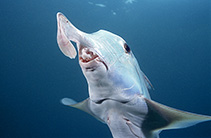 Callorhinchus milii
ภาพโดย Aitken, K.
รูปภาพหลายรูป | แสตมป์ เหรียญ อื่นๆ | Google image
ภาพโดย Aitken, K.
การจำแนกประเภท / ชื่อ ชื่อสามัญ | ชื่อพ้อง | Catalog of Fishes(สกุล, ชนิด) | ITIS | CoL | WoRMS | Cloffa
subclassHolocephali (chimaeras) (chimaeras) > Chimaeriformes (Chimaeras) > Callorhinchidae (Plownose chimaeras)
Etymology: Callorhinchus: Tautonymous with Chimaera callorynchus Linnaeus 1758 (but unnecessarily emended from -rynchus to -rhinchus: callum (L.), hard skin; rhynchus (L.), snout, referring to peculiar hoe-shaped proboscis (See ETYFish); milii: In honor of Bory de Saint-Vincent’s “old friend” (translation) Pierre Bernard Milius (1773‒1829), a French naval officer, naturalist and civil servant, who supplied specimen upon which description and its accompanying illustration (shown here) were based; (See ETYFish).
Eponymy: Baron Pierre Bernard Milius (1773–1829) was a French naval officer, naturalist and civil servant who took part in an exploratory voyage (1804) of the Mascarene Islands, Indian Ocean, under Nicolas Baudin, during which he became friends with Bory. [...] (Ref. 128868), visit book page.
Etymology: Callorhinchus: Tautonymous with Chimaera callorynchus Linnaeus 1758 (but unnecessarily emended from -rynchus to -rhinchus: callum (L.), hard skin; rhynchus (L.), snout, referring to peculiar hoe-shaped proboscis (See ETYFish); milii: In honor of Bory de Saint-Vincent’s “old friend” (translation) Pierre Bernard Milius (1773‒1829), a French naval officer, naturalist and civil servant, who supplied specimen upon which description and its accompanying illustration (shown here) were based; (See ETYFish).
Eponymy: Baron Pierre Bernard Milius (1773–1829) was a French naval officer, naturalist and civil servant who took part in an exploratory voyage (1804) of the Mascarene Islands, Indian Ocean, under Nicolas Baudin, during which he became friends with Bory. [...] (Ref. 128868), visit book page.
สิ่งแวดล้อม : สิ่งแวดล้อม / เขตภูมิอากาศ / ระดับความลึก / ระยะการกระจายสินค้า นิเวศวิทยา
เกี่ยวกับทะเล,น้ำเค็ม; กร่อย สัตว์น้ำหน้าดิน; สัตว์น้ำที่อาศัยและอพยพภายในทะเลเท่านั้น (Ref. 51243); ระดับความลึก 0 - 227 m (Ref. 26346). Subtropical; 33°S - 50°S
การแพร่กระจาย อาณาเขต | พื้นที่จำแนกตาม FAO | ระบบนิเวศหลายระบบ | การปรากฏขึ้น,การเกิดขึ้น,พบ | ตำแหน่งบนแผนที่ | การแนะนำ | Faunafri
Southwest Pacific: southern Australia and New Zealand.
ความยาวเมื่อครบกำหนดครั้งแรก / ขนาด / น้ำหนัก / อายุ
วัยเจริญพันธุ์: Lm 71.0, range 70 - ? cm
Max length : 125 cm TL เพศผู้/กระเทย; (Ref. 26346); common length : 75.0 cm TL เพศผู้/กระเทย; (Ref. 9258)
Max length : 125 cm TL เพศผู้/กระเทย; (Ref. 26346); common length : 75.0 cm TL เพศผู้/กระเทย; (Ref. 9258)
คำอธิบายสั้นๆ เครื่องมือที่ใช้ในการแยกชนิดสัตว์,สิ่งมีชีวิตออกจากกัน | สัณฐานวิทยา | ความยาวต่างๆ
Body shape (shape guide): elongated.
Occurs on continental shelves to depths of at least 200 m (Ref. 6871). Migrates into large estuaries and inshore bays in the spring to breed (Ref. 6871). Feeds mainly on shellfish (Ref. 26346). Oviparous (Ref. 50449). Eggs are encased in horny shells (Ref. 205). Flesh is of good eating quality. Males have a small, club-like protuberance on the head and also long copulation organs near the pelvic fins (Ref. 557).
วงจรชีวิตและพฤติกรรมการผสมพันธุ์ วัยเจริญพันธุ์ | การสืบพันธุ์ | การวางไข่ | เซลสืบพันธ์ของเพศเมีย(ไข่) | ความดกของไข่ | ตัวอ่อน
Migrates into large estuaries and inshore bays in the spring to breed (Ref. 6871). Oviparous, two egg cases (Ref. 26346) are laid on sandy or muddy bottoms and take up to 8 months to hatch (Ref. 6871). Embryos feed solely on yolk (Ref. 50449).Young hatch at about 15 cm (Ref. 26346).
อ้างอิงหลัก
อัพโหลดข้อมูลอ้างอิงของคุณ | อ้างอิง | ผู้ประสานงาน | ผู้ร่วมมือ
Last, P.R. and J.D. Stevens, 1994. Sharks and rays of Australia. CSIRO, Australia. 513 p. (Ref. 6871)
สถานะบัญชีแดงของ IUCN (Ref. 130435: Version 2025-2 (Global))
Least Concern (LC) ; Date assessed: 04 May 2024
CITES
Not Evaluated
ภัยคุกคามต่อมนุษย์
Harmless
การใช้ของมนุษย์
การประมง: การค้า
FAO - การประมง: การลงจอด; Publication: search | FIRMS - Stock assessments | FishSource | ทะเลรอบๆเรา
ข้อมูลเพิ่มเติม
พลวัตของประชากร
พารามิเตอร์การเจริญเติบโต
อายุสูงสุด / ขนาด
ความยาว-น้ำหนักสัมพันธ์
ความยาว-ความยาวสัมพันธ์
ความยาว-ความถี่
การแปลงมวล
การทดแทนที่
อุดมสมบรูณ์
พารามิเตอร์การเจริญเติบโต
อายุสูงสุด / ขนาด
ความยาว-น้ำหนักสัมพันธ์
ความยาว-ความยาวสัมพันธ์
ความยาว-ความถี่
การแปลงมวล
การทดแทนที่
อุดมสมบรูณ์
วงจรชีวิต
การสืบพันธุ์
วัยเจริญพันธุ์
ความสมบูรณ์พันธุ์/เหงือกที่เกี่ยวข้อง
ความดกของไข่
การวางไข่
การรวมตัวของสปอน
เซลสืบพันธ์ของเพศเมีย(ไข่)
การพัฒนาไข่
ตัวอ่อน
พลวัตของสัตว์น้ำวัยอ่อน
การสืบพันธุ์
วัยเจริญพันธุ์
ความสมบูรณ์พันธุ์/เหงือกที่เกี่ยวข้อง
ความดกของไข่
การวางไข่
การรวมตัวของสปอน
เซลสืบพันธ์ของเพศเมีย(ไข่)
การพัฒนาไข่
ตัวอ่อน
พลวัตของสัตว์น้ำวัยอ่อน
การแพร่กระจาย
อาณาเขต
พื้นที่จำแนกตาม FAO
ระบบนิเวศหลายระบบ
การปรากฏขึ้น,การเกิดขึ้น,พบ
การแนะนำ
BRUVS - วิดีโอ
อาณาเขต
พื้นที่จำแนกตาม FAO
ระบบนิเวศหลายระบบ
การปรากฏขึ้น,การเกิดขึ้น,พบ
การแนะนำ
BRUVS - วิดีโอ
สรีรวิทยา
องค์ประกอบของร่างกาย
สารอาหาร
การใช้ออกซิเจน
ประเภทการว่ายน้ำ
ระดับความเร็วในการว่ายน้ำ
เม็ดสีที่มองเห็นได้
เสียงปลา
โรคและปรสิต
ความเป็นพิษ (LC50s)
องค์ประกอบของร่างกาย
สารอาหาร
การใช้ออกซิเจน
ประเภทการว่ายน้ำ
ระดับความเร็วในการว่ายน้ำ
เม็ดสีที่มองเห็นได้
เสียงปลา
โรคและปรสิต
ความเป็นพิษ (LC50s)
พันธุศาสตร์
จีโนม
พันธุศาสตร์
ความไม่สมดุลทางเชื้อชาติ
อัตราพันธุกรรม
ความหลากหลายทางพันธุกรรม
จีโนม
พันธุศาสตร์
ความไม่สมดุลทางเชื้อชาติ
อัตราพันธุกรรม
ความหลากหลายทางพันธุกรรม
เกี่ยวข้องกับมนุษย์
ระบบการเพาะเลี้ยงสัตว์น้ำ
ประวัติการเพาะเลี้ยงสัตว์น้ำ
สายพันธุ์
กรณีซิเกวเทอรา
แสตมป์ เหรียญ อื่นๆ
ระบบการเพาะเลี้ยงสัตว์น้ำ
ประวัติการเพาะเลี้ยงสัตว์น้ำ
สายพันธุ์
กรณีซิเกวเทอรา
แสตมป์ เหรียญ อื่นๆ
เครื่องมือ
หนังสืออิเล็กทรอนิกส์ | คู่มือภาคสนาม | ผู้มีความชำนาญในเรื่องความถี่ของความยาว | เครื่องมือในการศึกษาชีวประวัติ | ตำแหน่งบนแผนที่ |
จับ-MSY |
รายงานพิเศษ
ตรวจสอบการบำรุงรักษาตู้ปลา | ตรวจสอบเอกสารข้อเท็จจริงเกี่ยวกับสายพันธุ์ | ตรวจสอบเอกสารข้อเท็จจริงเกี่ยวกับการเพาะเลี้ยงสัตว์น้ำ
ดาวน์โหลด XML
หน้าสรุป | ข้อมูลสำคัญ | ชื่อสามัญ | ภาพถ่าย
แหล่งที่มาจากอินเตอร์เน็ต
AFORO (otoliths) | Aquatic Commons | BHL | Cloffa | Websites from users | Check FishWatcher | CISTI | Catalog of Fishes: สกุล, ชนิด | DiscoverLife | ECOTOX | FAO - การประมง: การลงจอด; Publication: search | Faunafri | Fishipedia | Fishtrace | GloBI | Google Books | Google Scholar | Google | IGFA World Record | OneZoom | Open Tree of Life | Otolith Atlas of Taiwan Fishes | PubMed | Reef Life Survey | Socotra Atlas | TreeBase | แผนภูมิชีวิตแบบต้นไม้ | Wikipedia: Go, ค้นหา | World Records Freshwater Fishing | บันทึกทางด้านสัตววิทยา
การประมาณค่าตามแบบจำลอง
อุณหภูมิที่ต้องการ (อ้างอิง 123201): 12.1 - 18.2, mean 15.2 °C (based on 179 cells).
ดัชนีความหลากหลายทางวิวัฒนาการ (อ้างอิง 82804): PD50 = 0.7500 [Uniqueness, from 0.5 = low to 2.0 = high].
Bayesian length-weight: a=0.00479 (0.00194 - 0.01180), b=3.13 (2.91 - 3.35), in cm total length, based on LWR estimates for this species & (Sub)family-body (Ref. 93245).
ระดับชั้นอาหาร (อ้างอิง 69278): 3.6 ±0.29 se; based on food items.
ความสามารถในการกลับคืนสู่ปกติ (อ้างอิง 120179): ต่ำ, เวลาต่ำสุดที่จะทำให้ประชากรเพิ่มขึ้นเป็น 2 เท่าใช้เวลา 4.5 - 14 ปี (K=0.06-0.47; tm=2-6; Fec=2).
สารอาหาร (Ref. 124155): Calcium = 25.5 [6.4, 69.6] mg/100g; Iron = 0.758 [0.284, 2.957] mg/100g; Protein = 14.3 [11.2, 18.8] %; Omega3 = 0.258 [0.116, 0.579] g/100g; Selenium = 32 [9, 84] μg/100g; VitaminA = 7.14 [3.03, 17.16] μg/100g; Zinc = 0.661 [0.338, 1.252] mg/100g (wet weight);