



Nothobranchius guentheri (Pfeffer, 1893)
Redtail notho
Tải lên của bạn hình ảnh Và Video
Các tranh (Ảnh) | Tem, tiền xu, v.v. | Google image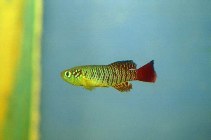 Nothobranchius guentheri
Hình ảnh của JJPhoto
Các tranh (Ảnh) | Tem, tiền xu, v.v. | Google image
Hình ảnh của JJPhoto
Phân loại / Tên Tên thường gặp | Các synonym ( Các tên trùng) | Catalog of Fishes(Giống, Các loài) | ITIS | CoL | WoRMS | Cloffa
> Cyprinodontiformes (Rivulines, killifishes and live bearers) > Nothobranchiidae (African rivulines)
Etymology: Nothobranchius: Greek, nothos = false + Greek, brangchia = gill (Ref. 45335).
Eponymy: Dr Albert Karl Ludwig Gotthilf Günther (1830–1914) was a German-born British zoologist, ichthyologist and herpetologist. [...] (Ref. 128868), visit book page.
Etymology: Nothobranchius: Greek, nothos = false + Greek, brangchia = gill (Ref. 45335).
Eponymy: Dr Albert Karl Ludwig Gotthilf Günther (1830–1914) was a German-born British zoologist, ichthyologist and herpetologist. [...] (Ref. 128868), visit book page.
Môi trường: môi trường / vùng khí hậu / Mức độ sâu / phạm vi phân phối Sinh thái học
; nước ngọt sống nổi và đáy; pH range: 6.0 - 7.0; dH range: 4 - 10; không di cư (Ref. 126106). Tropical; 22°C - 25°C (Ref. 1672)
Sự phân bố Lãnh thổ | Các khu vực của FAO | Các hệ sinh thái | Những lần xuất hiện | Bản đồ điểm | Những chỉ dẫn | Faunafri
Africa: endemic to Unguja Island, Zanzibar archipelago, eastern Tanzania (Ref. 122075).
Bộ gần gũi / Khối lượng (Trọng lượng) / Tuổi
Chín muồi sinh dục: Lm ? range ? - ? cm
Max length : 3.5 cm SL con đực/không giới tính; (Ref. 122075); 3.2 cm SL (female)
Max length : 3.5 cm SL con đực/không giới tính; (Ref. 122075); 3.2 cm SL (female)
Mô tả ngắn gọn Khóa để định loại | Hình thái học | Sinh trắc học
Các tia vây lưng cứng (tổng cộng) : 0; Các vây lưng mềm (tổng cộng) : 15 - 16; Tia cứng vây hậu môn: 0; Tia mềm vây hậu môn: 15 - 16; Động vật có xương sống: 28. Diagnosis: It is distinguished from all congeners by the combination of the following character states: caudal fin red with black posterior margin in males; flank and fins without dark spots in females; pre-dorsal length in males 57.5-61.4% of standard length; 3 + 12-14 gill-rakers on first branchial arch; 27-28 scales in longitudinal series; 14 series of scales around caudal peduncle; single longitudinal row of scales between anterior supraorbital series of neuromasts; anterior supraorbital series of neuromasts arranged in two sections, anterior section with one well-developed neuromast, posterior with two; three neuromasts in posterior supraorbital series; 26-27 caudal-fin rays; 28 vertebrae; second proximal radial of dorsal fin between neural spines of 10th and 12th vertebrae (Ref. 122075).
Body shape (shape guide): fusiform / normal; Cross section: compressed.
Body shape (shape guide): fusiform / normal; Cross section: compressed.
Found in temporary pools, swamps, ditches and small streams (Ref. 3788). Used for biological control of mosquitos (Ref. 3788). One of the so called 'annual fishes' which has eggs that can withstand seasonal droughts (Ref. 1739). A bottom spawner, 3-4 months incubation. Quite popular with aquarists; difficult to maintain in an aquarium (Ref. 27139).
Vòng đời và hành vi giao phối Chín muồi sinh dục | Sự tái sinh sản | Đẻ trứng | Các trứng | Sự sinh sản | Ấu trùng
Thrives in seasonal rainwater pools. Spawns throughout the short breeding period until the pool dries up and all fish die except their drought-resistant eggs. Eggs go through a dry period of many weeks. When rain comes and pool fills, most of the eggs begin to develop and hatch within hours. Fry grow very fast. In only 6 to 8 weeks they are sexually mature and start breeding (Ref. 7062). In aquaria, males showed aggressive behavior toward each other. Females were being pushed down to the substratum by the males as a prelude to spawning.
Tài liệu tham khảo chính
Tải lên tài liệu tham khảo của bạn | Các tài liệu tham khảo | Người điều phối | Người cộng tác
Huber, J.H., 1996. Killi-Data 1996. Updated checklist of taxonomic names, collecting localities and bibliographic references of oviparous Cyprinodont fishes (Atherinomorpha, Pisces). Société Française d'Ichtyologie, Muséum National d'Histoire Naturelle, Paris, France, 399 p. (Ref. 27139)
Tình trạng Sách đỏ IUCN (Ref. 130435: Version 2025-2 (Global))
Endangered (EN) (B1ab(iii,iv)+2ab(iii,iv)); Date assessed: 09 December 2018
CITES
Not Evaluated
Mối đe dọa đối với con người
Harmless
Sử dụng của con người
Các nghề cá: không ích lợi (thú vị); Bể nuôi cá: Tính thương mại
FAO - Publication: search | FishSource |
Thêm thông tin
Sinh thái dinh dưỡng
Thức ăn (con mồi)
Thành phần thức ăn
Thành phần thức ăn
Khẩu phần ăn
Các động vật ăn mồi
Thức ăn (con mồi)
Thành phần thức ăn
Thành phần thức ăn
Khẩu phần ăn
Các động vật ăn mồi
Biến động dân số
Các thông số tăng trưởng
Độ tuổi / kích thước tối đa
Chiều dài-trọng lượng tương đối
Chiều dài-chiều dài tương đối.
Chiều dài-tần số
Chuyển đổi khối lượng
Bổ xung
Sự phong phú
Các thông số tăng trưởng
Độ tuổi / kích thước tối đa
Chiều dài-trọng lượng tương đối
Chiều dài-chiều dài tương đối.
Chiều dài-tần số
Chuyển đổi khối lượng
Bổ xung
Sự phong phú
Vòng đời
Sự tái sinh sản
Chín muồi sinh dục
Độ trưởng thành/Mang liên quan
Sự sinh sản
Đẻ trứng
Tập hợp sinh sản
Các trứng
Sự phát triển của trứng
Ấu trùng
Sự biến động ấu trùng
Sự tái sinh sản
Chín muồi sinh dục
Độ trưởng thành/Mang liên quan
Sự sinh sản
Đẻ trứng
Tập hợp sinh sản
Các trứng
Sự phát triển của trứng
Ấu trùng
Sự biến động ấu trùng
Sự phân bố
Lãnh thổ
Các khu vực của FAO
Các hệ sinh thái
Những lần xuất hiện
Những chỉ dẫn
BRUVS - Video
Lãnh thổ
Các khu vực của FAO
Các hệ sinh thái
Những lần xuất hiện
Những chỉ dẫn
BRUVS - Video
Giải phẫu
Vùng mang
Não
sỏi tai
Vùng mang
Não
sỏi tai
Sinh lý học
Thành phần cơ thể
Chất dinh dưỡng
Thành phần ô-xy
Kiểu bơi
Tốc độ bơi
Sắc tố thị giác
Tiếng cá
Bệnh tật & Ký sinh trùng
Độc tính (LC50)
Thành phần cơ thể
Chất dinh dưỡng
Thành phần ô-xy
Kiểu bơi
Tốc độ bơi
Sắc tố thị giác
Tiếng cá
Bệnh tật & Ký sinh trùng
Độc tính (LC50)
Liên quan đến con người
Hệ thống nuôi trồng thủy sản
Các tổng quan nuôi trồng thủy sản
Các giống
Các trường hợp ngộ độc Ciguatera
Tem, tiền xu, v.v.
Hệ thống nuôi trồng thủy sản
Các tổng quan nuôi trồng thủy sản
Các giống
Các trường hợp ngộ độc Ciguatera
Tem, tiền xu, v.v.
Các công cụ
Sách điện tử | Hướng dẫn hiện trường | Tần suất chiều dài Wizard | Công cụ của vòng đời | Bản đồ điểm |
Bắt-MSY |
Báo cáo đặc biệt
Kiểm tra bảo trì bể cá | Kiểm tra các tờ thông tin về loài | Kiểm tra các tờ thông tin về nuôi trồng thủy sản
Tải xuống XML
Các nguồn internet
AFORO (otoliths) | Alien/Invasive Species database | Aquatic Commons | BHL | Cloffa | Websites from users | Check FishWatcher | CISTI | Catalog of Fishes: Giống, Các loài | DiscoverLife | ECOTOX | FAO - Publication: search | Faunafri | Fishipedia | Fishtrace | GloBI | Google Books | Google Scholar | Google | IGFA World Record | OneZoom | Open Tree of Life | Otolith Atlas of Taiwan Fishes | PubMed | Reef Life Survey | Socotra Atlas | TreeBase | Cây Đời sống | Wikipedia: Go, tìm | World Records Freshwater Fishing | Tạp chí Zoological Record
Ước tính dựa trên mô hình
Chỉ số đa dạng phát sinh loài (Tài liệu tham khảo 82804): PD50 = 0.5000 [Uniqueness, from 0.5 = low to 2.0 = high].
Bayesian length-weight: a=0.01096 (0.00461 - 0.02608), b=2.94 (2.74 - 3.14), in cm total length, based on LWR estimates for this (Sub)family-body shape (Ref. 93245).
Mức dinh dưỡng (Tài liệu tham khảo 69278): 3.2 ±0.4 se; based on size and trophs of closest relatives
Thích nghi nhanh (Tài liệu tham khảo 120179): Chiêù cao, thời gian nhân đôi của chủng quần tối thiểu là dưới 15 tháng (tm= 0.12-0.15; tmax < 1 yr).