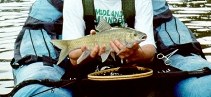
Environment: milieu / climate zone / rango de profundidad / distribution range
Ecología
; agua dulce bentopelágico; potamodromo (Ref. 51243). Subtropical; 25°S - 30°S
Africa: Natal, widespread from the Mkuze southwards to the Umtamvuna on Transkei border. Translocated to the Save in Zimbabwe.
Tamaño / Peso / Age
Madurez: Lm ? range ? - ? cm
Max length : 63.8 cm TL macho / no sexado; (Ref. 52193); peso máximo publicado: 4.6 kg (Ref. 52193)
Occurs in shoals and migrates upstream during spring and summer. Prefers warmer areas of rivers and often congregate at the inlets of small tributaries where the temperature is warmer than that of the main river. Feeds on algae, insect larvae and crabs. Spawns in fast-flowing stretches of rivers that are algae-free (Ref. 6465). Breeds in summer, migrates upstream and spawns over gravel beds. Males mature at about 10 cm FL, females at 15 cm FL (Ref. 7248, 52193).
Life cycle and mating behavior
Madurez | Reproducción | Puesta | Huevos | Fecundidad | Larva
Lévêque, C. and J. Daget, 1984. Cyprinidae. p. 217-342. In J. Daget, J.-P. Gosse and D.F.E. Thys van den Audenaerde (eds.) Check-list of the freshwater fishes of Africa (CLOFFA). ORSTOM, Paris and MRAC, Tervuren. Vol. 1. (Ref. 2801)
IUCN Red List Status (Ref. 130435: Version 2025-1)
Threat to humans
Harmless
Human uses
Pesquerías: pesquerías de subsistencia; pesca deportiva: si
Herramientas
Special reports
Download XML
Fuentes de Internet
Estimates based on models
Phylogenetic diversity index (Referencia
82804): PD
50 = 0.5000 [Uniqueness, from 0.5 = low to 2.0 = high].
Bayesian length-weight: a=0.00955 (0.00430 - 0.02123), b=3.02 (2.84 - 3.20), in cm total length, based on LWR estimates for this (Sub)family-body shape (Ref.
93245).
Nivel trófico (Referencia
69278): 3.0 ±0.42 se; based on food items.
Resiliencia (Referencia
120179): Bajo, población duplicada en un tiempo mínimo de 4.5-14 años (Preliminary K or Fecundity.).
Fishing Vulnerability (Ref.
59153): Moderate to high vulnerability (46 of 100).
🛈