>
Blenniiformes (Blennies) >
Blenniidae (Combtooth blennies) > Blenniinae
Etymology: Plagiotremus: Greek, plagios = oblique + Greek, trema = hole (Ref. 45335).
More on author: Gill.
Issue
Plagiotremus celebesensis (Herre, 1936) is a junior synonym (Ref. 90102).
Environment: milieu / climate zone / profondeur / distribution range
Écologie
marin démersal; profondeur 46 - 70 m (Ref. 7401). Tropical
Western Pacific: Irian Jaya, Indonesia, Philippines, China, Viet Nam, and Thailand.
Taille / Poids / Âge
Maturité: Lm ? range ? - ? cm
Max length : 17.4 cm SL mâle / non sexé; (Ref. 7401)
Description synthétique
Clés d'identification | Morphologie | Morphométrie
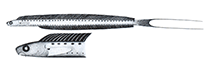
Épines dorsales (Total) : 10; Rayons mous dorsaux (Total) : 58 - 60; Épines anales: 2; Rayons mous anaux: 55 - 57. Yellowish brown head and body; greyish brown dorsal and anal fin; dorsal fin membranes with numerous tiny black spots; pale yellow pectoral fin with black spot on upper base; yellow caudal fin with black upper margin and black filamentous outer lobes. Segmented caudal rays 11; adults of both sexes with elongate and filamentous caudal fin outer lobes (much longer in males (up to 50% of SL); dentary incisors with arrowhead-shaped tips; 4 interorbital pore; body depth ca. 20-22 in SL. Maximum size to 27 cm TL (Ref. 90102).
Body shape (shape guide): eel-like.
Adults are found in muddy sand bottoms (Ref. 90102). Oviparous. Eggs are demersal and adhesive (Ref. 205), and are attached to the substrate via a filamentous, adhesive pad or pedestal (Ref. 94114). Larvae are planktonic, often found in shallow, coastal waters (Ref. 94114).
Life cycle and mating behavior
Maturité | Reproduction | Frai | Œufs | Fécondité | Larves
Oviparous, distinct pairing (Ref. 205).
Smith-Vaniz, W.F., 1987. The saber-toothed blennies, tribe Nemophini (Pisces: Bleniidae): an update. Proc. Acad. Nat. Sci. Philad. 139:1-52. (Ref. 7401)
Statut dans la liste rouge de l'IUCN (Ref. 130435: Version 2025-1)
Menace pour l'homme
Harmless
Utilisations par l'homme
Outils
Articles particuliers
Télécharger en XML
Sources Internet
Estimates based on models
Preferred temperature (Réf.
123201): 23.7 - 28.6, mean 27.5 °C (based on 154 cells).
Phylogenetic diversity index (Réf.
82804): PD
50 = 0.5005 [Uniqueness, from 0.5 = low to 2.0 = high].
Bayesian length-weight: a=0.00102 (0.00046 - 0.00225), b=3.06 (2.88 - 3.24), in cm total length, based on all LWR estimates for this body shape (Ref.
93245).
Niveau trophique (Réf.
69278): 4.8 ±0.9 se; based on size and trophs of closest relatives
Résilience (Réf.
120179): Milieu, temps minimum de doublement de population : 1,4 à 4,4 années (Preliminary K or Fecundity.).
Fishing Vulnerability (Ref.
59153): Low vulnerability (11 of 100).
🛈